
Determine the slope of the graph
ScanSolve AI Answer
Answer
Step-by-step solution
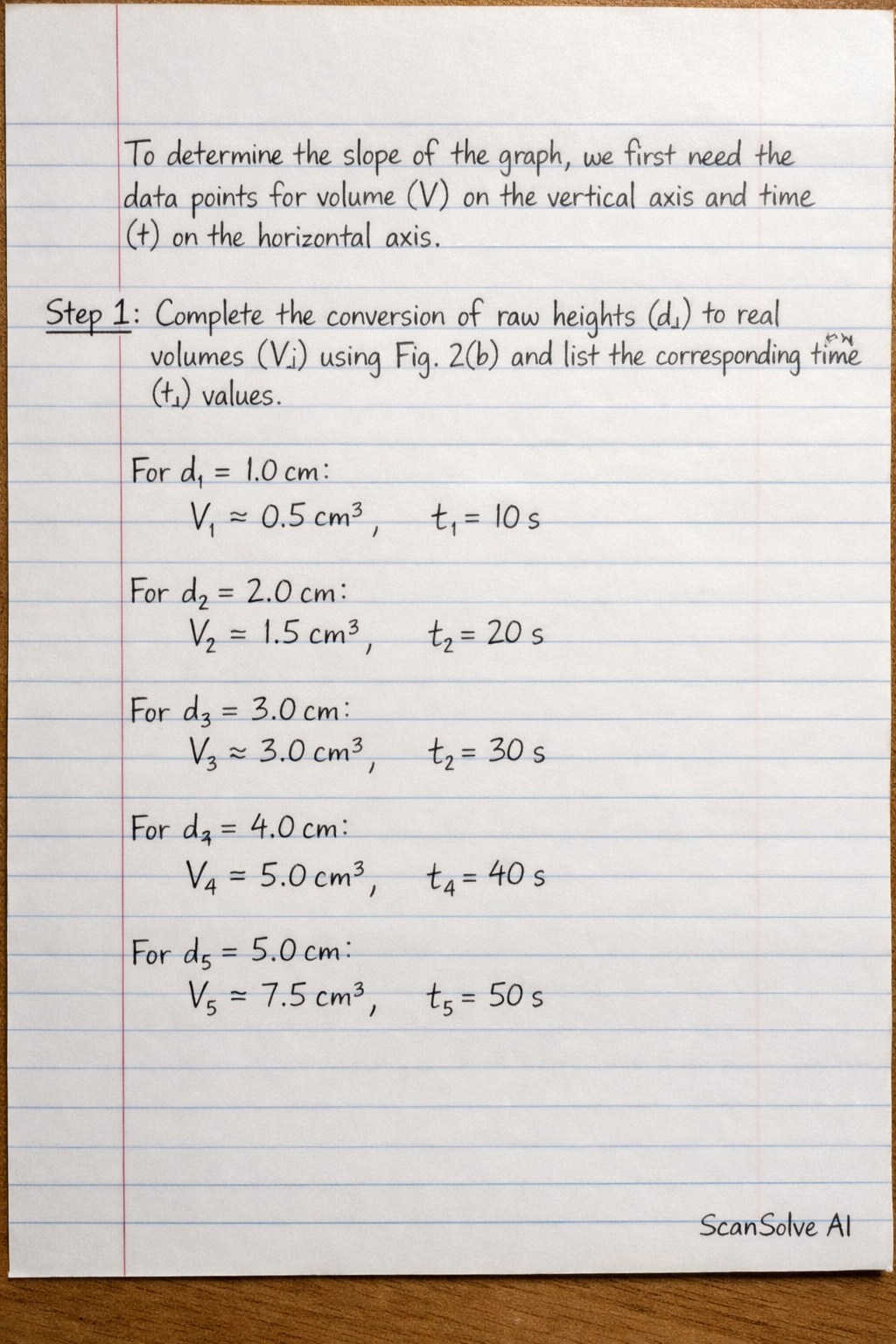
2 stepsTo determine the slope of the graph, we first need the data points for volume () on the vertical axis and time () on the horizontal axis.
Complete the conversion of raw heights () to real volumes () using Fig.
2(b) and list the corresponding time () values from the table in Fig. 2(a).
From the previous steps, we have:
- For , . The corresponding time is .
- For , . The corresponding time is .
- For , . The corresponding time is .
- For , . The corresponding time is .
- For , . The corresponding time is .
The data points for the graph with on the vertical axis and on the horizontal axis are:
Determine the slope of the graph.
The slope of a vs graph represents the rate of change of volume with respect to time. Since the relationship between and is not perfectly linear, we will calculate the average slope using the first and last data points.
The formula for the slope () is:Substitute the values:
The slope of the graph is .
Try one yourself
A new problem that tests the same skill.
Still stuck on this one?
Ask a follow-up, and the answer starts from this question.
More Mathematics Questions
Handwritten Step-by-Step Solution
Get this as a handwritten image on WhatsApp — like a tutor wrote it for you.
Try on WhatsApp