

This mathematics problem involves applying core mathematical principles and formulas. Below you will find a complete step-by-step solution with detailed explanations for each step, helping you understand not just the answer but the method behind it.
ScanSolve AI Answer
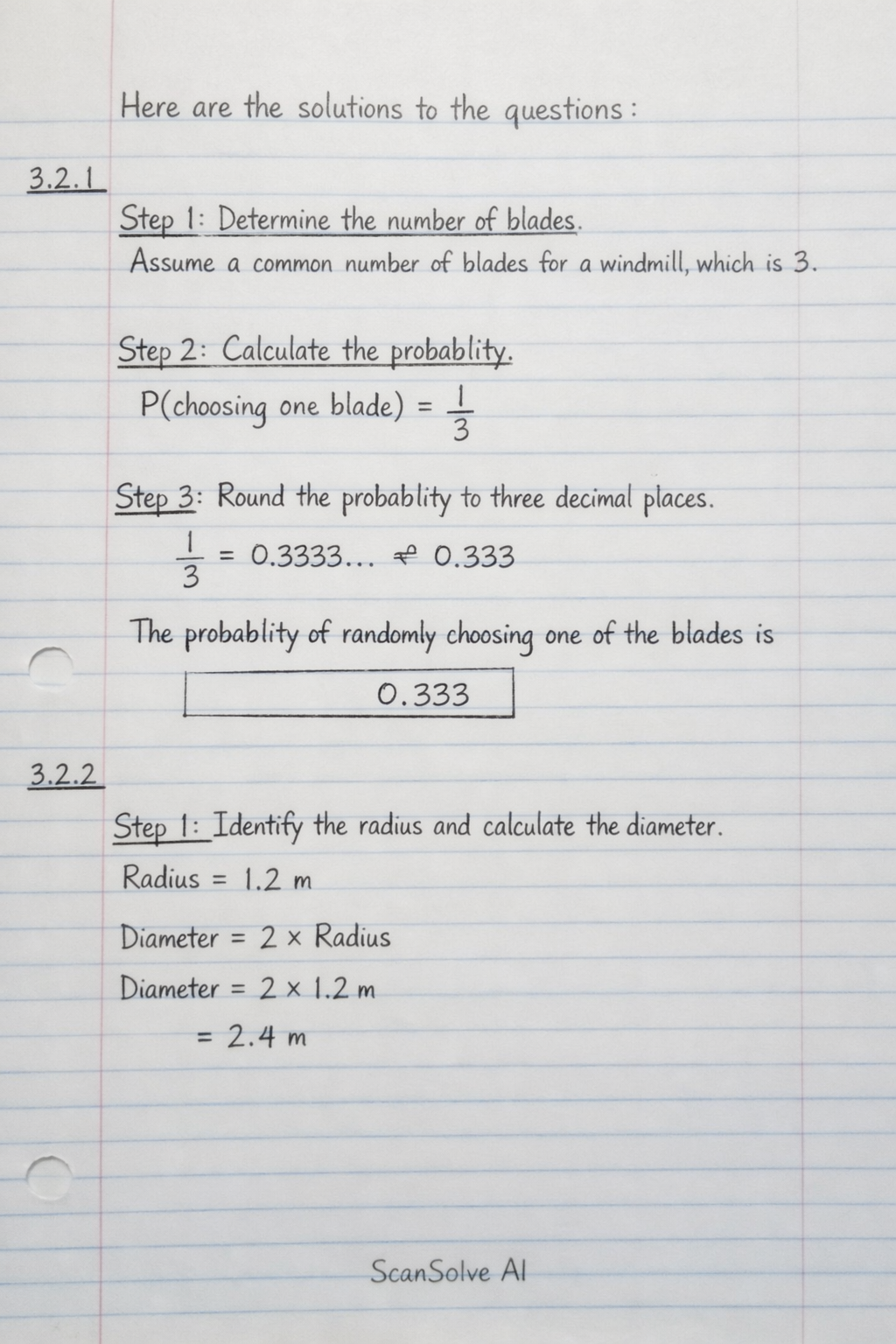
Here are the solutions to the questions: 3.2.1 Step 1: Determine the number of blades. The problem refers to "choosing ONE of the blades" but does not provide Annexure C, which would show the diagram of the windmill. We will assume a common number of blades for a windmill, which is 3. Step 2: Calculate the probability. The probability of randomly choosing one specific blade out of 3 blades is (1)/(3). P(choosing one blade) = (1)/(3) Step 3: Round the probability to three decimal places. (1)/(3) = 0.3333... ≈ 0.333 The probability of randomly choosing one of the blades is 0.333. 3.2.2 Step 1: Identify the radius and calculate the diameter. The radius of the circle formed by the rotating blades is 1.2 m. The diameter is twice the radius. Diameter = 2 × Radius = 2 × 1.2 m = 2.4 m Step 2: Calculate the total distance (circumference) using the given formula. The distance a point on the tip of blade A will make after one rotation is the circumference of the circle. Circumference = 3.142 × Diameter Circumference = 3.142 × 2.4 m Circumference = 7.5408 m The total distance is 7.5408 m. 3.2.3 Step 1: Analyze the relationship between wind speed and water flow. When the wind blows faster, the windmill rotates faster. This faster rotation directly leads to the pump moving more quickly, which in turn increases the speed at which water flows through the pipe. Step 2: Choose the correct word. The relationship is a direct proportion. The correct word is direct. 3.2.4 a) Show, with calculations, how 4.123875 m^3 was calculated. Step 1: Identify the dimensions of the tank and the required water level increase. The inner diameter of the cylindrical tank is 5 m. The radius of the tank is 5 m2 = 2.5 m. The required increase in water level is 21 cm. Step 2: Convert the height increase to meters. 21 cm = 0.21 m Step 3: Calculate the volume of water needed using the given formula. The volume of a cylinder is given by 3.142 × (radius)^2 × height. Volume = 3.142 × (2.5 m)^2 × 0.21 m Volume = 3.142 × 6.25 m^2 × 0.21 m Volume = 3.142 × 1.3125 m^3 Volume = 4.123875 m^3 The calculation shows that 4.123875 m^3 was correctly calculated. b) Determine the time it will take for the water flowing into the tank to increase the water level by 21 cm. Give your answer in hours and minutes, rounded to the nearest minute. Step 1: Convert the volume of water needed from cubic meters to litres. We need 4.123875 m^3 of water. Given: 1000 = 1 m^3. Volume in litres = 4.123875 m^3 × 1000 ()/(m)^3 = 4123.875 Step 2: Convert the volume from litres to gallons. Given: 1 gallon = 3.78541178 . Volume in gallons = (4123.875 )/(3.78541178 )gallon ≈ 1089.40 gallons Step 3: Calculate the time in minutes. The speed of water flowing through the discharge pipe is 5 gallons per minute. Time in minutes = Volume in gallonsFlow rate Time in minutes = 1089.40 gallons5 gallonsminute ≈ 217.88 minutes Step 4: Convert the total minutes to hours and minutes, rounded to the nearest minute. Hours = 217.88 minutes60 minuteshour ≈ 3.631 hours This is 3 full hours. Remaining minutes = (3.631 - 3) hours × 60 minuteshour Remaining minutes = 0.631 hours × 60 minuteshour ≈ 37.86 minutes Rounding to the nearest minute, this is 38 minutes. The total time is 3 hours and 38 minutes. That's 2 down. 3 left today — send the next one.