We read your photo as:

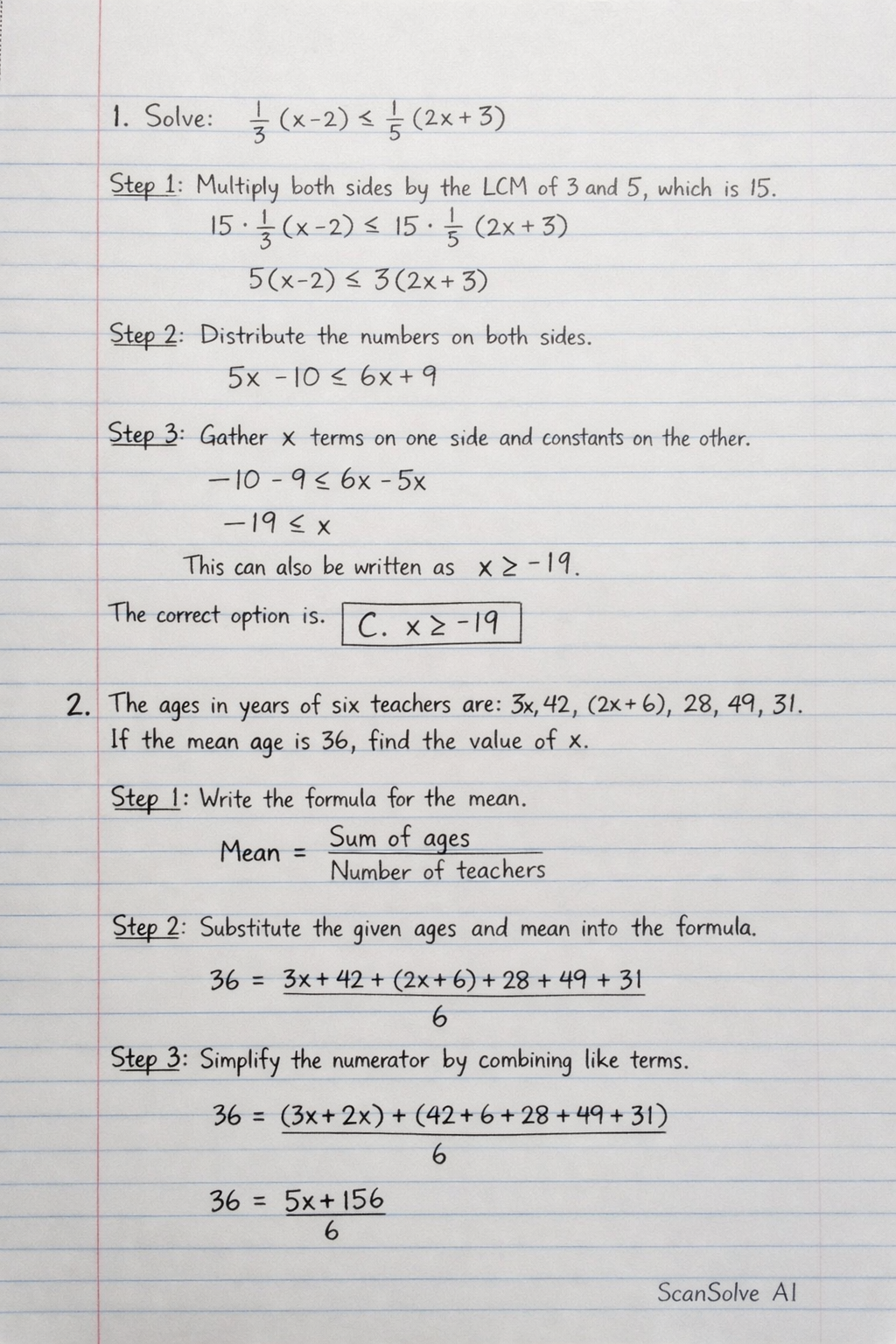
Solve: 1/3(x-2) <= 1/5(2x+3)

Mathematics

ScanSolve AI Answer

Answer

C

Step-by-step solution

20 steps

Here are the solutions to the problems:

1. Solve: 13(x−2)≤15(2x+3)\frac{1}{3}(x-2) \le \frac{1}{5}(2x+3)

  1. Multiply both sides by the least common multiple of the denominators (3 and 5), which is 15.

    15⋅13(x−2)≤15⋅15(2x+3)15 \cdot \frac{1}{3}(x-2) \le 15 \cdot \frac{1}{5}(2x+3) 5(x−2)≤3(2x+3)5(x-2) \le 3(2x+3)
  2. Distribute the numbers on both sides.

    5x−10≤6x+95x - 10 \le 6x + 9
  3. Gather xx terms on one side and constant terms on the other.

    −10−9≤6x−5x-10 - 9 \le 6x - 5x −19≤x-19 \le x

    This can also be written as x≥−19x \ge -19.

    The correct option is C.

    C. x≥−19\boxed{\text{C. } x \ge -19}

    2. The ages in years of six teachers in a school are: 3x,42,(2x+6),28,49,313x, 42, (2x+6), 28, 49, 31. If the mean age is 36 years, find the value of xx.

  4. Write the formula for the mean.

    Mean=Sum of agesNumber of teachers\text{Mean} = \frac{\text{Sum of ages}}{\text{Number of teachers}}
  5. Substitute the given ages and mean into the formula.

    36=3x+42+(2x+6)+28+49+31636 = \frac{3x + 42 + (2x+6) + 28 + 49 + 31}{6}
  6. Simplify the numerator by combining like terms.

    36=(3x+2x)+(42+6+28+49+31)636 = \frac{(3x + 2x) + (42 + 6 + 28 + 49 + 31)}{6} 36=5x+156636 = \frac{5x + 156}{6}
  7. Solve for xx.

    Multiply both sides by 6.

    36×6=5x+15636 \times 6 = 5x + 156 216=5x+156216 = 5x + 156

    Subtract 156 from both sides.

    216−156=5x216 - 156 = 5x 60=5x60 = 5x

    Divide by 5.

    x=605x = \frac{60}{5} x=12x = 12

    The correct option is C.

    C. 12\boxed{\text{C. } 12}

    3. Given that 2x−y=112x - y = 11 and 4x+y=14x + y = 1, find the value of (x+y)(x+y).

  8. Use the elimination method to solve the system of equations.

    Add the two equations together.

    (2x−y)+(4x+y)=11+1(2x - y) + (4x + y) = 11 + 1 6x=126x = 12
  9. Solve for xx.

    x=126x = \frac{12}{6} x=2x = 2
  10. Substitute the value of xx into the second equation (4x+y=14x + y = 1) to find yy.

    4(2)+y=14(2) + y = 1 8+y=18 + y = 1 y=1−8y = 1 - 8 y=−7y = -7
  11. Calculate the value of (x+y)(x+y).

    x+y=2+(−7)x+y = 2 + (-7) x+y=−5x+y = -5

    The correct option is A.

    A. −5\boxed{\text{A. } -5}

    4. The mean of 4,5,7,84, 5, 7, 8 and 11 is 7. Calculate the standard deviation.

  12. List the data points (xix_i) and the mean (xˉ\bar{x}).

    Data points: 4,5,7,8,114, 5, 7, 8, 11
    Mean (xˉ\bar{x}): 7
    Number of data points (nn): 5

  13. Calculate the deviation of each data point from the mean (xi−xˉx_i - \bar{x}) and square it (xi−xˉ)2(x_i - \bar{x})^2.

    • 4−7=−3  ⟹  (−3)2=94 - 7 = -3 \implies (-3)^2 = 9
    • 5−7=−2  ⟹  (−2)2=45 - 7 = -2 \implies (-2)^2 = 4
    • 7−7=0  ⟹  (0)2=07 - 7 = 0 \implies (0)^2 = 0
    • 8−7=1  ⟹  (1)2=18 - 7 = 1 \implies (1)^2 = 1
    • 11−7=4  ⟹  (4)2=1611 - 7 = 4 \implies (4)^2 = 16
  14. Sum the squared deviations.

    ∑(xi−xˉ)2=9+4+0+1+16=30\sum (x_i - \bar{x})^2 = 9 + 4 + 0 + 1 + 16 = 30
  15. Calculate the variance (σ2\sigma^2) using the formula σ2=∑(xi−xˉ)2n\sigma^2 = \frac{\sum (x_i - \bar{x})^2}{n}.

    σ2=305=6\sigma^2 = \frac{30}{5} = 6
  16. Calculate the standard deviation (σ\sigma) by taking the square root of the variance.

    σ=6\sigma = \sqrt{6}

    The correct option is B.

    B. 6\boxed{\text{B. } \sqrt{6}}

    5. Given that OT⃗=(35)\vec{OT} = \begin{pmatrix} 3 \\ 5 \end{pmatrix}, AB⃗=(−1−2)\vec{AB} = \begin{pmatrix} -1 \\ -2 \end{pmatrix}, where OO is the origin, find OB⃗\vec{OB}.

  17. Understand the vector relationship.

    The vector AB⃗\vec{AB} can be expressed as OB⃗−OA⃗\vec{OB} - \vec{OA}.

    AB⃗=OB⃗−OA⃗\vec{AB} = \vec{OB} - \vec{OA}

    Since OO is the origin, OA⃗\vec{OA} is the position vector of point A. The vector OT⃗\vec{OT} is a distractor in this problem, as it refers to point T, which is not involved in finding OB⃗\vec{OB} from AB⃗\vec{AB}.

  18. To find OB⃗\vec{OB}, we need OA⃗\vec{OA}.

    Given the multiple-choice options, the most plausible interpretation is that point A coincides with the origin OO. If AA is the origin, then its position vector OA⃗\vec{OA} is the zero vector.

    OA⃗=(00)\vec{OA} = \begin{pmatrix} 0 \\ 0 \end{pmatrix}
  19. Substitute OA⃗\vec{OA} into the vector relationship.

    AB⃗=OB⃗−(00)\vec{AB} = \vec{OB} - \begin{pmatrix} 0 \\ 0 \end{pmatrix} AB⃗=OB⃗\vec{AB} = \vec{OB}
  20. Use the given value for AB⃗\vec{AB} to find OB⃗\vec{OB}.

    OB⃗=(−1−2)\vec{OB} = \begin{pmatrix} -1 \\ -2 \end{pmatrix}

    The correct option is A.

    A. (−1−2)\boxed{\text{A. } \begin{pmatrix} -1 \\ -2 \end{pmatrix}}
Was this helpful?

Try one yourself

A new problem that tests the same skill.

Still stuck on this one?

Ask a follow-up, and the answer starts from this question.

Got a different question?Ask your own question
Handwritten step-by-step solution preview

Handwritten Step-by-Step Solution

Get this as a handwritten image on WhatsApp — like a tutor wrote it for you.

Try on WhatsApp