
We read your photo as:
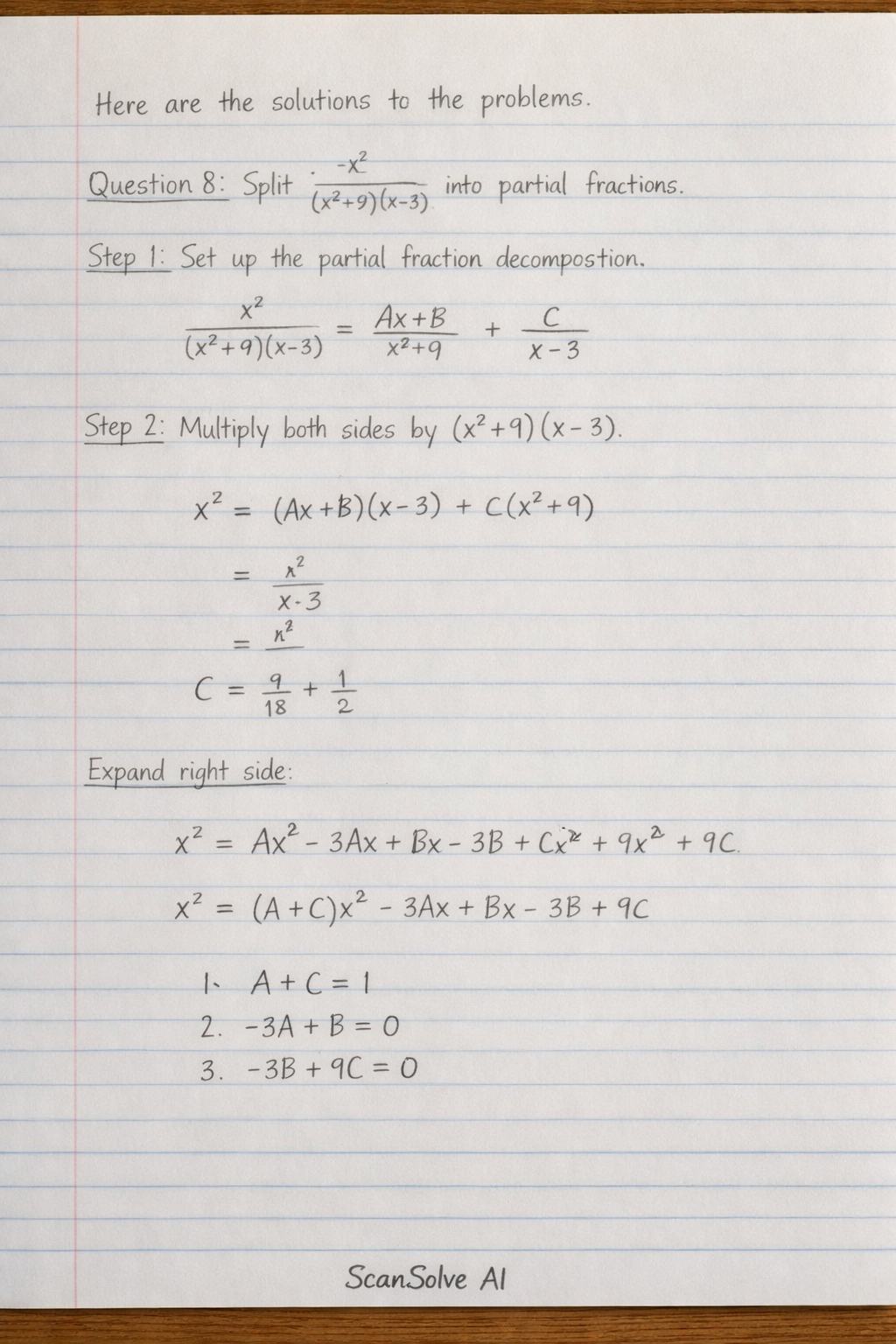
Split (x2)/((x2+9)(x-3)) into partial fractions.
ScanSolve AI Answer
Answers
3 partsStep-by-step solution
11 stepsHere are the solutions to the problems.
Part 8· 4 steps
Split into partial fractions.
Set up the partial fraction decomposition.
The denominator has an irreducible quadratic factor and a linear factor .
Multiply both sides by the common denominator .
Solve for A, B, and C.
To find C, let :
Expand the right side of the equation from Step 2:
Group terms by powers of :
Equate coefficients:
- Coefficient of :
- Coefficient of :
- Constant term:
Substitute into equation (1):
Substitute into equation (2):
(As a check, substitute B and C into equation (3): . This is correct.)
Substitute the values of A, B, and C back into the partial fraction form.
The partial fraction decomposition is .
Part 9
Split into partial fractions.
Set up the partial fraction decomposition.
The denominator has a linear factor and an irreducible quadratic factor .
Multiply both sides by the common denominator .
Solve for A, B, and C.
To find A, let :
Expand the right side of the equation from Step 2:
Group terms by powers of :
Equate coefficients:
- Coefficient of :
- Coefficient of :
- Constant term:
Substitute into equation (1):
Substitute into equation (2):
(As a check, substitute A and C into equation (3): . This is correct.)
Substitute the values of A, B, and C back into the partial fraction form.
The partial fraction decomposition is .
Part 10-5
Evaluate if .
Multiply both sides by the common denominator .
Solve for A and B.
To find A, let :
To find B, let :
Evaluate .
The value of is .
Try one yourself
A new problem that tests the same skill.
Still stuck on this one?
Ask a follow-up, and the answer starts from this question.
More Mathematics Questions
Handwritten Step-by-Step Solution
Get this as a handwritten image on WhatsApp — like a tutor wrote it for you.
Try on WhatsApp