
We read your photo as:
Find the square root of 2.56 and 7.29 using the long division method.
ScanSolve AI Answer
Answers
4 partsi) 2.56
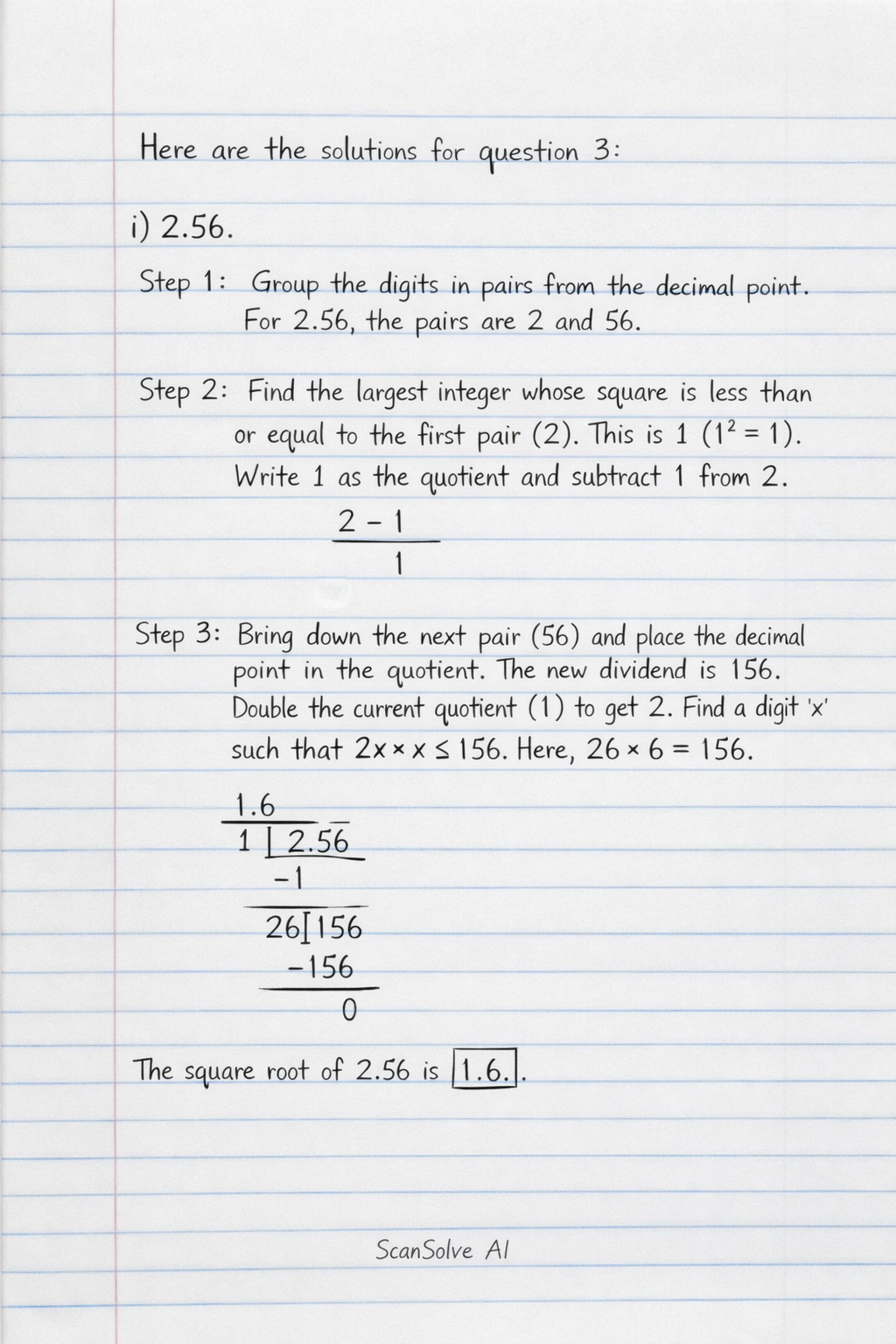
Step 1: Group the digits in pairs from the decimal point. For 2.56, the pairs are 2 and 56.
Step 2: Find the largest integer whose square is less than or equal to the first pair (2). This is 1 (). Write 1 as the quotient and subtract 1 from 2.
Step 3: Bring down the next pair (56) and place the decimal point in the quotient. The new dividend is 156. Double the current quotient (1) to get 2. Find a digit 'x' such that . Here, .
The square root of 2.56 is .
ii) 7.29
Step 1: Group the digits in pairs from the decimal point. For 7.29, the pairs are 7 and 29.
Step 2: Find the largest integer whose square is less than or equal to the first pair (7). This is 2 (). Write 2 as the quotient and subtract 4 from 7.
Step 3: Bring down the next pair (29) and place the decimal point in the quotient. The new dividend is 329. Double the current quotient (2) to get 4. Find a digit 'x' such that . Here, .
The square root of 7.29 is .
iii) 51.84
Step 1: Group the digits in pairs from the decimal point. For 51.84, the pairs are 51 and 84.
Step 2: Find the largest integer whose square is less than or equal to the first pair (51). This is 7 (). Write 7 as the quotient and subtract 49 from 51.
Step 3: Bring down the next pair (84) and place the decimal point in the quotient. The new dividend is 284. Double the current quotient (7) to get 14. Find a digit 'x' such that . Here, .
The square root of 51.84 is .
v) 31.36
Step 1: Group the digits in pairs from the decimal point. For 31.36, the pairs are 31 and 36.
Step 2: Find the largest integer whose square is less than or equal to the first pair (31). This is 5 (). Write 5 as the quotient and subtract 25 from 31.
Step 3: Bring down the next pair (36) and place the decimal point in the quotient. The new dividend is 636. Double the current quotient (5) to get 10. Find a digit 'x' such that . Here, .
The square root of 31.36 is .
Try one yourself
A new problem that tests the same skill.
Still stuck on this one?
Ask a follow-up, and the answer starts from this question.
More Mathematics Questions
Handwritten Step-by-Step Solution
Get this as a handwritten image on WhatsApp — like a tutor wrote it for you.
Try on WhatsApp