

This mathematics problem involves applying core mathematical principles and formulas. Below you will find a complete step-by-step solution with detailed explanations for each step, helping you understand not just the answer but the method behind it.
ScanSolve AI Answer
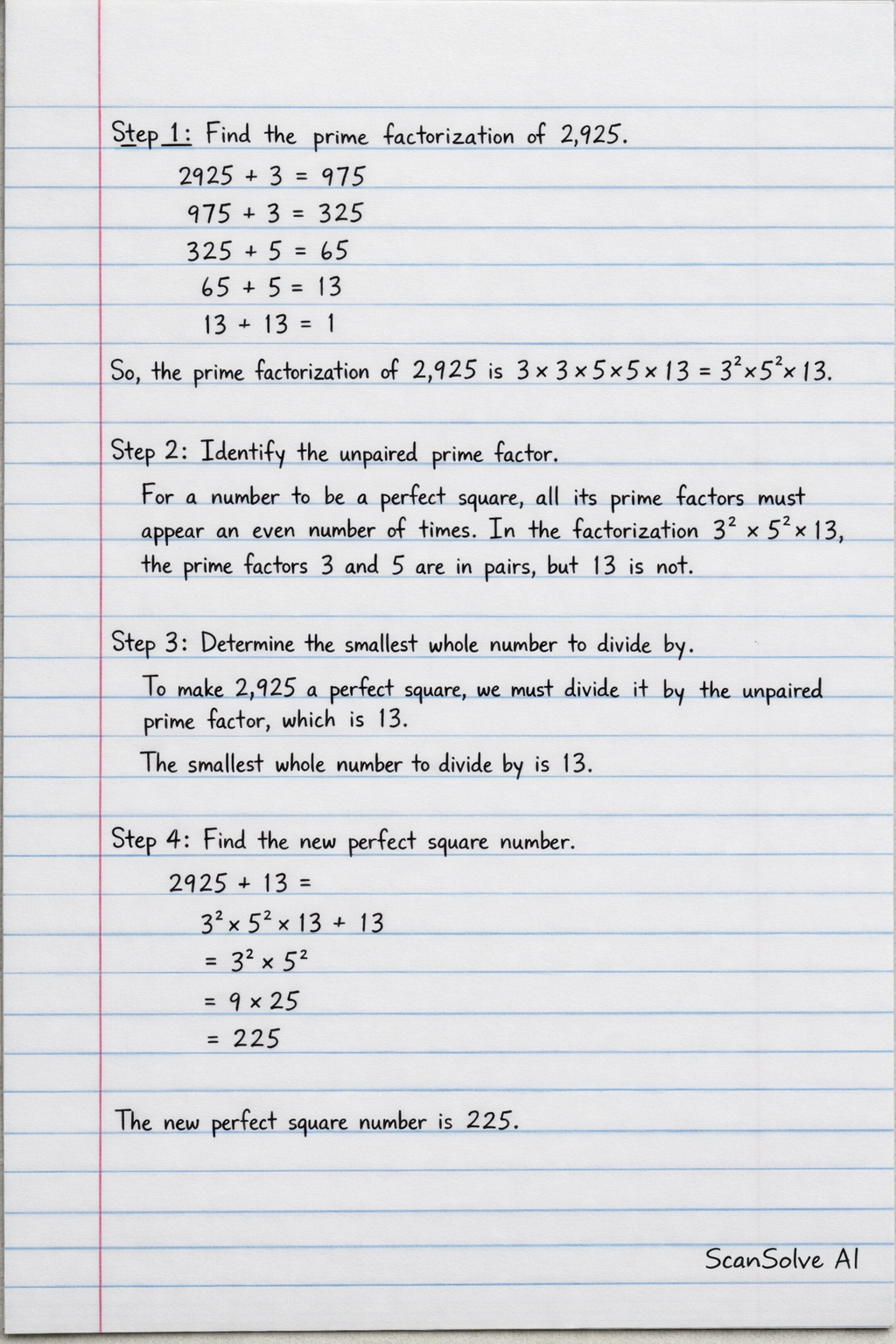
Step 1: Find the prime factorization of 2,925. Divide 2,925 by prime numbers. 2925 = 3 × 975 975 = 3 × 325 325 = 5 × 65 65 = 5 × 13 13 = 13 × 1 So, the prime factorization of 2,925 is 3 × 3 × 5 × 5 × 13 = 3^2 × 5^2 × 13. Step 2: Identify the unpaired prime factor. For a number to be a perfect square, all its prime factors must appear an even number of times. In the factorization 3^2 × 5^2 × 13, the prime factors 3 and 5 are in pairs, but 13 is not. Step 3: Determine the smallest whole number to divide by. To make 2,925 a perfect square, we must divide it by the unpaired prime factor, which is 13. The smallest whole number to divide by is 13. Step 4: Find the new perfect square number. Divide 2,925 by 13: 2925 ÷ 13 = (3^2 × 5^2 × 13) ÷ 13 = 3^2 × 5^2 = 9 × 25 = 225 The new perfect square number is 225. Step 5: Find the square root of the new perfect square number. sqrt(225) = sqrt(3^2 × 5^2) = 3 × 5 = 15 The square root of the new perfect square number is 15. The smallest whole number to divide by is 13. The perfect square number obtained is 225. The square root of the perfect square number is 15. That's 2 down. 3 left today — send the next one.