

This mathematics problem involves applying core mathematical principles and formulas. Below you will find a complete step-by-step solution with detailed explanations for each step, helping you understand not just the answer but the method behind it.
ScanSolve AI Answer
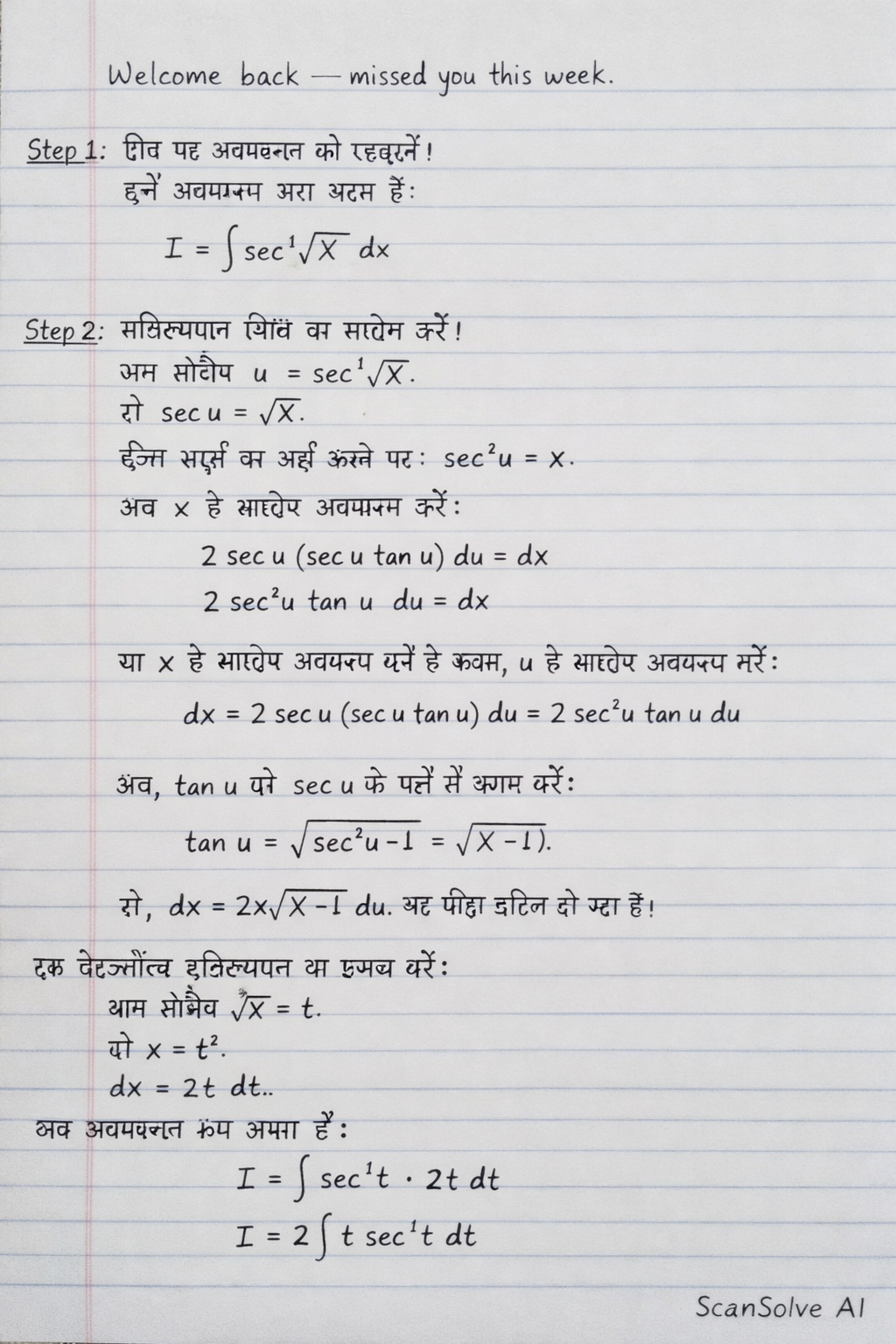
Step 1: दिए गए समाकलन को पहचानें। हमें समाकलन ज्ञात करना है: I = ^-1sqrt(x) \, dx Step 2: प्रतिस्थापन विधि का प्रयोग करें। मान लीजिए u = ^-1sqrt(x)। तो u = sqrt(x)। दोनों पक्षों का वर्ग करने पर: ^2 u = x। अब x के सापेक्ष अवकलन करें: 2 u ( u u) du = dx 2 ^2 u u \, du = dx या x के सापेक्ष अवकलन करने के बजाय, u के सापेक्ष अवकलन करें: dx = 2 u ( u u) du = 2 ^2 u u \, du अब, u को u के पदों में व्यक्त करें: u = sqrt(^2 u - 1) = sqrt(x - 1) तो, dx = 2x sqrt(x-1) \, du। यह थोड़ा जटिल हो रहा है। एक वैकल्पिक प्रतिस्थापन का प्रयास करें: मान लीजिए sqrt(x) = t। तो x = t^2। dx = 2t \, dt। अब समाकलन बन जाता है: I = ^-1t · 2t \, dt I = 2 t ^-1t \, dt Step 3: खंडशः समाकलन (Integration by Parts) का प्रयोग करें। खंडशः समाकलन का सूत्र है: v \, dw = vw - w \, dv। यहाँ, v = ^-1t (पहला फलन) और dw = t \, dt (दूसरा फलन)। dv = (1)/(tsqrt(t^2-1)) \, dt w = t \, dt = (t^2)/(2) अब सूत्र में मान रखें: I = 2 [ ^-1t · (t^2)/(2) - (t^2)/(2) · (1)/(tsqrt(t^2-1)) \, dt ] I = 2 [ (t^2)/(2) ^-1t - (1)/(2) (t)/(sqrt(t^2-1)) \, dt ] I = t^2 ^-1t - (t)/(sqrt(t^2-1)) \, dt Step 4: शेष समाकलन को हल करें। शेष समाकलन (t)/(sqrt(t^2-1)) \, dt को हल करने के लिए, एक और प्रतिस्थापन करें। मान लीजिए z = t^2 - 1। तो dz = 2t \, dt t \, dt = (1)/(2) dz। (t)/(sqrt(t^2-1)) \, dt = (1)/(sqrt(z)) · (1)/(2) dz = (1)/(2) z^-1/2 \, dz = (1)/(2) z^1/21/2 + C' = sqrt(z) + C' = sqrt(t^2-1) + C' Step 5: सभी पदों को संयोजित करें और t को वापस x में बदलें। I = t^2 ^-1t - sqrt(t^2-1) + C अब t = sqrt(x) को वापस प्रतिस्थापित करें: I = (sqrt(x))^2 ^-1(sqrt(x)) - sqrt((x))^2-1 + C I = x ^-1sqrt(x) - sqrt(x-1) + C Step 6: प्राप्त हल की तुलना दिए गए विकल्पों से करें। हमारा हल x ^-1sqrt(x) - sqrt(x-1) + C है। यह विकल्प (2) से मेल खाता है। The final answer is (2) x ^-1sqrt(x) - sqrt(x-1) + c. अगला प्रश्न भेजें 📸