
We read your photo as:
Evaluate lim_(x->0) ((x+b)-b)/x
ScanSolve AI Answer
Answer
Step-by-step solution
3 stepsEvaluate the limit for Question 16.
First, simplify the numerator of the expression.
Since , is not exactly zero, so we can cancel from the numerator and denominator.
Answer for 16:
Evaluate the limit for Question 17.
If we substitute directly, we get , which is an indeterminate form. We need to simplify the expression.
Expand the numerator:Now substitute this back into the limit expression:
Factor out from the numerator:
Since , is not exactly zero, so we can cancel :
Now substitute :
Answer for 17:
Evaluate the limit for Question 18.
If we substitute directly, we get , which is an indeterminate form. We need to simplify the expression.
Expand the numerator :Now substitute this back into the numerator of the limit expression:
Substitute this simplified numerator back into the limit:
Factor out from the numerator:
Since , is not exactly zero, so we can cancel :
Now substitute :
Answer for 18:
Try one yourself
A new problem that tests the same skill.
Still stuck on this one?
Ask a follow-up, and the answer starts from this question.
More Mathematics Questions
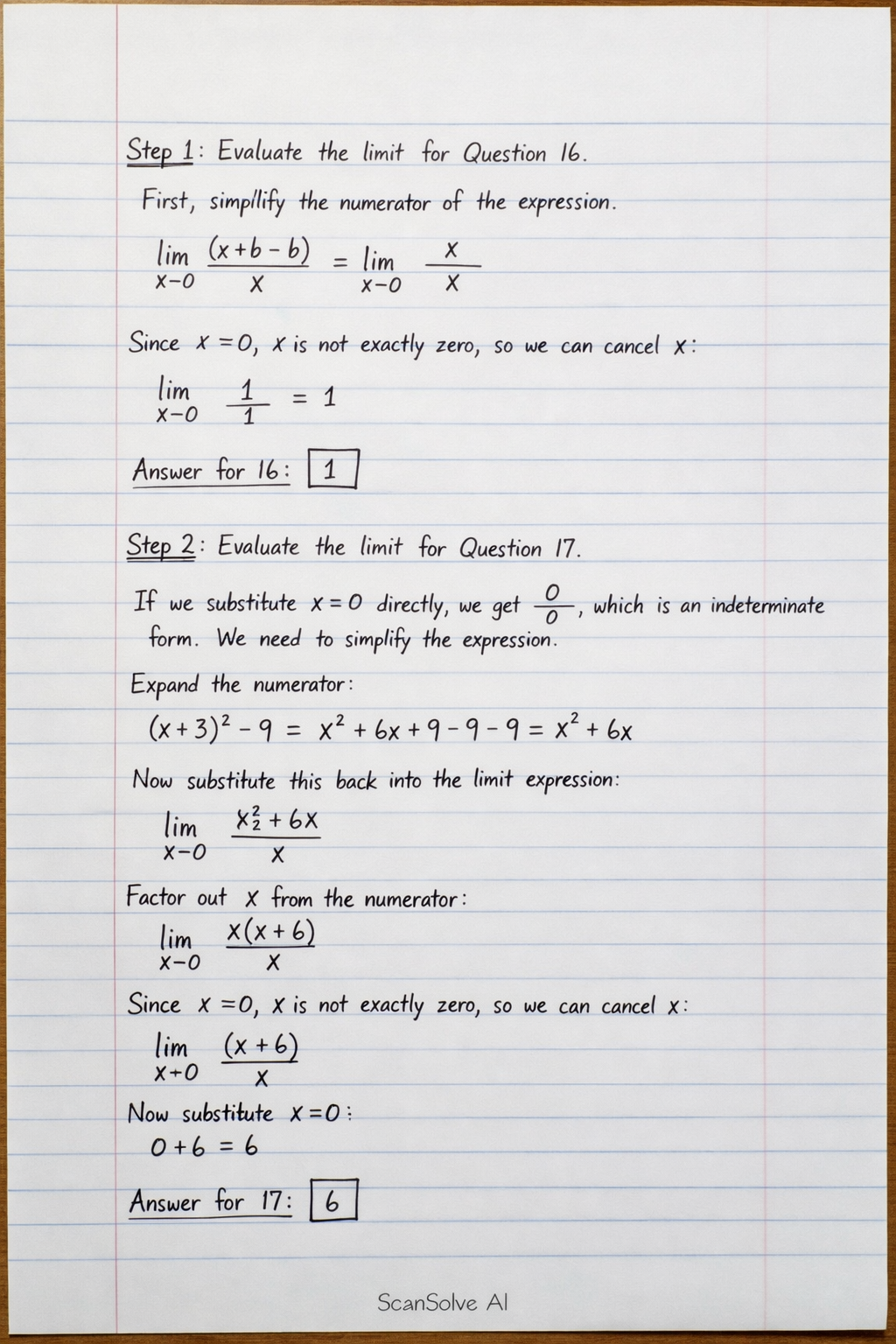
Handwritten Step-by-Step Solution
Get this as a handwritten image on WhatsApp — like a tutor wrote it for you.
Try on WhatsApp