For the curve y=f(x) show that the gradient of the secant passing through the points (x, f(x)) and (x+h, f(x+h)) is (f(x+h)-f(x))/h. If y = 2x2 + 3, find the value of dy/dx and hence show that dy/dx = 4 at x=1. Differentiate y = 2x2 - x + 3 by first finding the value of dy/dx.
|Mathematics
For the curve y=f(x) show that the gradient of the secant passing through the points (x, f(x)) and (x+h, f(x+h)) is (f(x+h)-f(x))/h. If y = 2x2 + 3, find the value of dy/dx and hence show that dy/dx = 4 at x=1. Differentiate y = 2x2 - x + 3 by first finding the value of dy/dx.
ScanSolve AI Answer
Answer
hf(x+h)−f(x)
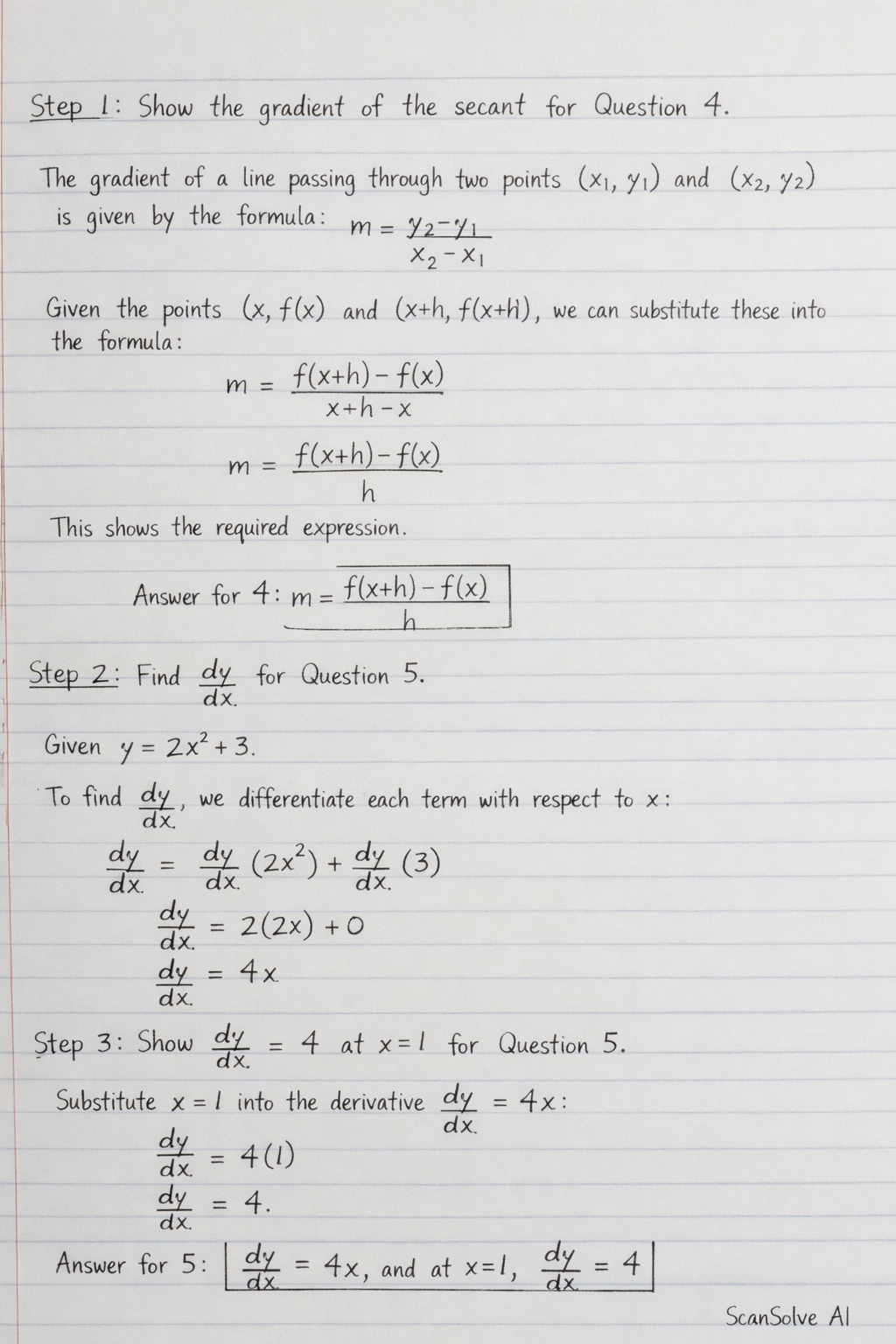
Step 1: Show the gradient of the secant for Question 4.
The gradient of a line passing through two points (x1,y1) and (x2,y2) is given by the formula m=x2−x1y2−y1.
Given the points (x,f(x)) and (x+h,f(x+h)), we can substitute these into the formula:
m=(x+h)−xf(x+h)−f(x)m=hf(x+h)−f(x)
This shows the required expression.
Answer for 4: hf(x+h)−f(x)
Step 2: Find dxdy for Question 5.
Given y=2x2+3.
To find dxdy, we differentiate each term with respect to x:
dxdy=dxd(2x2)+dxd(3)
Using the power rule dxd(axn)=anxn−1 and dxd(c)=0:
dxdy=2(2x2−1)+0dxdy=4x
Step 3: Show dxdy=4 at x=1 for Question 5.
Substitute x=1 into the derivative dxdy=4x:
dxdyx=1=4(1)dxdyx=1=4
Answer for 5: dxdy=4x,andatx=1,dxdy=4
Step 4: Find ΔxΔy for Question 6.
Given y=f(x)=2x2−x+3.
First, find f(x+Δx):
f(x+Δx)=2(x+Δx)2−(x+Δx)+3f(x+Δx)=2(x2+2xΔx+(Δx)2)−x−Δx+3f(x+Δx)=2x2+4xΔx+2(Δx)2−x−Δx+3
Next, find Δy=f(x+Δx)−f(x):
Δy=(2x2+4xΔx+2(Δx)2−x−Δx+3)−(2x2−x+3)Δy=2x2+4xΔx+2(Δx)2−x−Δx+3−2x2+x−3Δy=4xΔx+2(Δx)2−Δx
Now, find ΔxΔy:
ΔxΔy=Δx4xΔx+2(Δx)2−Δx
Factor out Δx from the numerator:
ΔxΔy=ΔxΔx(4x+2Δx−1)ΔxΔy=4x+2Δx−1
Step 5: Differentiate y=2x2−x+3 by taking the limit of ΔxΔy for Question 6.
To find the derivative dxdy, we take the limit of ΔxΔy as Δx→0:
dxdy=limΔx→0(4x+2Δx−1)
Substitute Δx=0:
dxdy=4x+2(0)−1dxdy=4x−1
Answer for 6: ΔxΔy=4x+2Δx−1,anddxdy=4x−1
Last free one today — make it count tomorrow, or type /upgrade for unlimited.
Was this helpful?
Need help with your own homework?
Get instant step-by-step solutions to any question. Free to start.
Show the gradient of the secant for Question 4. The gradient of a line passing through two points (x_1, y_1) and (x_2, y_2) is given by the formula m = (y_2 - y_1)/(x_2 - x_1).
For the curve y=f(x) show that the gradient of the secant passing through the points (x, f(x)) and (x+h, f(x+h)) is (f(x+h)-f(x))/h. If y = 2x2 + 3, find the value of dy/dx and hence show that dy/dx = 4 at x=1. Differentiate y = 2x2 - x + 3 by first finding the value of dy/dx.
This mathematics problem involves applying core mathematical principles and formulas. Below you will find a complete step-by-step solution with detailed explanations for each step, helping you understand not just the answer but the method behind it.
ScanSolve AI Answer
Step 1: Show the gradient of the secant for Question 4. The gradient of a line passing through two points (x_1, y_1) and (x_2, y_2) is given by the formula m = (y_2 - y_1)/(x_2 - x_1). Given the points (x, f(x)) and (x+h, f(x+h)), we can substitute these into the formula: m = (f(x+h) - f(x))/((x+h) - x) m = (f(x+h) - f(x))/(h) This shows the required expression. Answer for 4: (f(x+h)-f(x))/(h) Step 2: Find (dy)/(dx) for Question 5. Given y = 2x^2 + 3. To find (dy)/(dx), we differentiate each term with respect to x: (dy)/(dx) = (d)/(dx)(2x^2) + (d)/(dx)(3) Using the power rule (d)/(dx)(ax^n) = anx^n-1 and (d)/(dx)(c) = 0: (dy)/(dx) = 2(2x^2-1) + 0 (dy)/(dx) = 4x Step 3: Show (dy)/(dx) = 4 at x=1 for Question 5. Substitute x=1 into the derivative (dy)/(dx) = 4x: (dy)/(dx) |_x=1 = 4(1) (dy)/(dx) |_x=1 = 4 Answer for 5: (dy)/(dx) = 4x, and at x=1, (dy)/(dx) = 4 Step 4: Find ( y)/( x) for Question 6. Given y = f(x) = 2x^2 - x + 3. First, find f(x+ x): f(x+ x) = 2(x+ x)^2 - (x+ x) + 3 f(x+ x) = 2(x^2 + 2x x + ( x)^2) - x - x + 3 f(x+ x) = 2x^2 + 4x x + 2( x)^2 - x - x + 3 Next, find y = f(x+ x) - f(x): y = (2x^2 + 4x x + 2( x)^2 - x - x + 3) - (2x^2 - x + 3) y = 2x^2 + 4x x + 2( x)^2 - x - x + 3 - 2x^2 + x - 3 y = 4x x + 2( x)^2 - x Now, find ( y)/( x): ( y)/( x) = (4x x + 2( x)^2 - x)/( x) Factor out x from the numerator: ( y)/( x) = ( x (4x + 2 x - 1))/( x) ( y)/( x) = 4x + 2 x - 1 Step 5: Differentiate y = 2x^2 - x + 3 by taking the limit of ( y)/( x) for Question 6. To find the derivative (dy)/(dx), we take the limit of ( y)/( x) as x 0: (dy)/(dx) = _ x 0 (4x + 2 x - 1) Substitute x = 0: (dy)/(dx) = 4x + 2(0) - 1 (dy)/(dx) = 4x - 1 Answer for 6: ( y)/( x) = 4x + 2 x - 1, and (dy)/(dx) = 4x - 1 Last free one today — make it count tomorrow, or type /upgrade for unlimited.