We read your photo as:

Evaluate sum_k=1ⁿ (k2 + k).

Mathematics

ScanSolve AI Answer

Step-by-step solution

8 steps
  1. Evaluate ∑k=1n(k2+k)\sum_{k=1}^{n} (k^2 + k).
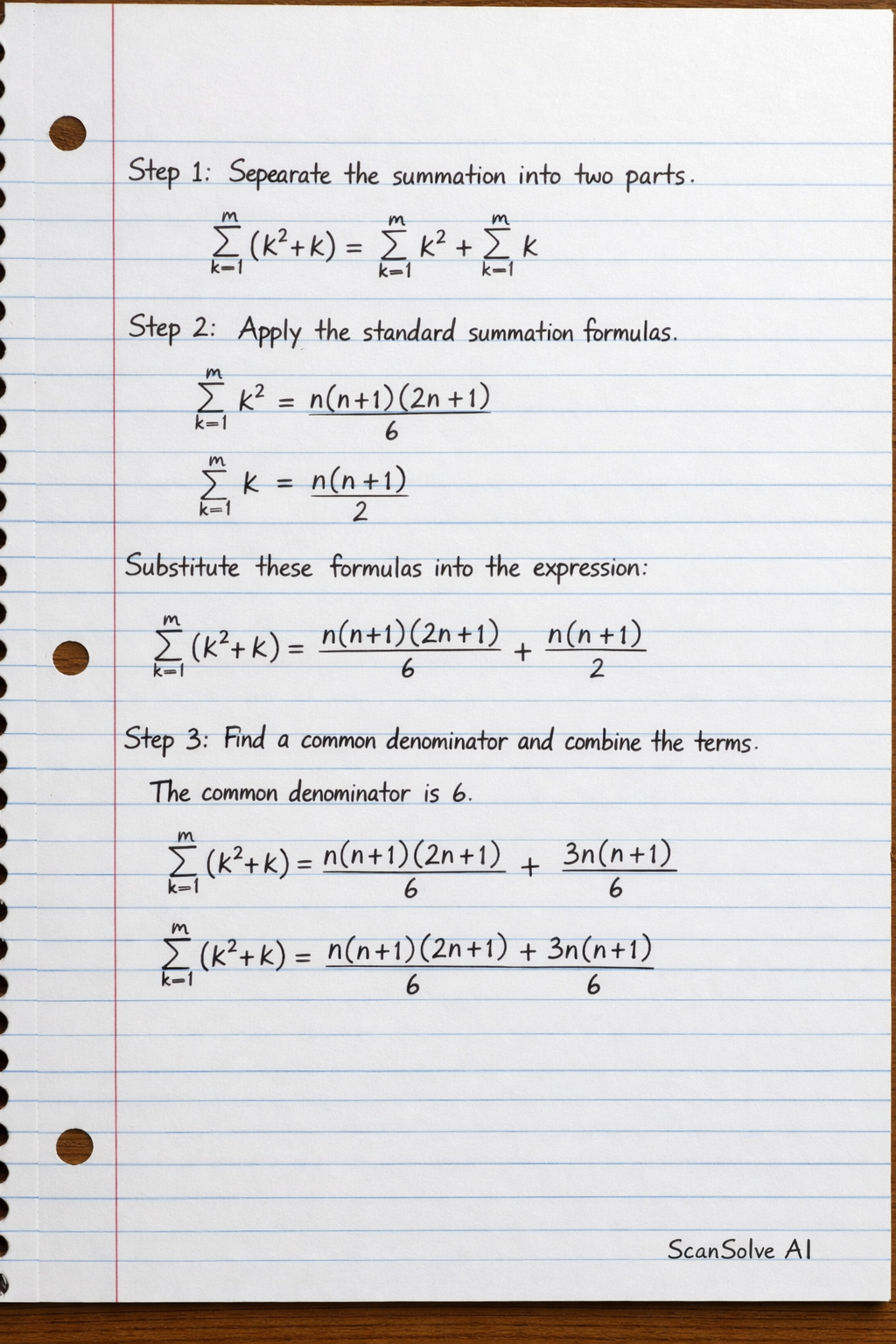
  1. Separate the summation into two parts.

    ∑k=1n(k2+k)=∑k=1nk2+∑k=1nk\sum_{k=1}^{n} (k^2 + k) = \sum_{k=1}^{n} k^2 + \sum_{k=1}^{n} k
  2. Apply the standard summation formulas.

    The formula for the sum of the first nn squares is ∑k=1nk2=n(n+1)(2n+1)6\sum_{k=1}^{n} k^2 = \frac{n(n+1)(2n+1)}{6}.
    The formula for the sum of the first nn natural numbers is ∑k=1nk=n(n+1)2\sum_{k=1}^{n} k = \frac{n(n+1)}{2}.

    Substitute these formulas into the expression:

    ∑k=1n(k2+k)=n(n+1)(2n+1)6+n(n+1)2\sum_{k=1}^{n} (k^2 + k) = \frac{n(n+1)(2n+1)}{6} + \frac{n(n+1)}{2}
  3. Find a common denominator and combine the terms.

    The common denominator is 6.

    ∑k=1n(k2+k)=n(n+1)(2n+1)6+3n(n+1)6\sum_{k=1}^{n} (k^2 + k) = \frac{n(n+1)(2n+1)}{6} + \frac{3n(n+1)}{6} ∑k=1n(k2+k)=n(n+1)(2n+1)+3n(n+1)6\sum_{k=1}^{n} (k^2 + k) = \frac{n(n+1)(2n+1) + 3n(n+1)}{6}
  4. Factor out common terms and simplify.

    Factor out n(n+1)n(n+1) from the numerator:

    ∑k=1n(k2+k)=n(n+1)[(2n+1)+3]6\sum_{k=1}^{n} (k^2 + k) = \frac{n(n+1)[(2n+1) + 3]}{6} ∑k=1n(k2+k)=n(n+1)(2n+4)6\sum_{k=1}^{n} (k^2 + k) = \frac{n(n+1)(2n+4)}{6}

    Factor out 2 from (2n+4)(2n+4):

    ∑k=1n(k2+k)=n(n+1)2(n+2)6\sum_{k=1}^{n} (k^2 + k) = \frac{n(n+1)2(n+2)}{6} ∑k=1n(k2+k)=2n(n+1)(n+2)6\sum_{k=1}^{n} (k^2 + k) = \frac{2n(n+1)(n+2)}{6} ∑k=1n(k2+k)=n(n+1)(n+2)3\sum_{k=1}^{n} (k^2 + k) = \frac{n(n+1)(n+2)}{3}

    The evaluated sum is n(n+1)(n+2)3\boxed{\frac{n(n+1)(n+2)}{3}}.

    1. The 13th and 16th terms of an A.P. are 80 and 98 respectively. Find the first term, the common difference and the last term if there are 20 terms.
  5. Set up equations using the formula for the nn-th term of an A.P., an=a+(n−1)da_n = a + (n-1)d.

    Given a13=80a_{13} = 80:

    a+(13−1)d=80a + (13-1)d = 80 a+12d=80(Equation 1)a + 12d = 80 \quad \text{(Equation 1)}

    Given a16=98a_{16} = 98:

    a+(16−1)d=98a + (16-1)d = 98 a+15d=98(Equation 2)a + 15d = 98 \quad \text{(Equation 2)}
  6. Solve the system of equations for aa and dd.

    Subtract Equation 1 from Equation 2:

    (a+15d)−(a+12d)=98−80(a + 15d) - (a + 12d) = 98 - 80 3d=183d = 18 d=183d = \frac{18}{3} d=6d = 6

    Substitute d=6d=6 into Equation 1:

    a+12(6)=80a + 12(6) = 80 a+72=80a + 72 = 80 a=80−72a = 80 - 72 a=8a = 8
  7. State the first term and common difference.

    The first term is 8\boxed{8}.
    The common difference is 6\boxed{6}.

  8. Find the last term if there are 20 terms.

    The last term is a20a_{20}. Using the formula an=a+(n−1)da_n = a + (n-1)d:

    a20=8+(20−1)6a_{20} = 8 + (20-1)6 a20=8+(19)6a_{20} = 8 + (19)6 a20=8+114a_{20} = 8 + 114 a20=122a_{20} = 122

    The last term is 122\boxed{122}.

Was this helpful?

Still stuck on this one?

Ask a follow-up, and the answer starts from this question.

Got a different question?Ask your own question
Handwritten step-by-step solution preview

Handwritten Step-by-Step Solution

Get this as a handwritten image on WhatsApp — like a tutor wrote it for you.

Try on WhatsApp