
We read your photo as:
Calculate the sum of frequencies (sum f) and the sum of (frequency x mark) (sum fx).
ScanSolve AI Answer
Step-by-step solution
2 stepsStep 1: Calculate the sum of frequencies () and the sum of (frequency mark) ().
The given table is:
| Marks (x) | 5 | 6 | 7 | 8 | 9 | 10 |
|---|---|---|---|---|---|---|
| Frequency (f) | 4 | 7 | 8 |
Sum of frequencies:
Sum of (frequency mark):
Step 2: Use the given mean to find the value of .
The mean of the distribution is given as . Convert this to an improper fraction:
The formula for the mean is .
Cross-multiply:
Rearrange the terms to solve for :
Part a· 1 step
The value of x is*
Calculate the total number of students in 3G2.
The total number of students is the sum of frequencies, .
Substitute the value of :
Part b· 1 step
The total number of students in 3G2 is*
Calculate the probability that a student chosen at random obtained a mark not more than 6.
"Not more than 6" means marks of 5 or 6.
Frequency for mark 5 is . Substitute : .
Frequency for mark 6 is . Substitute : .
Number of students with marks not more than 6 = .
Total number of students = 30 (from part b).
The probability is:Simplify the fraction:
Part c
The probability that a student chosen at random obtained a mark not more than 6 is*
Still stuck on this one?
Ask a follow-up, and the answer starts from this question.
More Mathematics Questions
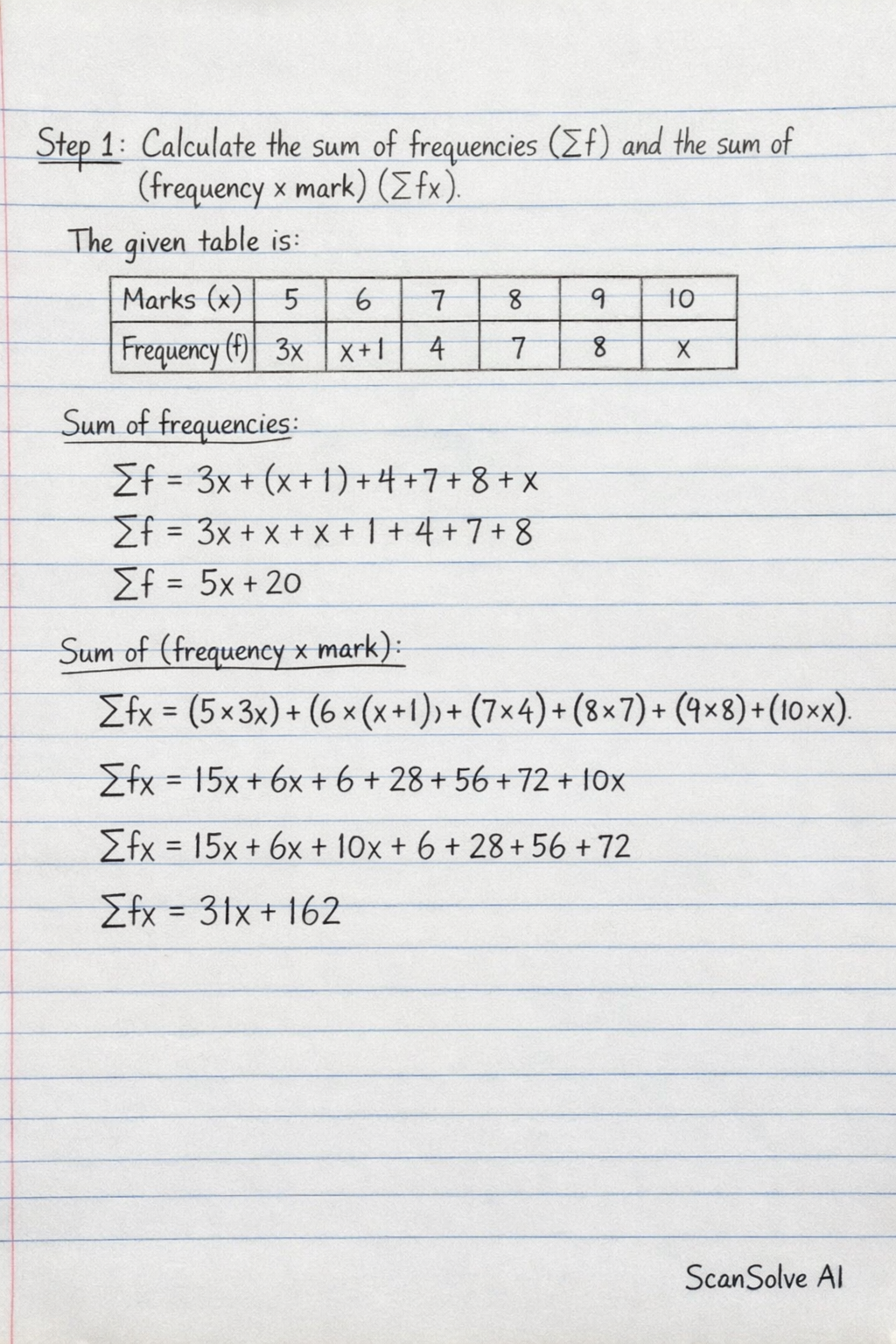
Handwritten Step-by-Step Solution
Get this as a handwritten image on WhatsApp — like a tutor wrote it for you.
Try on WhatsApp