
We read your photo as:
Suppose A = x ∈ R : -2 ≤ x < 5 and B = (-1, 6]. Draw A and B on two separate number lines. Find A ∪ B and give the answer in interval notation. Write A ∩ B as one set using set builder notation.
ScanSolve AI Answer
Step-by-step solution
9 stepsHere are the solutions to your questions.
Question 1
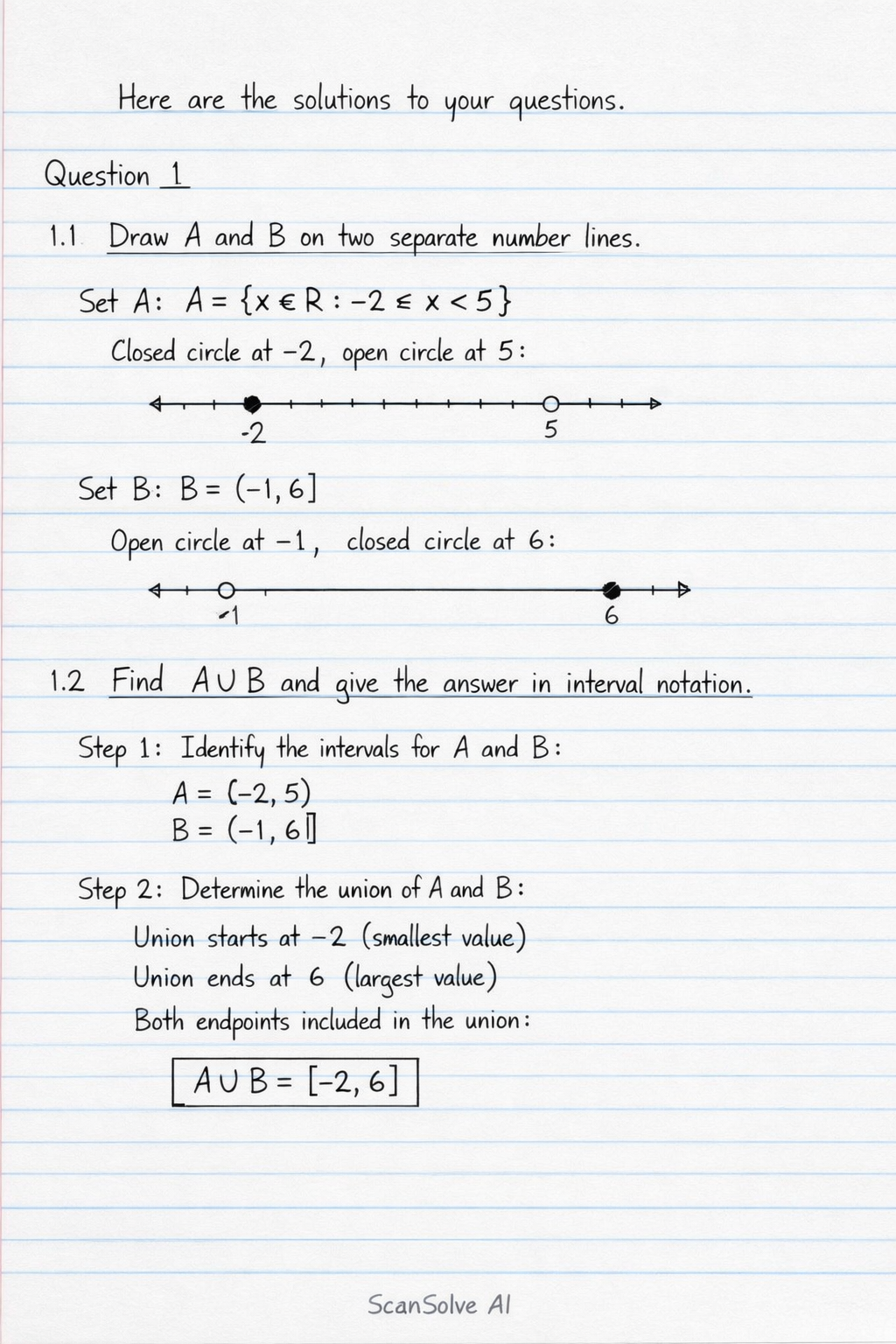
1.1 Draw A and B on two separate number lines.
Set A:
This represents an interval starting at -2 (inclusive) and ending at 5 (exclusive). On a number line, you would draw a closed circle at -2, an open circle at 5, and a line connecting them.
Set B:
This represents an interval starting at -1 (exclusive) and ending at 6 (inclusive). On a number line, you would draw an open circle at -1, a closed circle at 6, and a line connecting them.
1.2 Find and give the answer in interval notation.
Identify the intervals for A and B.
Determine the union, which includes all elements present in either A or B.
The union starts at the smallest value in either set, which is -2 (from A).
The union ends at the largest value in either set, which is 6 (from B).
Since -2 is included in A, and 6 is included in B, both endpoints are included in the union.1.3 Write as one set using set builder notation.
Identify the intervals for A and B.
Determine the intersection, which includes only elements common to both A and B.
The intersection starts at the largest of the lower bounds, which is -1 (since -1 is not included in B, it's not included in the intersection).
The intersection ends at the smallest of the upper bounds, which is 5 (since 5 is not included in A, it's not included in the intersection).Write the intersection in set builder notation.
Question 2
Calculate without using a calculator.
Simplify the division and the expression inside the parenthesis.
Substitute these simplified values back into the original expression.
Find a common denominator for the fractions, which is 12.
Perform the addition and subtraction.
a) as an improper fraction
b) as a mixed fraction
Divide 49 by 12: with a remainder of 1.c) as a decimal fraction correct to two decimal places.
Convert the improper fraction to a decimal.Rounding to two decimal places:
Question 3
*a) A certain bank offers an interest rate of on a one-year fixed deposit and the interest is compounded at the end of the year.
Still stuck on this one?
Ask a follow-up, and the answer starts from this question.
More Mathematics Questions
Handwritten Step-by-Step Solution
Get this as a handwritten image on WhatsApp — like a tutor wrote it for you.
Try on WhatsApp