
Teach me binomial theorem into details
ScanSolve AI Answer
Answer
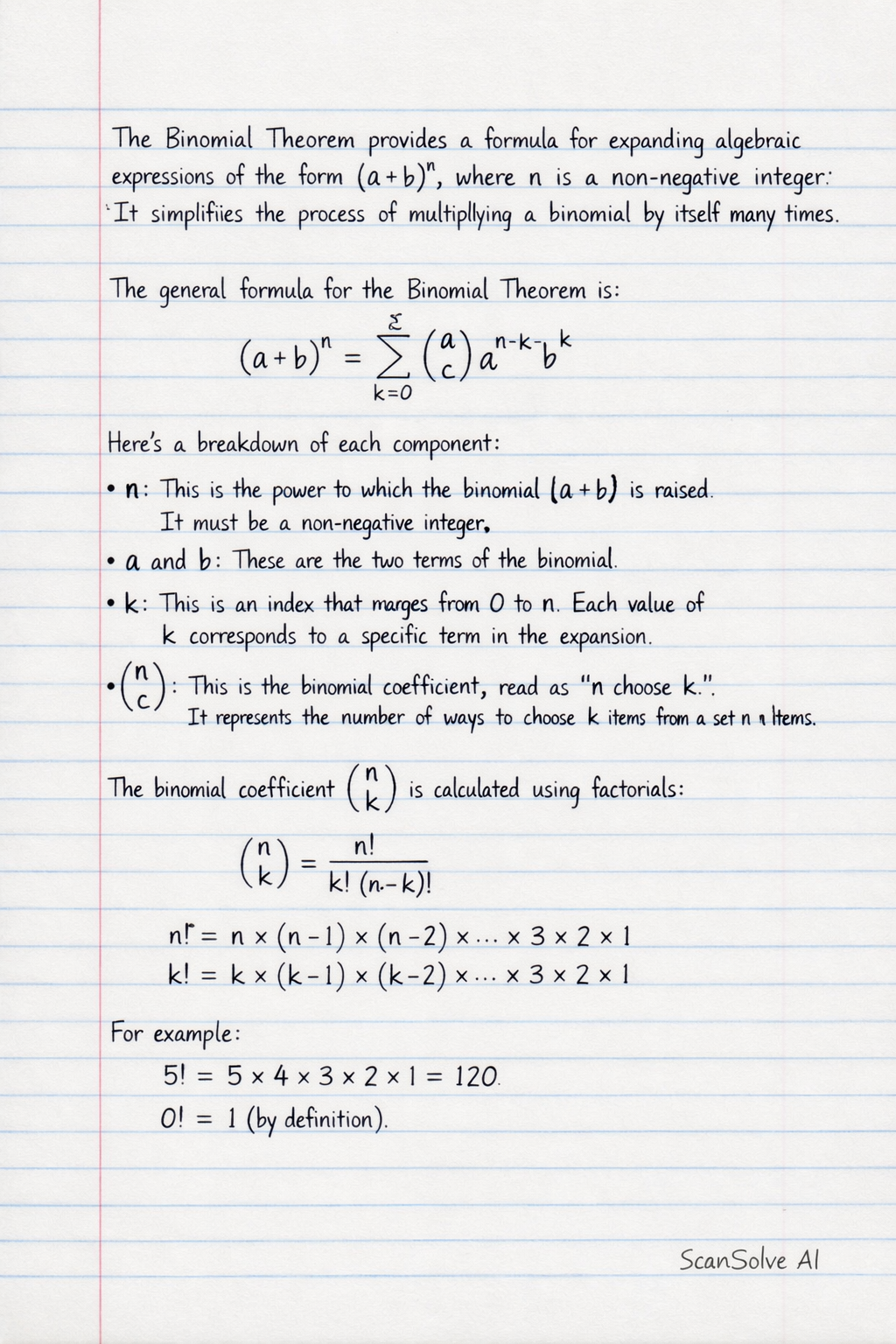
The Binomial Theorem provides a formula for expanding algebraic expressions of the form , where is a non-negative integer. It simplifies the process of multiplying a binomial by itself many times.
The general formula for the Binomial Theorem is:
Here's a breakdown of each component:
- : This is the power to which the binomial is raised. It must be a non-negative integer.
- and : These are the two terms of the binomial.
- : This is an index that ranges from 0 to . Each value of corresponds to a specific term in the expansion.
- : This is the binomial coefficient, read as "n choose k". It represents the number of ways to choose items from a set of items.
The binomial coefficient is calculated using factorials:
where (n factorial) is the product of all positive integers up to (e.g., ). By definition, .
Let's expand using the Binomial Theorem as an example:
Here, , , and . We will sum terms for .
For :
For :
For :
For :
Adding these terms together, we get the full expansion:
Some key properties of binomial expansions:
- The expansion of has terms.
- The sum of the exponents of and in each term is always .
- The binomial coefficients are symmetric; for example, .
Still stuck on this one?
Ask a follow-up, and the answer starts from this question.
More Mathematics Questions
Handwritten Step-by-Step Solution
Get this as a handwritten image on WhatsApp — like a tutor wrote it for you.
Try on WhatsApp