
Teach me everything on polynomials and quadratic equations
ScanSolve AI Answer
Answer
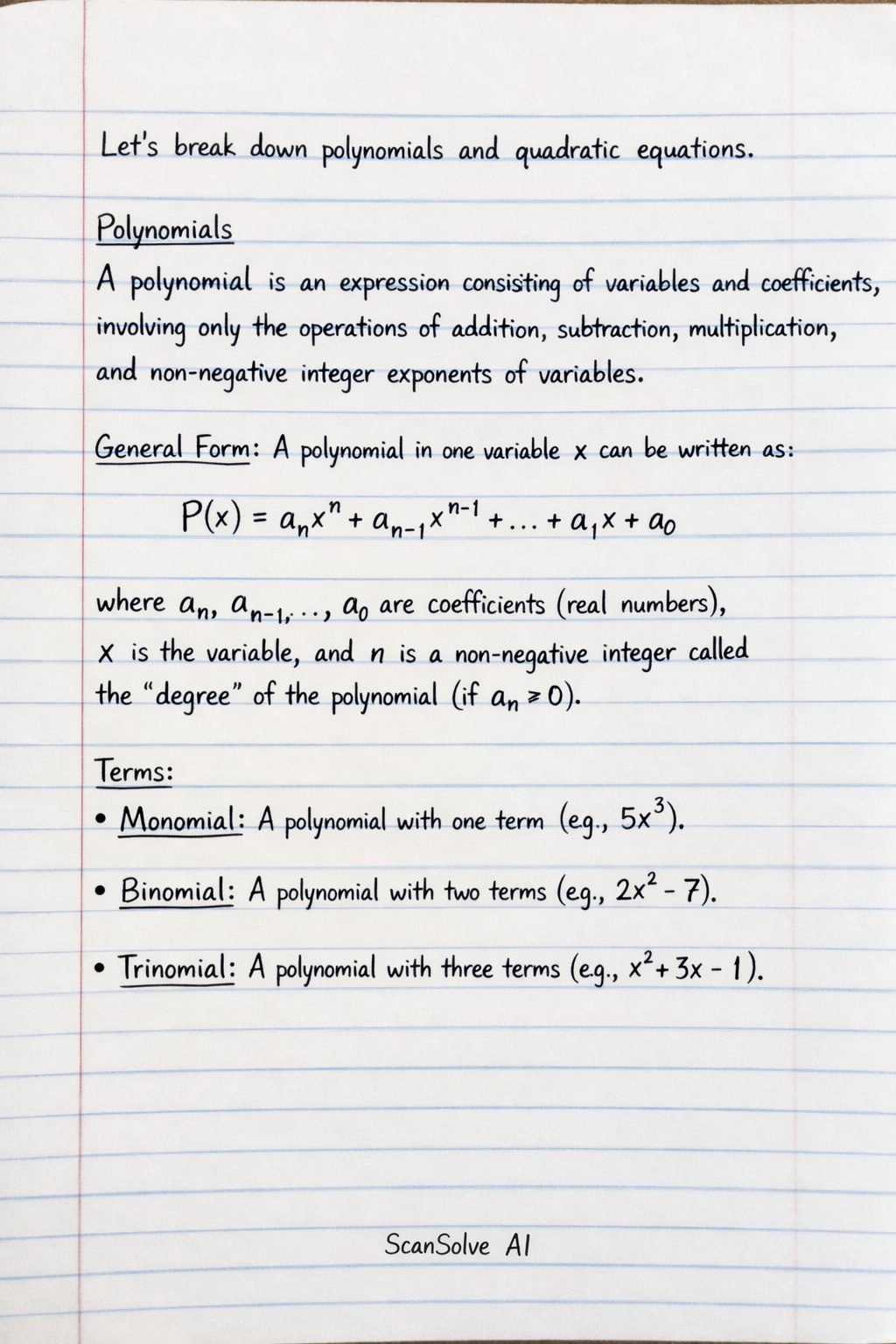
Let's break down polynomials and quadratic equations.
Polynomials
A polynomial is an expression consisting of variables and coefficients, involving only the operations of addition, subtraction, multiplication, and non-negative integer exponents of variables.
-
General Form: A polynomial in one variable can be written as:
where are coefficients (real numbers), is the variable, and is a non-negative integer called the degree of the polynomial (if ).
-
Terms:
- Monomial: A polynomial with one term (e.g., ).
- Binomial: A polynomial with two terms (e.g., ).
- Trinomial: A polynomial with three terms (e.g., ).
-
Degree: The highest exponent of the variable in a polynomial.
- Example: has a degree of 4.
- Linear polynomial: Degree 1 (e.g., ).
- Quadratic polynomial: Degree 2 (e.g., ).
- Cubic polynomial: Degree 3 (e.g., ).
-
Standard Form: Writing terms in descending order of their degrees.
- Example: in standard form is .
-
Operations: Polynomials can be added, subtracted, and multiplied.
- Example (Multiplication): .
-
Roots/Zeros: The values of for which . These are the x-intercepts of the polynomial's graph.
Quadratic Equations
A quadratic equation is a polynomial equation of degree 2.
-
Standard Form:
where are real numbers and .
-
Methods to Solve Quadratic Equations:
-
Factoring: If the quadratic expression can be factored, set each factor to zero and solve for .
- Example: Solve . The solutions are and .
-
Completing the Square: A method to convert a quadratic expression into a perfect square trinomial. This can be used to derive the quadratic formula.
-
Quadratic Formula: This formula can solve any quadratic equation. For , the solutions for are given by:
- Example: Solve . Here, , , . Two solutions: The solutions are .
-
-
The Discriminant (): The expression under the square root in the quadratic formula, . It tells us about the nature of the roots:
- If : Two distinct real roots.
- If : One real root (a repeated root).
- If : Two complex conjugate roots (no real roots).
-
Graphing Quadratic Equations (Parabolas): The graph of a quadratic equation is a parabola.
- If , the parabola opens upwards.
- If , the parabola opens downwards.
- The vertex is the turning point of the parabola. Its x-coordinate is given by .
- The axis of symmetry is the vertical line passing through the vertex, .
Try one yourself
A new problem that tests the same skill.
Still stuck on this one?
Ask a follow-up, and the answer starts from this question.
More Mathematics Questions
Handwritten Step-by-Step Solution
Get this as a handwritten image on WhatsApp — like a tutor wrote it for you.
Try on WhatsApp