We read your photo as:

Determine the tenth and nth terms using a table and number sentence.

Mathematics

ScanSolve AI Answer

Answers

4 parts
a

10n + 3\text{10n + 3}

103\text{103}

b

6n + 5\text{6n + 5}

65\text{65}

c

3n + 14\text{3n + 14}

44\text{44}

d

-7n - 9\text{-7n - 9}

-79\text{-79}

Step-by-step solution

12 steps

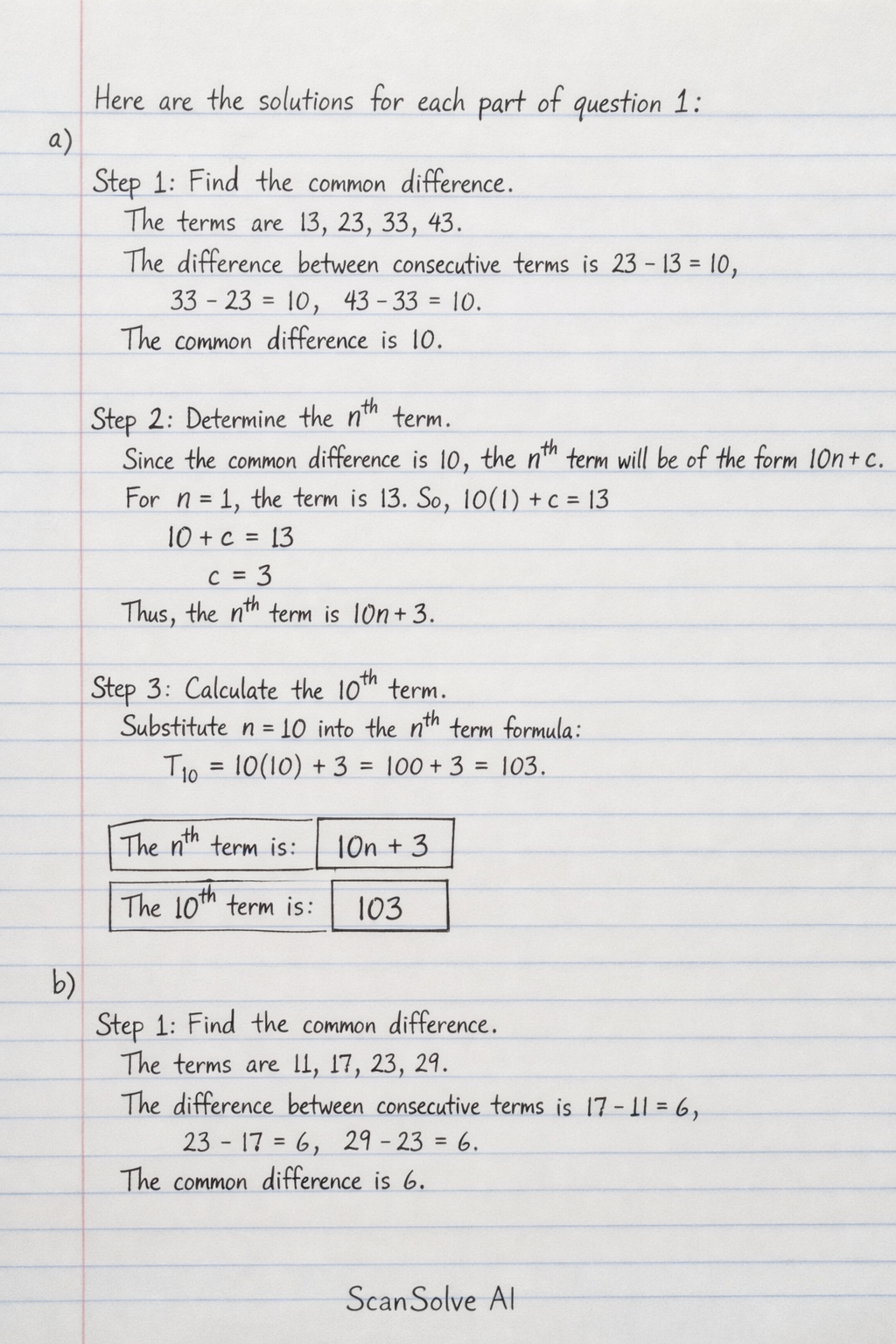
Here are the solutions for each part of question 1:

Part a· 3 steps

  1. Find the common difference.

    The terms are 13,23,33,4313, 23, 33, 43.
    The difference between consecutive terms is 23−13=1023 - 13 = 10, 33−23=1033 - 23 = 10, 43−33=1043 - 33 = 10.
    The common difference is 10.

  2. Determine the nthn^{th} term.

    Since the common difference is 10, the nthn^{th} term will be of the form 10n+c10n + c.
    For n=1n=1, the term is 13. So, 10(1)+c=13  ⟹  10+c=13  ⟹  c=310(1) + c = 13 \implies 10 + c = 13 \implies c = 3.
    Thus, the nthn^{th} term is 10n+310n + 3.

  3. Calculate the 10th10^{th} term.

    Substitute n=10n=10 into the nthn^{th} term formula:
    T10=10(10)+3=100+3=103T_{10} = 10(10) + 3 = 100 + 3 = 103.

    The nthn^{th} term is: 10n + 3\boxed{\text{10n + 3}}
    The 10th10^{th} term is: 103\boxed{\text{103}}

Part b

6n + 5\text{6n + 5}

  1. Find the common difference.

    The terms are 11,17,23,2911, 17, 23, 29.
    The difference between consecutive terms is 17−11=617 - 11 = 6, 23−17=623 - 17 = 6, 29−23=629 - 23 = 6.
    The common difference is 6.

  2. Determine the nthn^{th} term.

    Since the common difference is 6, the nthn^{th} term will be of the form 6n+c6n + c.
    For n=1n=1, the term is 11. So, 6(1)+c=11  ⟹  6+c=11  ⟹  c=56(1) + c = 11 \implies 6 + c = 11 \implies c = 5.
    Thus, the nthn^{th} term is 6n+56n + 5.

  3. Calculate the 10th10^{th} term.

    Substitute n=10n=10 into the nthn^{th} term formula:
    T10=6(10)+5=60+5=65T_{10} = 6(10) + 5 = 60 + 5 = 65.

    The nthn^{th} term is: 6n + 5\boxed{\text{6n + 5}}
    The 10th10^{th} term is: 65\boxed{\text{65}}

Part c

3n + 14\text{3n + 14}

  1. Find the common difference.

    The terms are 17,20,23,2617, 20, 23, 26.
    The difference between consecutive terms is 20−17=320 - 17 = 3, 23−20=323 - 20 = 3, 26−23=326 - 23 = 3.
    The common difference is 3.

  2. Determine the nthn^{th} term.

    Since the common difference is 3, the nthn^{th} term will be of the form 3n+c3n + c.
    For n=1n=1, the term is 17. So, 3(1)+c=17  ⟹  3+c=17  ⟹  c=143(1) + c = 17 \implies 3 + c = 17 \implies c = 14.
    Thus, the nthn^{th} term is 3n+143n + 14.

  3. Calculate the 10th10^{th} term.

    Substitute n=10n=10 into the nthn^{th} term formula:
    T10=3(10)+14=30+14=44T_{10} = 3(10) + 14 = 30 + 14 = 44.

    The nthn^{th} term is: 3n + 14\boxed{\text{3n + 14}}
    The 10th10^{th} term is: 44\boxed{\text{44}}

Part d

-7n - 9\text{-7n - 9}

  1. Find the common difference.

    The terms are −16,−23,−30,−37-16, -23, -30, -37.
    The difference between consecutive terms is −23−(−16)=−7-23 - (-16) = -7, −30−(−23)=−7-30 - (-23) = -7, −37−(−30)=−7-37 - (-30) = -7.
    The common difference is −7-7.

  2. Determine the nthn^{th} term.

    Since the common difference is −7-7, the nthn^{th} term will be of the form −7n+c-7n + c.
    For n=1n=1, the term is −16-16. So, −7(1)+c=−16  ⟹  −7+c=−16  ⟹  c=−9-7(1) + c = -16 \implies -7 + c = -16 \implies c = -9.
    Thus, the nthn^{th} term is −7n−9-7n - 9.

  3. Calculate the 10th10^{th} term.

    Substitute n=10n=10 into the nthn^{th} term formula:
    T10=−7(10)−9=−70−9=−79T_{10} = -7(10) - 9 = -70 - 9 = -79.

    The nthn^{th} term is: -7n - 9\boxed{\text{-7n - 9}}
    The 10th10^{th} term is: -79\boxed{\text{-79}}

Was this helpful?

Try one yourself

A new problem that tests the same skill.

Still stuck on this one?

Ask a follow-up, and the answer starts from this question.

Got a different question?Ask your own question
Handwritten step-by-step solution preview

Handwritten Step-by-Step Solution

Get this as a handwritten image on WhatsApp — like a tutor wrote it for you.

Try on WhatsApp