
We read your photo as:
Find the rule for the sequence: Input (n): 1, 2, 3, 4. Output (Tn): 7, 9, 11, 13. Then find the 10th and 100th terms.
Mathematics
ScanSolve AI Answer
Step-by-step solution
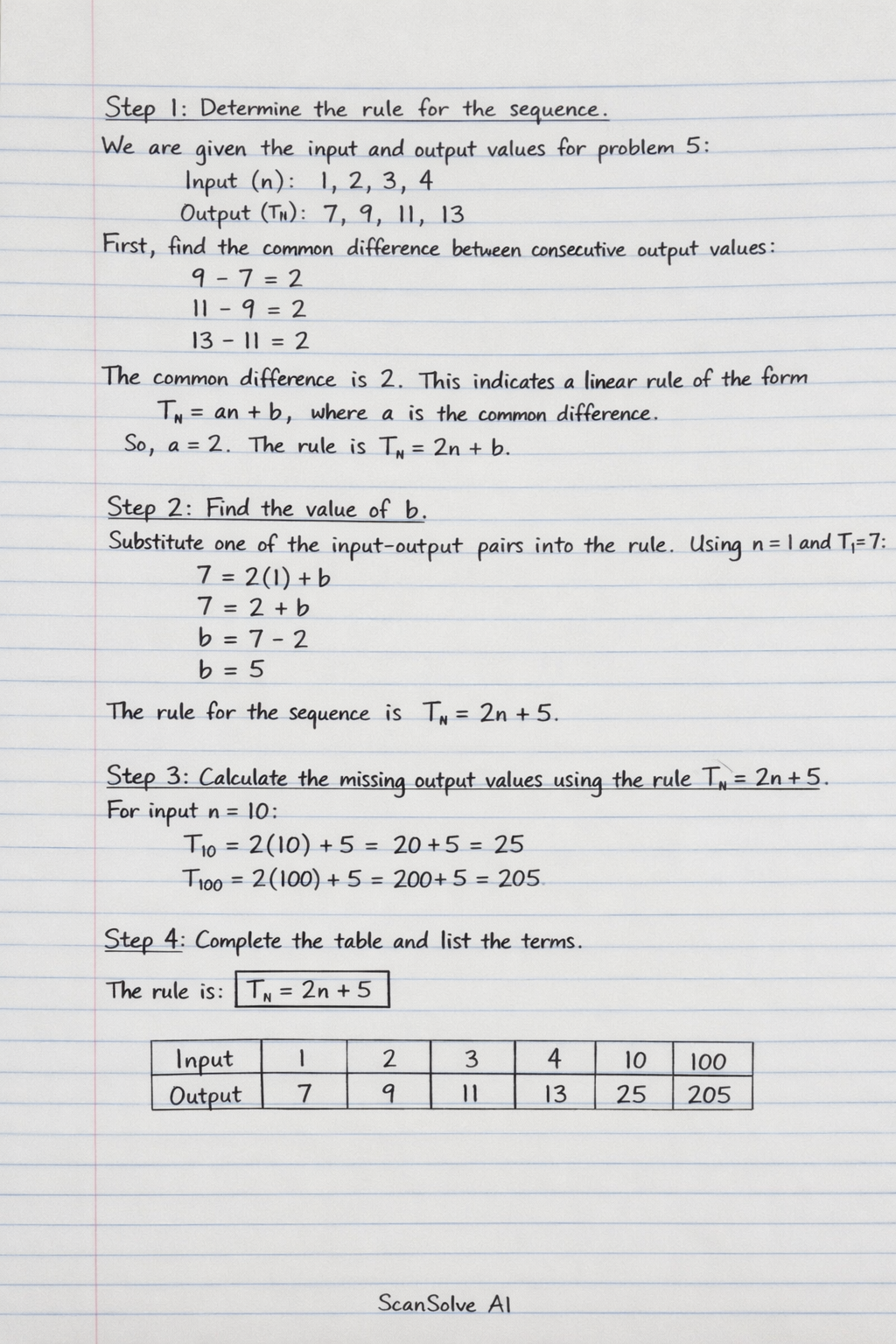
4 stepsDetermine the rule for the sequence.
We are given the input and output values for :
Input (): 1, 2, 3, 4
Output (): 7, 9, 11, 13First, find the common difference between consecutive output values:
The common difference is 2. This indicates a linear rule of the form , where is the common difference.
So, . The rule is .Find the value of .
Substitute one of the input-output pairs into the rule. Using and :
The rule for the sequence is .
Calculate the missing output values using the rule .
For Input :
For Input :
Complete the table and list the terms.
The rule is:
The completed table is:
Input 1 2 3 4 10 100 Output 7 9 11 13 25 205 The terms are:
Was this helpful?
Still stuck on this one?
Ask a follow-up, and the answer starts from this question.
Got a different question?Ask your own question
More Mathematics Questions
QFind the rule for the sequence where T1=5, T2=8, T3=11 and then find T4, T10 and T100.QA flow diagram takes an input n and produces an output Tn. Given the following input-output pairs…QFind the rule for the sequence: 8, 9, 15, ...QGiven the formula for the n-th term of a sequence is Tn = 2 × 2n − 2, simplify the formula and find…QWhat is the nth term rule for the pattern: 3, 6, 9, 12, 15,...?
Handwritten Step-by-Step Solution
Get this as a handwritten image on WhatsApp — like a tutor wrote it for you.
Try on WhatsApp