
We read your photo as:
Tentukan sama ada garis PQ dan RS adalah selari atau tidak. Nyatakan sebab anda. Determine whether the lines PQ and RS are parallel or not. State your reason.
ScanSolve AI Answer
Step-by-step solution
18 stepsHere's how to determine if lines PQ and RS are parallel for each problem:
1)
Identify the angles.
The two angles given are corresponding angles.
Angle 1 =
Angle 2 =Check for parallelism.
For lines to be parallel, corresponding angles must be equal.
Since , the corresponding angles are equal.Conclusion.
Lines PQ and RS are parallel because their corresponding angles are equal.
2)
Identify the angles.
The two angles given are alternate exterior angles.
Angle 1 =
Angle 2 =Check for parallelism.
For lines to be parallel, alternate exterior angles must be equal.
Since , the alternate exterior angles are equal.Conclusion.
Lines PQ and RS are parallel because their alternate exterior angles are equal.
3)
Identify the angles.
The two angles given are alternate interior angles.
Angle 1 =
Angle 2 =Check for parallelism.
For lines to be parallel, alternate interior angles must be equal.
Since , the alternate interior angles are equal.Conclusion.
Lines PQ and RS are parallel because their alternate interior angles are equal.
4)
Identify the angles.
The two angles given are alternate exterior angles.
Angle 1 =
Angle 2 =Check for parallelism.
For lines to be parallel, alternate exterior angles must be equal.
Since , the alternate exterior angles are equal.Conclusion.
Lines PQ and RS are parallel because their alternate exterior angles are equal.
5)
Identify the angles.
The two angles given are consecutive interior angles (also known as interior angles on the same side of the transversal).
Angle 1 =
Angle 2 =Check for parallelism.
For lines to be parallel, consecutive interior angles must sum to .
Sum = .
Since , the sum is not .Conclusion.
Lines PQ and RS are not parallel because their consecutive interior angles do not sum to .
6)
Identify the angles.
The two angles given are consecutive interior angles.
Angle 1 =
Angle 2 =Check for parallelism.
For lines to be parallel, consecutive interior angles must sum to .
Sum = .
Since , the sum is not .Conclusion.
Lines PQ and RS are not parallel because their consecutive interior angles do not sum to .
Still stuck on this one?
Ask a follow-up, and the answer starts from this question.
More Mathematics Questions
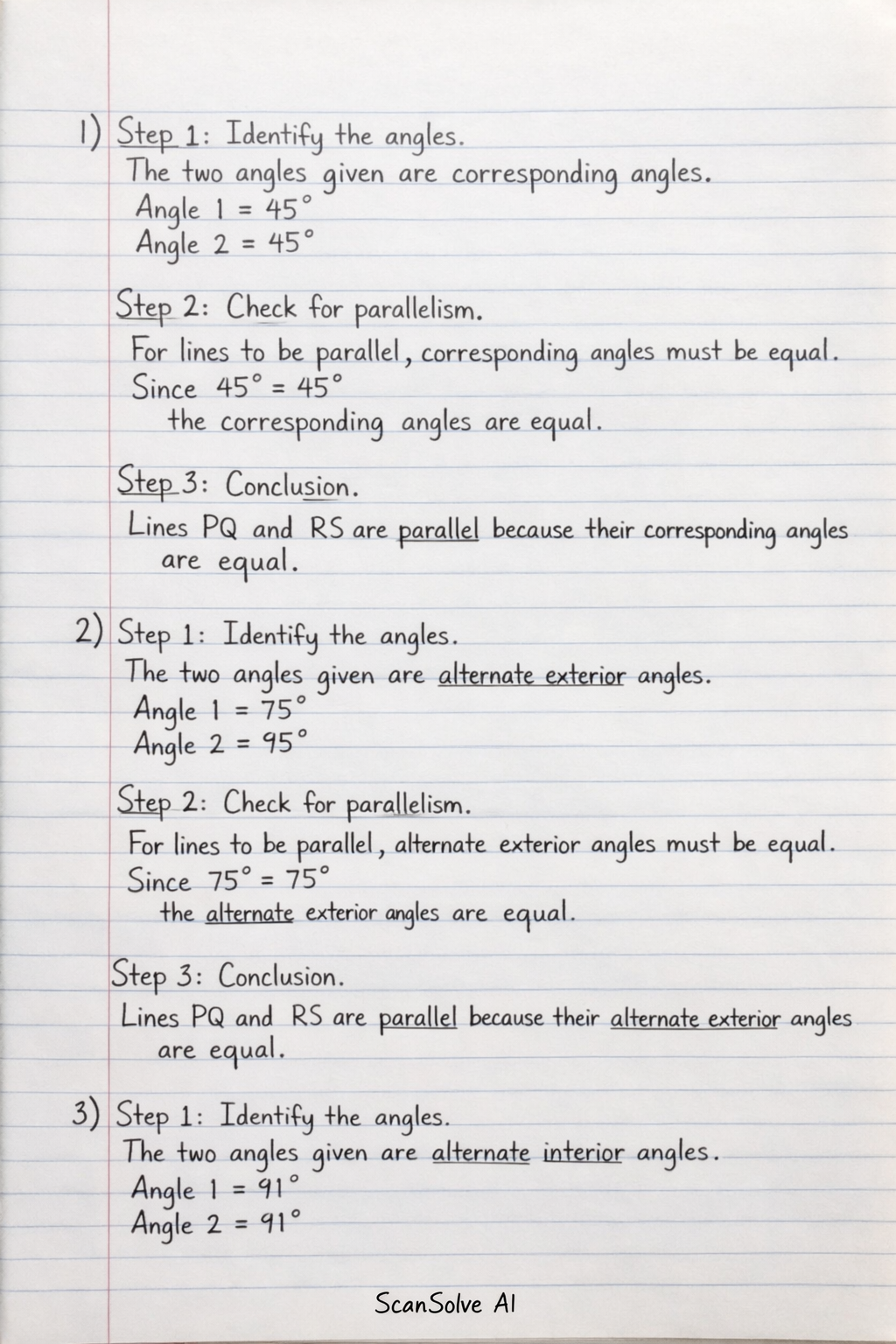
Handwritten Step-by-Step Solution
Get this as a handwritten image on WhatsApp — like a tutor wrote it for you.
Try on WhatsApp