
We read your photo as:
Prove that TU is parallel to SR, given that T and U are the midpoints of PS and QR respectively in parallelogram PQRS.
ScanSolve AI Answer
Answer
Step-by-step solution
5 stepsIdentify properties of parallelogram PQRS.
Since PQRS is a parallelogram, its opposite sides are parallel and equal in length.
Therefore, we have:Use the definitions of midpoints T and U.
T is the midpoint of PS, so .
U is the midpoint of QR, so .Establish relationships between PT and QU.
From Step 1, we know .
From Step 2, and .
Substituting into the midpoint equations, we get and .
Thus, .
Also, since (from Step 1) and T lies on PS while U lies on QR, it follows that .Prove that quadrilateral PTUQ is a parallelogram.
Consider quadrilateral PTUQ. We have shown that and .
A quadrilateral with one pair of opposite sides that are both parallel and equal in length is a parallelogram.
Therefore, PTUQ is a parallelogram.Conclude the parallelism of TU and SR.
Since PTUQ is a parallelogram, its opposite sides are parallel.
Thus, .
From Step 1, we know that .
Since and , by the transitive property of parallel lines, we can conclude that .
Try one yourself
A new problem that tests the same skill.
Still stuck on this one?
Ask a follow-up, and the answer starts from this question.
More Mathematics Questions
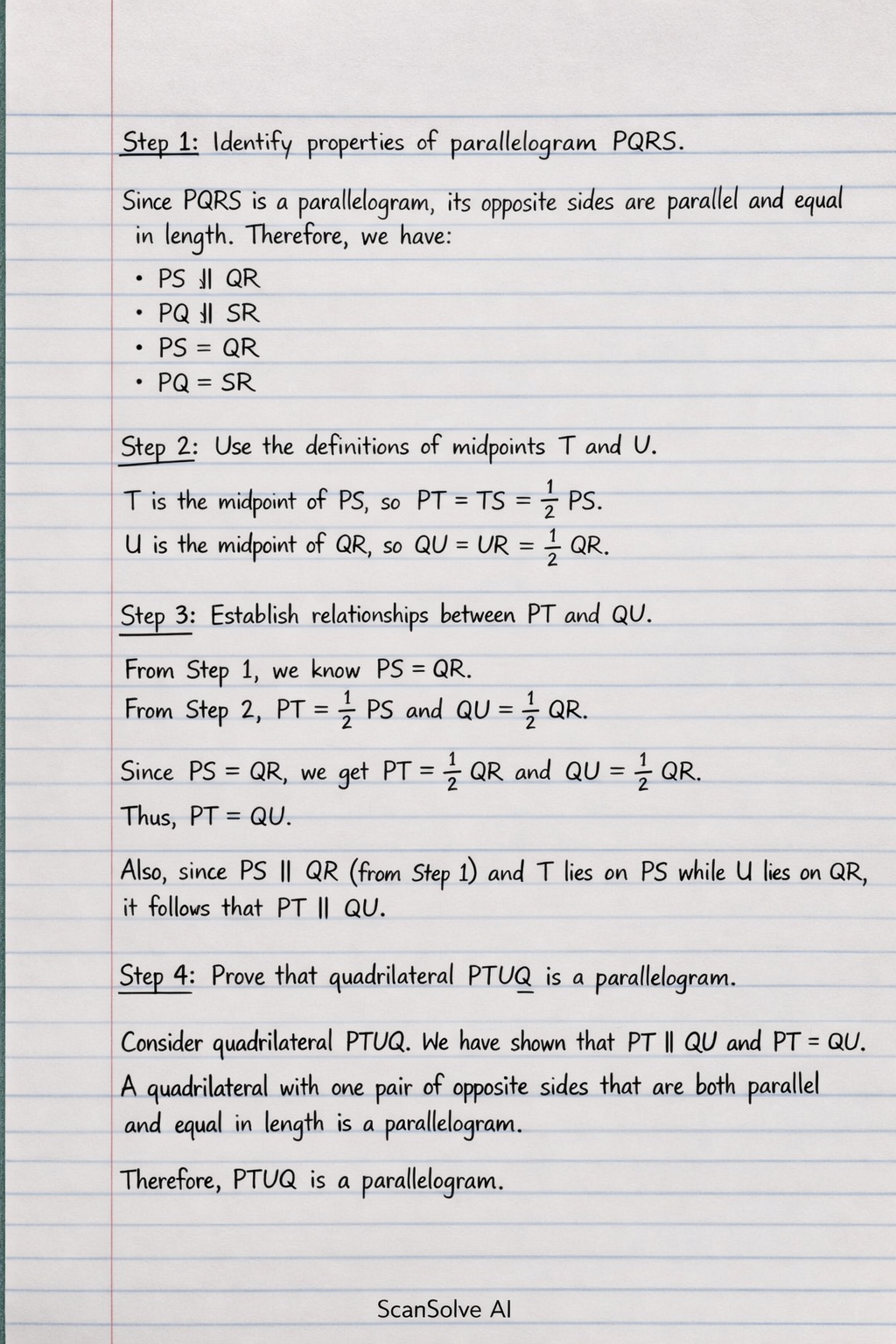
Handwritten Step-by-Step Solution
Get this as a handwritten image on WhatsApp — like a tutor wrote it for you.
Try on WhatsApp