
We read your photo as:
The table shows the marks of some students in a test. Use the information to answer questions 29 and 30.
ScanSolve AI Answer
Step-by-step solution
28 stepsHere are the solutions to your questions:
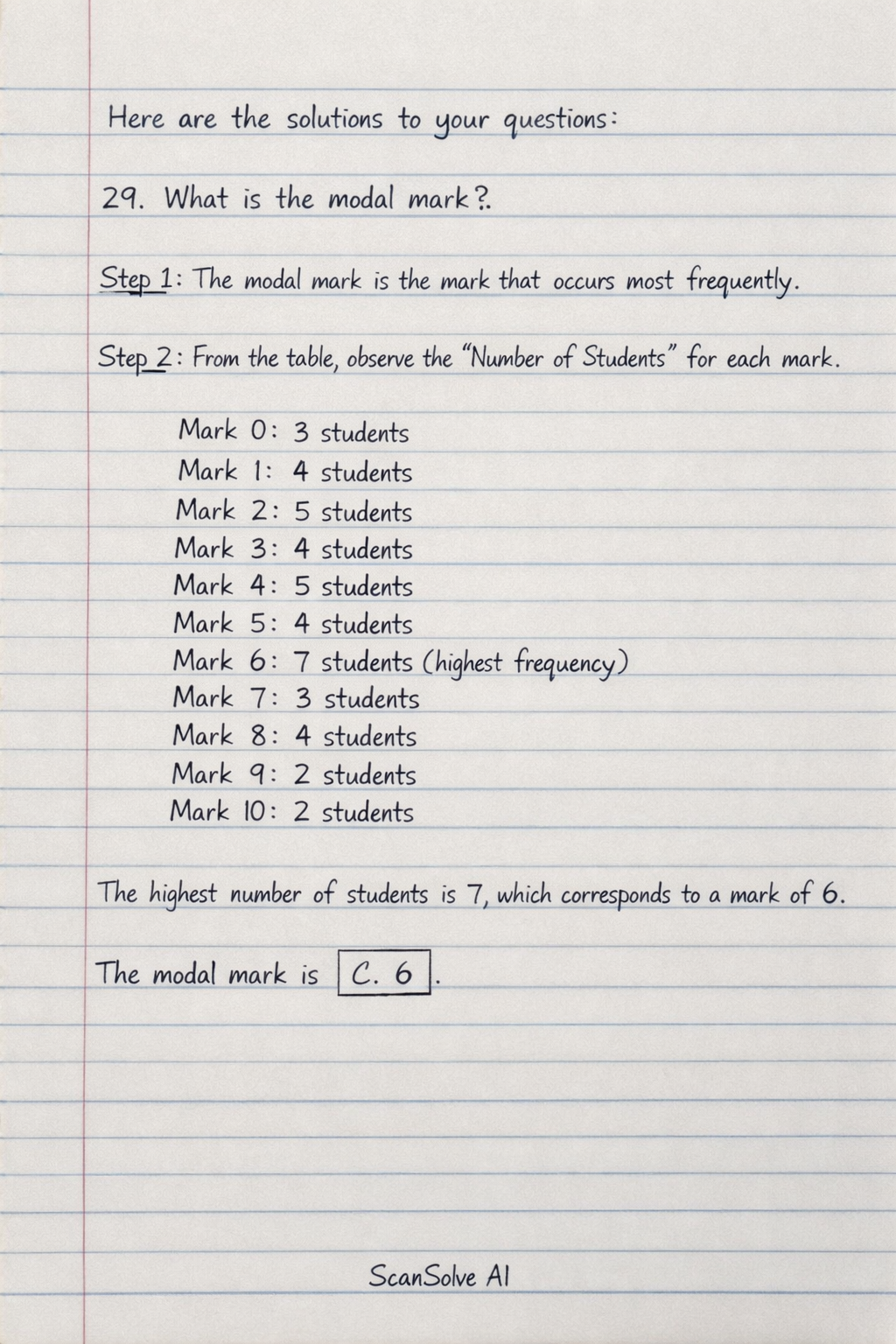
- What is the modal mark?
The modal mark is the mark that occurs most frequently.
From the table, observe the "Number of Students" for each mark.
Mark 0: 3 students Mark 1: 4 students Mark 2: 5 students Mark 3: 4 students Mark 4: 5 students Mark 5: 4 students Mark 6: 7 students (highest frequency) Mark 7: 3 students Mark 8: 4 students Mark 9: 2 students Mark 10: 2 students The highest number of students is 7, which corresponds to a mark of 6. The modal mark is $\boxed{\text{C. } 6}$.30. How many students failed the test, if the pass mark was 4?
Students failed if their mark was less than 4.
This includes marks 0, 1, 2, and 3.
Sum the number of students for these marks.
Number of students with Mark 0 = 3 Number of students with Mark 1 = 4 Number of students with Mark 2 = 5 Number of students with Mark 3 = 4 Total failed students = $3 + 4 + 5 + 4 = 16$. The number of students who failed is $\boxed{\text{C. } 16}$.31. What is the probability of obtaining 4, when a fair die is tossed once?
A fair die has 6 possible outcomes
{1, 2, 3, 4, 5, 6}. So, the total number of outcomes is 6.
The number of favorable outcomes (obtaining a 4) is 1.
Calculate the probability.
$$ P(\text{obtaining 4}) = \frac{\text{Number of favorable outcomes}}{\text{Total number of outcomes}} = \frac{1}{6} $$ The probability is $\boxed{\text{A. } \frac{1}{6}}$.32. Find the median of the numbers (17, 12, 15, 16, 8, 18, 13 and 14).
Arrange the numbers in ascending order.
$$ 8, 12, 13, 14, 15, 16, 17, 18 $$Count the number of values.
There are 8 numbers. Since the count is an even number, the median is the average of the two middle numbers.
The middle numbers are the 4th and 5th values in the ordered list.
4th value = 14
5th value = 15Calculate the average of these two numbers.
$$ \text{Median} = \frac{14 + 15}{2} = \frac{29}{2} = 14.5 $$ The median is $\boxed{\text{C. } 14.5}$.33. How many students took the test?
Count the total number of leaves in the stem and leaf plot.
Each leaf represents one student's mark.
Stem 2: 5 leaves (0, 2, 5, 7, 8)
Stem 3: 3 leaves (2, 7, 9)
Stem 4: 4 leaves (3, 5, 5, 5)
Stem 5: 4 leaves (4, 6, 6, 8)
Stem 6: 3 leaves (3, 5, 7)
Stem 7: 2 leaves (0, 6)Sum the number of leaves.
Total students = $5 + 3 + 4 + 4 + 3 + 2 = 21$. The number of students who took the test is $\boxed{\text{C. } 21}$.34. What is the modal mark?
The modal mark is the mark that appears most frequently in the stem and leaf plot.
Look for repeated leaves.
The mark 45 (stem 4, leaf 5) appears 3 times. No other mark appears more than 3 times. The modal mark is $\boxed{\text{A. } 45}$.35. What is the median mark?
There are 21 students (from Q33).
Since the number of students is odd, the median is the mark of the -th student.
Count the marks in order from the stem and leaf plot until you reach the 11th mark.
Marks: 20, 22, 25, 27, 28 (5 marks) 32, 37, 39 (3 marks, total 8) 43, 45, 45 (3 marks, total 11) The 11th mark is 45. The median mark is $\boxed{\text{A. } 45}$.36. The point K (1, 5) is rotated through anti-clockwise about the origin. Find the coordinates of the image of K.
The rule for a anti-clockwise rotation about the origin for a point is .
Apply this rule to point K(1, 5).
Here, $x = 1$ and $y = 5$. The image coordinates will be $(-5, 1)$. The coordinates of the image of K are $\boxed{\text{B. } (-5, 1)}$.37. Find the value of the angle marked y.
The sum of angles in a circle (pie chart) is .
Sum the given angles and equate to .
$$ 120^\circ (\text{Science}) + 60^\circ (\text{Vocational}) + 80^\circ (\text{Arts}) + y (\text{Technical}) = 360^\circ $$ $$ 260^\circ + y = 360^\circ $$Solve for y.
$$ y = 360^\circ - 260^\circ $$ $$ y = 100^\circ $$ The value of y is $\boxed{\text{C. } 100^\circ}$.38. How many more students offer science subjects than Arts subjects?
Calculate the number of students offering Science subjects.
$$ \text{Number of Science students} = \frac{120^\circ}{360^\circ} \times 720 = \frac{1}{3} \times 720 = 240 $$Calculate the number of students offering Arts subjects.
$$ \text{Number of Arts students} = \frac{80^\circ}{360^\circ} \times 720 = \frac{2}{9} \times 720 = 2 \times 80 = 160 $$Find the difference.
$$ \text{Difference} = 240 - 160 = 80 $$ 80 more students offer science subjects than Arts subjects. The answer is $\boxed{\text{B. } 80}$.39. Which village is farthest from the market town?
Read the distance for each village from the bar chart.
Village P: 7 km Village Q: 11 km Village R: 6 km Village S: 12 km Village T: 11 kmIdentify the largest distance.
The largest distance is 12 km, which corresponds to Village S. The village farthest from the market town is $\boxed{\text{D. } S}$.40. How much farther is village R from the market town than village P?
Read the distances for Village R and Village P from the bar chart.
Distance of Village R = 6 km Distance of Village P = 7 kmCalculate the difference in their distances.
Note that Village P is actually farther than Village R. The question asks for the difference in distance. The difference in distance is .
Still stuck on this one?
Ask a follow-up, and the answer starts from this question.
More Mathematics Questions
Handwritten Step-by-Step Solution
Get this as a handwritten image on WhatsApp — like a tutor wrote it for you.
Try on WhatsApp