
We read your photo as:
Prove that 7ⁿ-1 is divisible by 7 for all positive integers n.
ScanSolve AI Answer
Answer
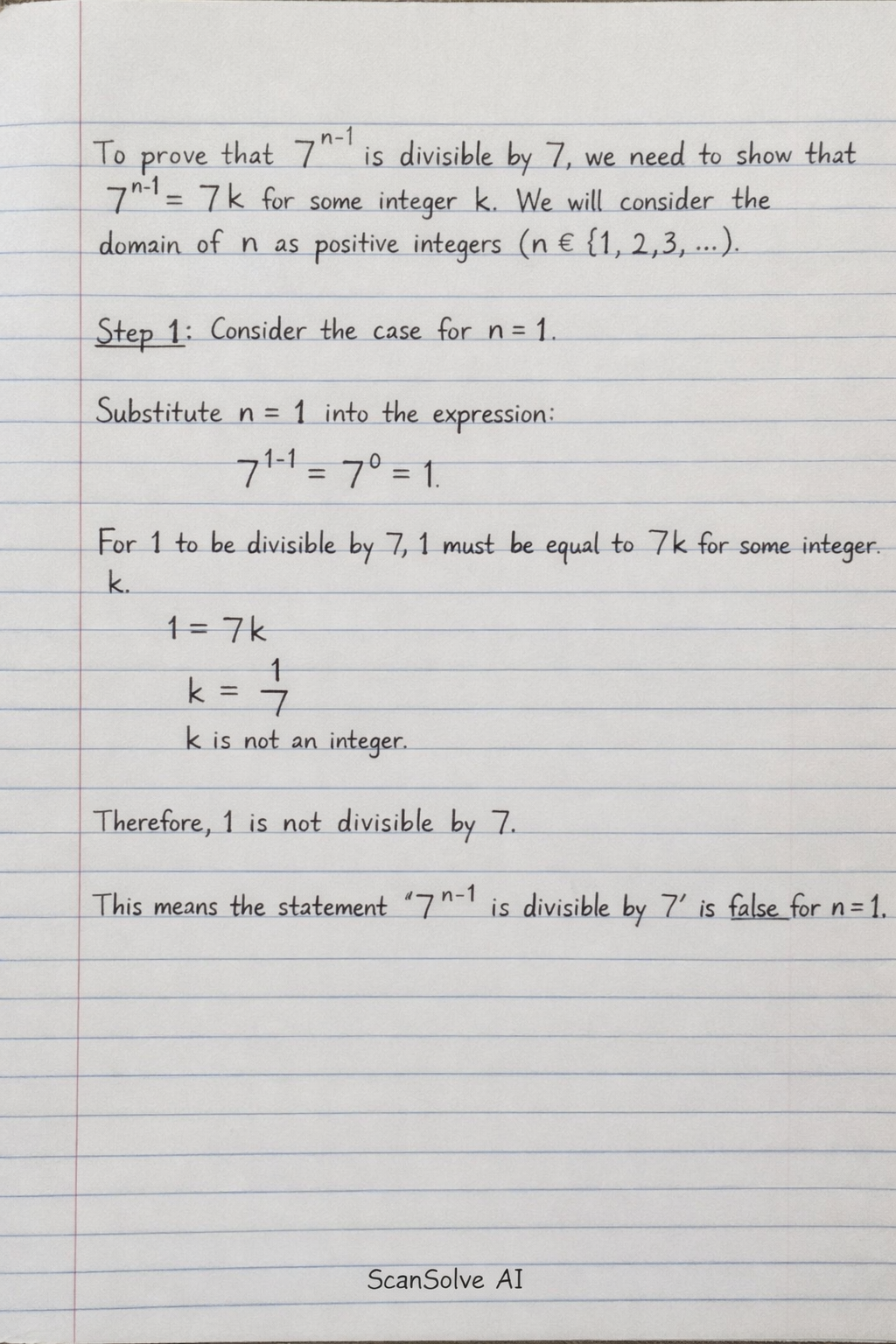
To prove that is divisible by 7, we need to show that for some integer . We will consider the domain of as positive integers ().
Step-by-step solution
2 stepsConsider the case for .
Substitute into the expression:
For 1 to be divisible by 7, 1 must be equal to for some integer . However, is not an integer.
Therefore, 1 is not divisible by 7.
This means the statement " is divisible by 7" is false for .Prove for integers .
For any integer , the exponent will be a positive integer.
Let . Since , we have .
The expression becomes .
We can rewrite as:Since , the exponent is a non-negative integer ().
Therefore, is an integer.
Let . Since is an integer, is an integer.
So, we have:This shows that is a multiple of 7, and thus divisible by 7.
Substituting back , we conclude that is divisible by 7 for all integers .Conclusion:
The statement " is divisible by 7" is not true for all positive integers . It is false for . However, it is true for all integers .
Still stuck on this one?
Ask a follow-up, and the answer starts from this question.
More Mathematics Questions
Handwritten Step-by-Step Solution
Get this as a handwritten image on WhatsApp — like a tutor wrote it for you.
Try on WhatsApp