
We read your photo as:
Prove that AC2 = AD AE and EF AC = ED * AF
ScanSolve AI Answer
Answers
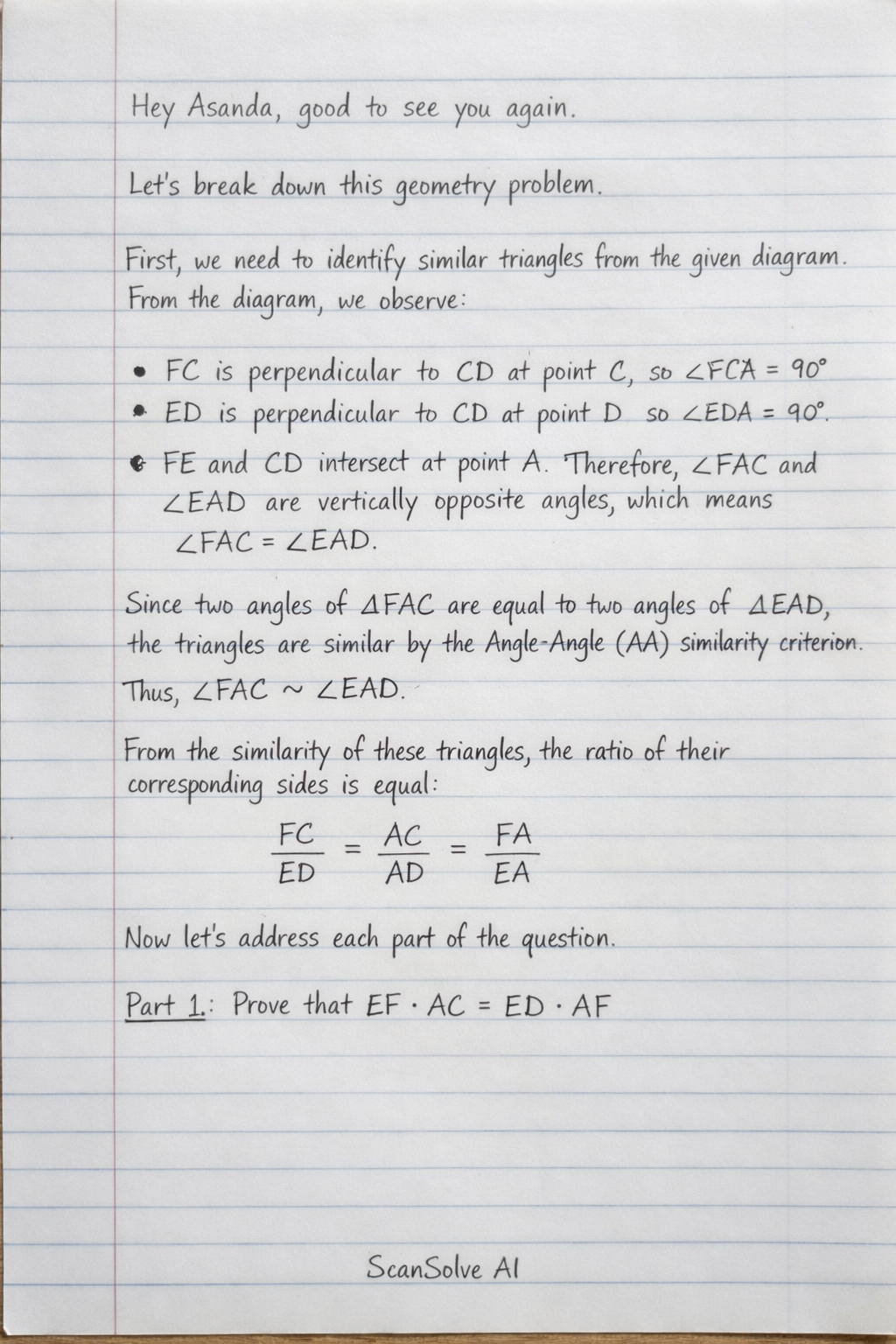
2 partsLet's break down this geometry problem.
First, we need to identify similar triangles from the given diagram.
From the diagram, we observe:
- The line segment is perpendicular to the line segment at point , so .
- The line segment is perpendicular to the line segment at point , so .
- The lines and intersect at point . Therefore, and are vertically opposite angles, which means .
Since two angles of are equal to two angles of , the triangles are similar by the Angle-Angle (AA) similarity criterion.
Thus, .
From the similarity of these triangles, the ratio of their corresponding sides is equal:
Now let's address each part of the question.
Part 1: Prove that
From the similarity ratio , we can write .
Also, from the diagram, points are collinear, and is between and . So, .
Let's substitute these into the equation we need to prove:
Substitute :
Factor out :
Since :
Divide both sides by (assuming ):
From the similarity ratio , we can write .
Substitute this into the equation:
This expression is not generally true and does not simplify to an identity. This indicates that the statement is not generally true based on the given similar triangles and collinearity. It is highly probable there is a typo in the question. A common relation derived from these similar triangles is .
Part 2: Prove that
From the similarity ratio , we can cross-multiply to get:
For the statement to be true, we would need , which implies .
However, is a segment on the line , and is a perpendicular segment. They are not necessarily equal. Therefore, the statement is also not generally true based on the given similar triangles.
Given that both statements are not generally true under the standard interpretation of similar triangles, it is likely there are typos in the question. If the question intended to ask for relations directly derived from the similarity, they would be:
- (from )
- (from )
- (from )
Since I must answer the question as written, and the statements are not generally true, I will state the conclusion.
Conclusion:
Based on the similarity , the given statements are not generally true.
- The statement implies , which is not generally true.
- The statement implies , which is not generally true.
It is possible there is a typo in the question.
Still stuck on this one?
Ask a follow-up, and the answer starts from this question.
More Mathematics Questions
Handwritten Step-by-Step Solution
Get this as a handwritten image on WhatsApp — like a tutor wrote it for you.
Try on WhatsApp