
We read your photo as:
Prove that DEC ||| BEA and FAB ||| FCA given that ABCD is a cyclic quadrilateral and FA is tangent to the circle at A.
ScanSolve AI Answer
Answers
5 partsStep-by-step solution
14 stepsPart 1.1· 3 steps
Prove that .
Identify common angles.
This is a common angle to both triangles and .
Identify equal angles using properties of cyclic quadrilaterals.
ABCD is a cyclic quadrilateral. The sum of opposite angles in a cyclic quadrilateral is .
Angles on a straight line sum to .
From these two equations, we can conclude:
Conclude similarity.
Since two angles of are equal to two angles of , the triangles are similar by the Angle-Angle (AA) similarity criterion.
Part 1.2
Prove that .
Identify common angles.
This is a common angle to both triangles and .
Identify equal angles using the tangent-chord theorem.
FA is a tangent to the circle at A. The angle between the tangent FA and the chord AB () is equal to the angle in the alternate segment subtended by the chord AB ( or ).
Conclude similarity.
Since two angles of are equal to two angles of , the triangles are similar by the Angle-Angle (AA) similarity criterion.
Part 1.3FA.CA = FC. AB
Hence show that FA.CA = FC. AB
Use the similarity from part 1.2.
Since , the ratio of their corresponding sides is equal:
Select the relevant ratio and cross-multiply.
From the first two parts of the ratio:
Cross-multiplying gives:
This completes the proof.
Part 2.1
Prove that .
Identify common angles.
This is a common angle to both triangles and .
Identify equal angles using properties of cyclic quadrilaterals.
KRST is a cyclic quadrilateral. The sum of opposite angles in a cyclic quadrilateral is .
Angles on a straight line sum to .
From these two equations, we can conclude:
Conclude similarity.
Since two angles of are equal to two angles of , the triangles are similar by the Angle-Angle (AA) similarity criterion.
Part 2.2
JR.TK = RS²
Use the similarity from part 2.1.
Since , the ratio of their corresponding sides is equal:
Select the relevant ratio and cross-multiply.
From the first two parts of the ratio:
Cross-multiplying gives:
Substitute the given information.
We are given that . Substitute this into the equation:
This completes the proof.
Try one yourself
A new problem that tests the same skill.
Still stuck on this one?
Ask a follow-up, and the answer starts from this question.
More Mathematics Questions
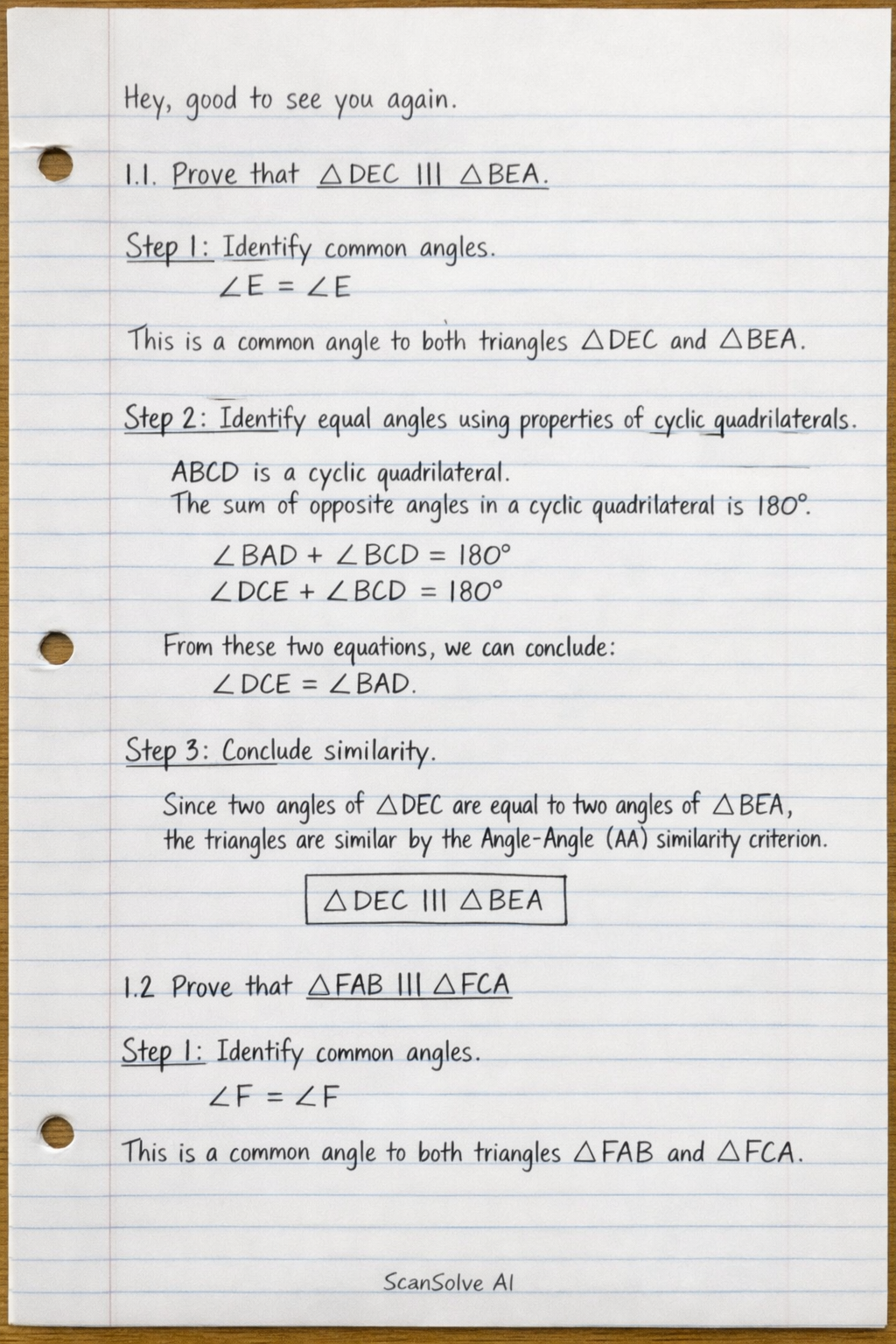
Handwritten Step-by-Step Solution
Get this as a handwritten image on WhatsApp — like a tutor wrote it for you.
Try on WhatsApp