
We read your photo as:
Show that for a quadratic function y = ax2 + bx + c with a < 0, the function has a maximum value at x = -b/(2a) using the method of completing the square.
ScanSolve AI Answer
Answer
Step-by-step solution
7 stepsTo show that if , the quadratic function has a maximum value when , we can use the method of completing the square.
Start with the given quadratic function.
Factor out from the terms involving .
Complete the square inside the parenthesis.
To do this, add and subtract .
Group the perfect square trinomial and separate the constant term.
Distribute back into the terms inside the parenthesis.
Combine the constant terms to get the vertex form of the quadratic equation.
This is the vertex form , where the vertex is at . In this case, and .
Analyze the expression to determine if it's a maximum or minimum.
The term is always greater than or equal to zero, i.e., .
The minimum value of this term is 0, which occurs when , or .We are given that .
Since is negative and is non-negative, the product will always be less than or equal to zero:To maximize , we need to make the term as large as possible. Since it is always non-positive, its maximum value is 0.
This occurs when , which means .At , the function reaches its maximum value:
Therefore, if , the quadratic function has a maximum value when .
Try one yourself
A new problem that tests the same skill.
Still stuck on this one?
Ask a follow-up, and the answer starts from this question.
More Mathematics Questions
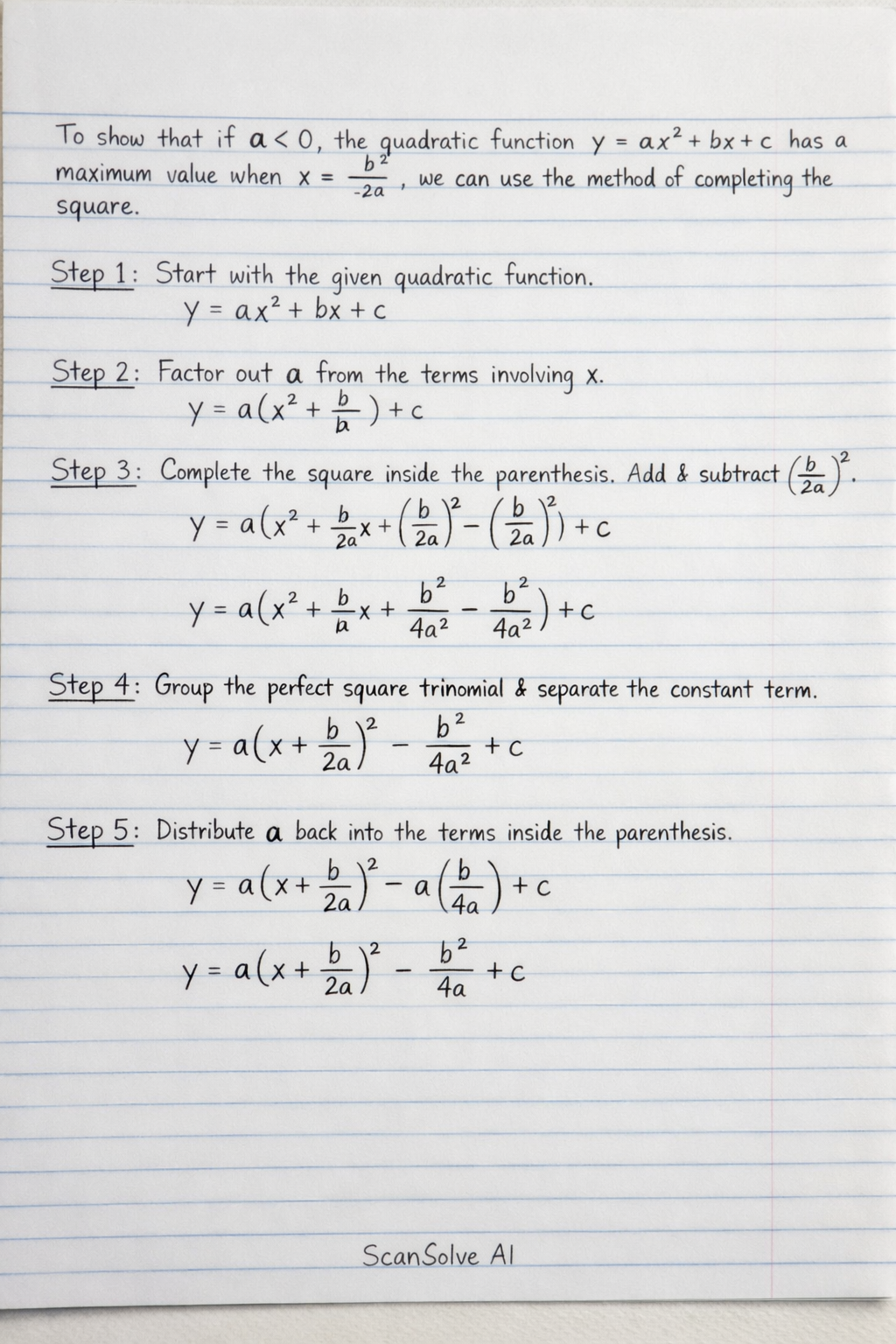
Handwritten Step-by-Step Solution
Get this as a handwritten image on WhatsApp — like a tutor wrote it for you.
Try on WhatsApp