
We read your photo as:
Prove that for any odd integer m, the expression (m4 + 4m2 + 11) / 16 is an integer.
ScanSolve AI Answer
This answer stops before the end.
It was cut off when it was first written. Ask ScanSolve this question again for the full working.
Step 1: Express in terms of an integer .
Since is an odd integer, we can write for some integer .
Step 2: Calculate .
Since and are consecutive integers, one of them must be even. Thus, is always an even number. Let for some integer .
Step 3: Calculate .
Step 4: Substitute and into the given expression.
The expression is .
Substitute the values:
Step 5: Simplify the expression.
Since is an integer, is also an integer.
Therefore, the number is an integer.
The final answer is .
Step 1: Combine the terms under a single square root.
Given are positive real numbers.
We use the property .
Step 2: Multiply the fractions inside the square root.
Step 3: Simplify the expression inside the square root.
Step 4: Evaluate the square root.
Thus, .
The final answer is .
Step 1: Substitute the given value of .
We are given .
We need to find .
Step 2: Calculate .
The final answer is .
Step 1: Start with a known true inequality.
For any real numbers and , the square of their difference is always non-negative:
Step 2: Expand the inequality.
Step 3: Add to both sides.
Step 4: Divide both sides by .
Since and are positive real numbers, is also positive. Dividing by a positive number does not change the direction of the inequality.
Step 5: Separate the terms on the left side and simplify.
This proves the inequality.
The final answer is .
Step 1: Start with a known true inequality.
For any real number , the square of is always non-negative, provided :
Still stuck on this one?
Ask a follow-up, and the answer starts from this question.
More Mathematics Questions
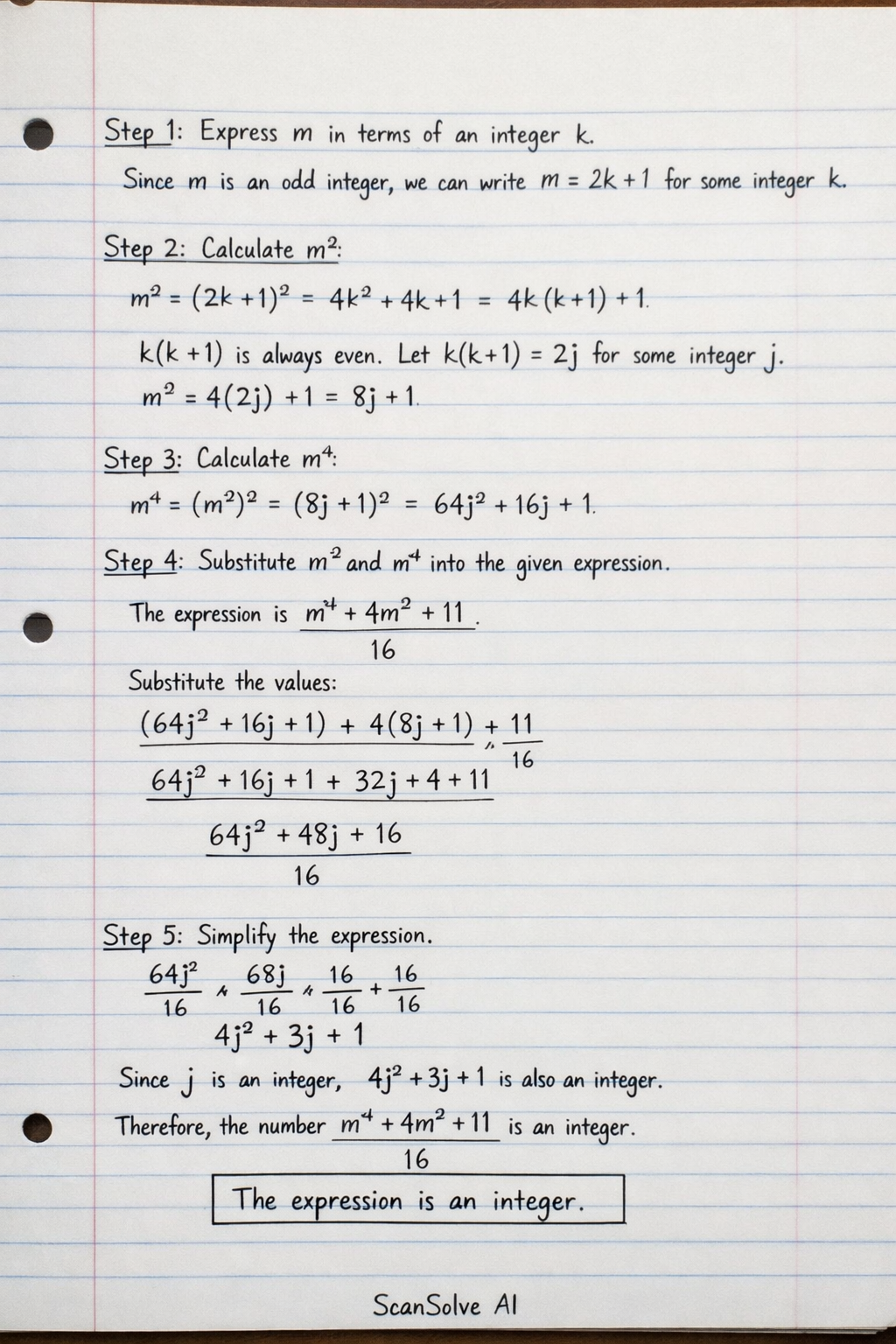
Handwritten Step-by-Step Solution
Get this as a handwritten image on WhatsApp — like a tutor wrote it for you.
Try on WhatsApp