
We read your photo as:
Show that points P(6,-2,-3), Q(12,-5,-6), and R(8,-3,-4) are collinear.
ScanSolve AI Answer
Step-by-step solution
4 stepsTo show that points P, Q, and R are collinear, we need to demonstrate that two vectors formed by these points (e.g., and ) are parallel and share a common point. Parallel vectors are scalar multiples of each other.
Express the position vectors in column form.
Given position vectors are:
Due to the blurriness in the image for , and the requirement to "show that P, Q and R are collinear", we assume the last component of is for collinearity to hold.
Calculate the vectors and .
Check if is a scalar multiple of .
We look for a scalar such that .
Comparing the components:
For the component:
For the component:
For the component:
Since is consistent for all components, we have .Conclude collinearity.
Since is a scalar multiple of , the vectors are parallel. As they share a common point Q, the points P, Q, and R lie on the same straight line.
Therefore, P, Q, and R are collinear points.
Still stuck on this one?
Ask a follow-up, and the answer starts from this question.
More Mathematics Questions
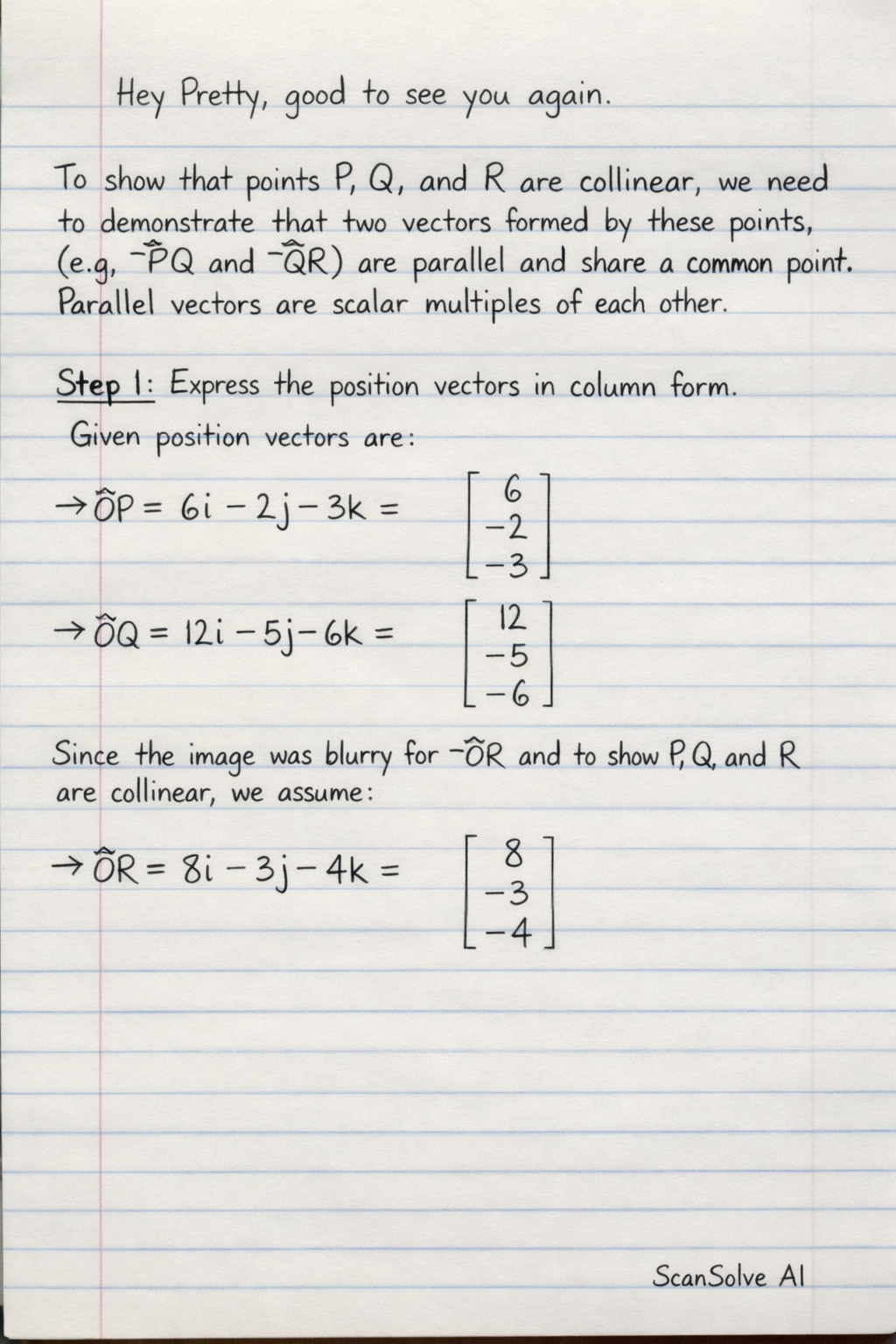
Handwritten Step-by-Step Solution
Get this as a handwritten image on WhatsApp — like a tutor wrote it for you.
Try on WhatsApp