

This mathematics problem involves applying core mathematical principles and formulas. Below you will find a complete step-by-step solution with detailed explanations for each step, helping you understand not just the answer but the method behind it.
ScanSolve AI Answer
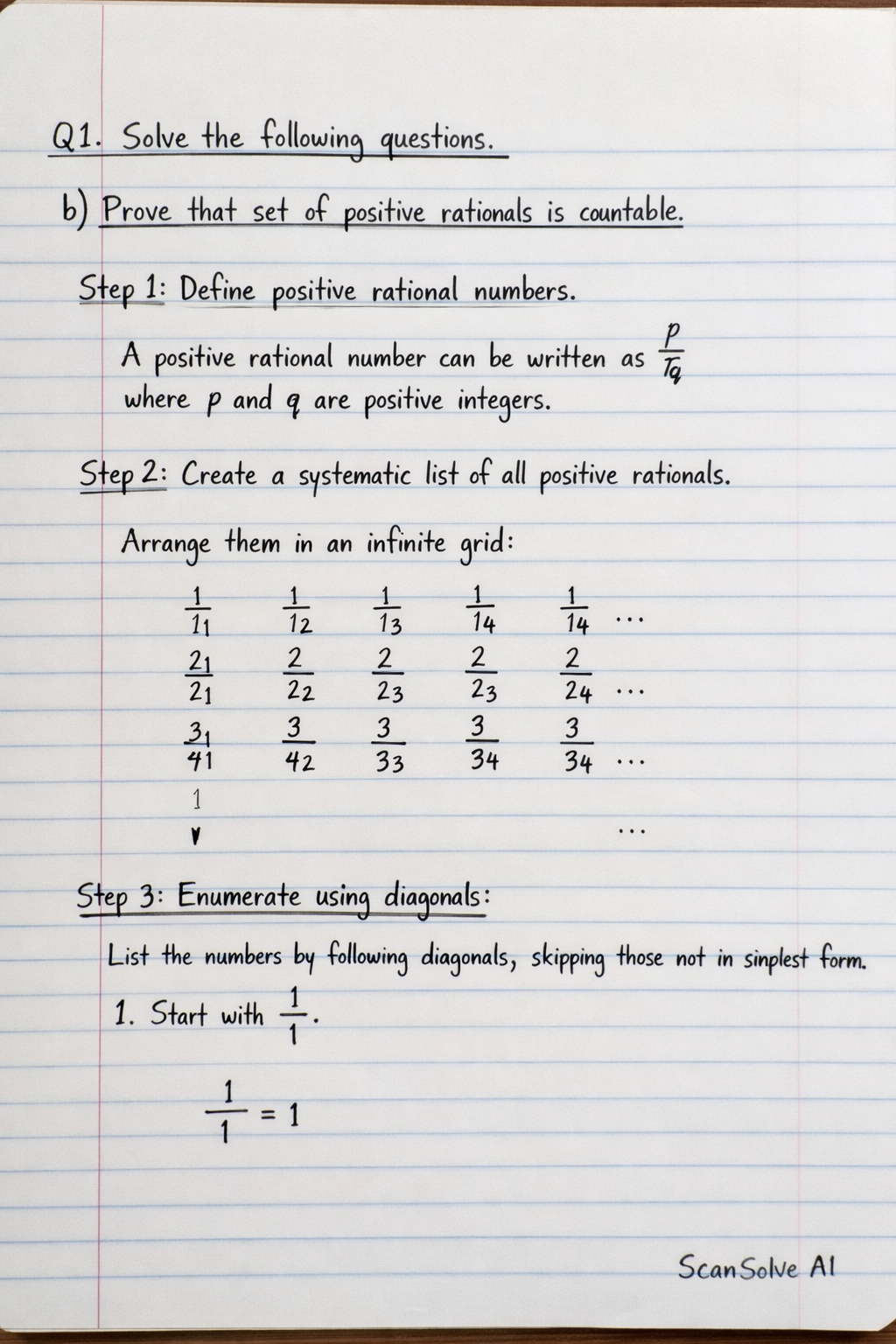
Here are the solutions to the questions from the image: Q1. Solve the following questions. b) Prove that Set of positive rationals is countable. Step 1: Define positive rational numbers. A positive rational number can be written as (p)/(q) where p and q are positive integers. Step 2: Create a systematic way to list all positive rational numbers. We can arrange all positive rational numbers in an infinite grid where the p-th row and q-th column contains the fraction (p)/(q). cccccc (1)/(1) & (1)/(2) & (1)/(3) & (1)/(4) & \\ (2)/(1) & (2)/(2) & (2)/(3) & (2)/(4) & \\ (3)/(1) & (3)/(2) & (3)/(3) & (3)/(4) & \\ (4)/(1) & (4)/(2) & (4)/(3) & (4)/(4) & \\ & & & & Step 3: Use a diagonalization method to enumerate the numbers. We can list these numbers by following diagonals, skipping any fractions that are not in simplest form (to avoid duplicates). 1. Start with (1)/(1). 2. Move to the next diagonal: (1)/(2), then (2)/(1). 3. Move to the next diagonal: (1)/(3), (2)/(2) (skip, as it's (1)/(1)), (3)/(1). 4. Move to the next diagonal: (1)/(4), (2)/(3), (3)/(2), (4)/(1). The sequence of unique positive rational numbers would be: (1)/(1), (1)/(2), (2)/(1), (1)/(3), (3)/(1), (1)/(4), (2)/(3), (3)/(2), (4)/(1), (1)/(5), (5)/(1), Since we can create an ordered list (a bijection with the set of natural numbers) of all positive rational numbers, the set of positive rational numbers is countable. Proven c) Find a formula for the sequence 0, 0, 0, 0, 1, 1, 1, 1, 2, 2, 2, 2, ... Step 1: Observe the pattern of the sequence. The sequence consists of each integer repeated four times: 0, 0, 0, 0 (4 terms) 1, 1, 1, 1 (4 terms) 2, 2, 2, 2 (4 terms) ... Step 2: Determine the value of the n-th term. For the first 4 terms (n=1, 2, 3, 4), the value is 0. For the next 4 terms (n=5, 6, 7, 8), the value is 1. For the next 4 terms (n=9, 10, 11, 12), the value is 2. Step 3: Relate the term number n to the value. The value changes every 4 terms. This suggests using integer division by 4. If n is the term number (starting from n=1): For n=1, 2, 3, 4, the value is 0. (n-1)/4 = 0. For n=5, 6, 7, 8, the value is 1. (n-1)/4 = 1. For n=9, 10, 11, 12, the value is 2. (n-1)/4 = 2. The formula for the n-th term, a_n, is (n-1)/(4) . a_n = (n-1)/(4) for n 1 d) Let us assume that we have a hotel with an infinite many rooms, each occupied by a person. Is it possible to adjust 5 new guests keeping in mind that each room can accommodate a single guest and no old guest will be asked to leave. How? Yes, it is possible. This is a classic problem illustrating the properties of infinite sets, often called Hilbert's Grand Hotel Paradox. Step 1: Understand the current state. The hotel has an infinite number of rooms, R_1, R_2, R_3, , and each room is currently occupied by a guest. Step 2: Make space for the new guests. To accommodate 5 new guests without asking any old guest to leave, we can ask each existing guest to move to a room with a higher number. Specifically, each guest in room R_i moves to room R_i+5. The guest in R_1 moves to R_6. The guest in R_2 moves to R_7. The guest in R_3 moves to R_8. And so on. The guest in R_i moves to R_i+5. Step 3: Accommodate the new guests. After all existing guests have moved, rooms R_1, R_2, R_3, R_4, R_5 will be empty. These 5 empty rooms can then be assigned to the 5 new guests. All old guests remain in the hotel, just in different rooms, and the 5 new guests are accommodated. Yes, it is possible. Each existing guest in room R_i moves to room R_i+5, freeing up rooms R_1 through R_5 for the new guests. e) In how many different orders can five runners finish a race if no ties are allowed? Step 1: Identify the type of problem. This is a permutation problem because the order in which the runners finish matters, and each runner is distinct. Step 2: Determine the number of choices for each position. For the 1st place, there are 5 possible runners. For the 2nd place, there are 4 remaining runners. For the 3rd place, there are 3 remaining runners. For the 4th place, there are 2 remaining runners. For the 5th place, there is 1 remaining runner. Step 3: Calculate the total number of orders. The total number of different orders is the product of the number of choices for each position, which is 5! (5 factorial). 5! = 5 × 4 × 3 × 2 × 1 = 120 There are 120 different orders in which five runners can finish a race. 120 f) What is Inclusion-Exclusion principle? Also find how many bits of string of length 8 start with a 1 bit and end with two bits 00 are possible? The Inclusion-Exclusion Principle is a counting technique used to find the number of elements in the union of multiple finite sets. It states that to find the size of the union of two sets, you sum the sizes of the individual sets and then subtract the size of their intersection to avoid double-counting. For three sets, it involves summing individual sizes, subtracting pairwise intersections, and adding back the intersection of all three. For two sets A and B: |A B| = |A| + |B| - |A B| For three sets A, B, C: |A B C| = |A| + |B| + |C| - (|A B| + |A C| + |B C|) + |A B C| Now, let's find the number of bit strings of length 8 that start with a 1 bit and end with two bits 00. Step 1: Visualize the structure of the bit string. The string has 8 bits: b_1 b_2 b_3 b_4 b_5 b_6 b_7 b_8. Step 2: Apply the given conditions. • Starts with a 1 bit: b_1 = 1. • Ends with two bits 00: b_7 = 0 and b_8 = 0. Step 3: Determine the fixed and variable bits. b_1 is fixed as 1. b_7 is fixed as 0. b_8 is fixed as 0. The remaining bits are b_2, b_3, b_4, b_5, b_6. These 5 bits can be either 0 or 1. Step 4: Calculate the number of possibilities for the variable bits. Each of the 5 variable bits (b_2, b_3, b_4, b_5, b_6) has 2 possible values (0 or 1). So, the number of ways to choose these 5 bits is 2^5. 2^5 = 32 There are 32 such bit strings. Inclusion-Exclusion Principle explained above. Number of bit strings: 32 Q4. What is Bayes Rule for Probability. Prove this rule. Explain it with two examples. Bayes' Rule (or Bayes' Theorem) is a fundamental theorem in probability theory that describes how to update the probability of a hypothesis based on new evidence. It relates the conditional probability of an event A given event B to the conditional probability of event B given event A, and the prior probabilities of A and B. The formula for Bayes' Rule is: P(A|B) = (P(B|A)P(A))/(P(B)) Where: • P(A|B) is the posterior probability: the probability of event A occurring given that event B has occurred. • P(B|A) is the likelihood: the probability of event B occurring given that event A has occurred. • P(A) is the prior probability: the probability of event A occurring independently. • P(B) is the marginal probability: the probability of event B occurring independently. Proof of Bayes' Rule: Step 1: Start with the definition of conditional probability. The conditional probability of A given B is: P(A|B) = (P(A B))/(P(B)) (Equation 1, provided P(B) > 0) The conditional probability of B given A is: P(B|A) = (P(A B))/(P(A)) (Equation 2, provided P(A) > 0) Step 2: Rearrange Equation 2 to express P(A B). From Equation 2, we can write: P(A B) = P(B|A)P(A) Step 3: Substitute this expression for P(A B) into Equation 1. P(A|B) = (P(B|A)P(A))/(P(B)) This completes the proof of Bayes' Rule. Examples: Example 1: Medical Diagnosis Suppose a rare disease affects 1% of the population (P(Disease) = 0.01). A test for the disease is 90% accurate (meaning P(Positive|Disease) = 0.90) and has a 5% false positive rate (meaning P(Positive|No Disease) = 0.05). If a person tests positive, what is the probability they actually have the disease? Let D be the event of having the disease, and T be the event of testing positive. We want to find P(D|T). We know: P(D) = 0.01 P(T|D) = 0.90 P(No D) = 1 - P(D) = 1 - 0.01 = 0.99 P(T|No D) = 0.05 First, calculate P(T) using the law of total probability: P(T) = P(T|D)P(D) + P(T|No D)P(No D) P(T) = (0.90)(0.01) + (0.05)(0.99) P(T) = 0.009 + 0.0495 = 0.0585 Now, apply Bayes' Rule: P(D|T) = (P(T|D)P(D))/(P(T)) = ((0.90)(0.01))/(0.0585) = (0.009)/(0.0585) ≈ 0.1538 So, even with a positive test, there's only about a 15.38% chance the person actually has the disease, due to its rarity and the false positive rate. Example 2: Spam Email Detection Suppose 80% of emails are spam (P(Spam) = 0.80). The word "Viagra" appears in 10% of spam emails (P(Viagra|Spam) = 0.10) and in 1% of non-spam emails (P(Viagra|Non-Spam) = 0.01). If an email contains the word "Viagra", what is the probability it is spam? Let S be the event of an email being spam, and V be the event of containing "Viagra". We want to find P(S|V). We know: P(S) = 0.80 P(V|S) = 0.10 P(Non-Spam) = 1 - P(S) = 1 - 0.80 = 0.20 P(V|Non-Spam) = 0.01 First, calculate P(V): P(V) = P(V|S)P(S) + P(V|Non-Spam)P(Non-Spam) P(V) = (0.10)(0.80) + (0.01)(0.20) P(V) = 0.08 + 0.002 = 0.082 Now, apply Bayes' Rule: P(S|V) = (P(V|S)P(S))/(P(V)) = ((0.10)(0.80))/(0.082) =