
We read your photo as:
Show that triangle ADF is similar to triangle ABE and complete the table for y = 2x − 3.
ScanSolve AI Answer
Use the left and right arrow keys to trace the curve, up and down to jump between key points, and plus and minus to zoom.
| Point | x | y |
|---|---|---|
| y-intercept | 0 | −3 |
| x-intercept | 1.5 | 0 |
Step-by-step solution
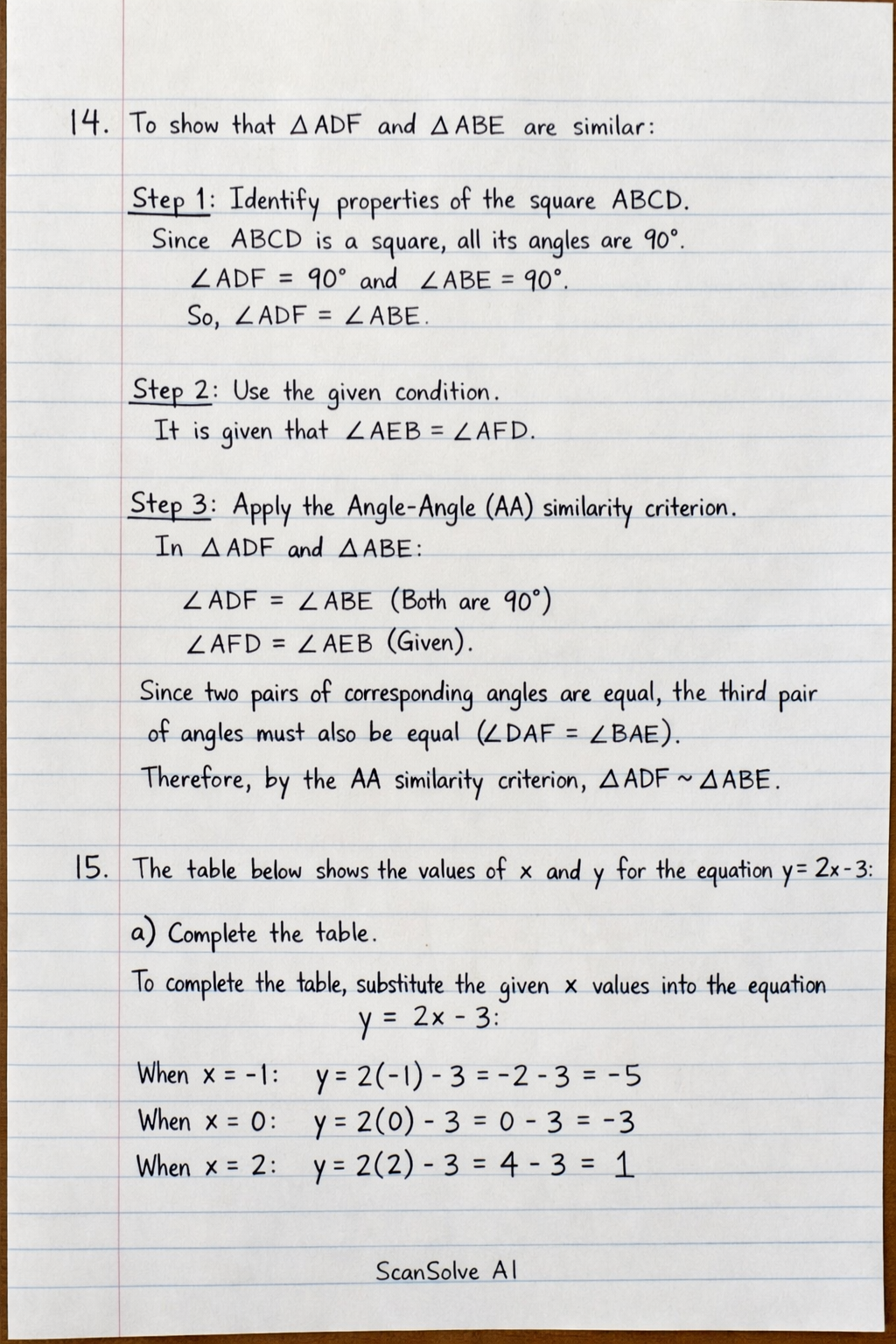
5 steps14. To show that and are similar:
Step 1: Identify properties of the square ABCD.
Since ABCD is a square, all its angles are .
Therefore, and .
So, .
Step 2: Use the given condition.
It is given that .
Step 3: Apply the Angle-Angle (AA) similarity criterion.
In and :
- (Both are angles of the square).
- (Given).
Since two pairs of corresponding angles are equal, the third pair of angles must also be equal ().
Therefore, by the AA similarity criterion, is similar to .
15. The table below shows the values of and for the equation .
Part a
Complete the table.
To complete the table, substitute the given values into the equation .
When :
When :
When :
The completed table is:
| 0 | 1 | 2 | |
|---|---|---|---|
| -3 | -1 | 1 |
Part b· 5 steps
Using a scale of 2 cm to represent 1 unit on both axes, draw the graph of on page 7.
To draw the graph:
Draw a horizontal x-axis and a vertical y-axis on your graph paper.
Label the x-axis and y-axis.
Apply the given scale
For every 2 cm along an axis, mark 1 unit. For example, mark 0, 1, 2, 3... on the positive x-axis and -1, -2, -3... on the negative x-axis, with 2 cm spacing between each integer. Do the same for the y-axis.
Plot the points from the completed table
, , and .
Draw a straight line that passes through all three plotted points.
This line represents the graph of .
Still stuck on this one?
Ask a follow-up, and the answer starts from this question.
More Mathematics Questions
Handwritten Step-by-Step Solution
Get this as a handwritten image on WhatsApp — like a tutor wrote it for you.
Try on WhatsApp