
The 2nd 3rd and 14th term of an AP are 3concecutive term ofaGP the 10ty term of AP is 18 find first term and common different of the progration
ScanSolve AI Answer
Step-by-step solution
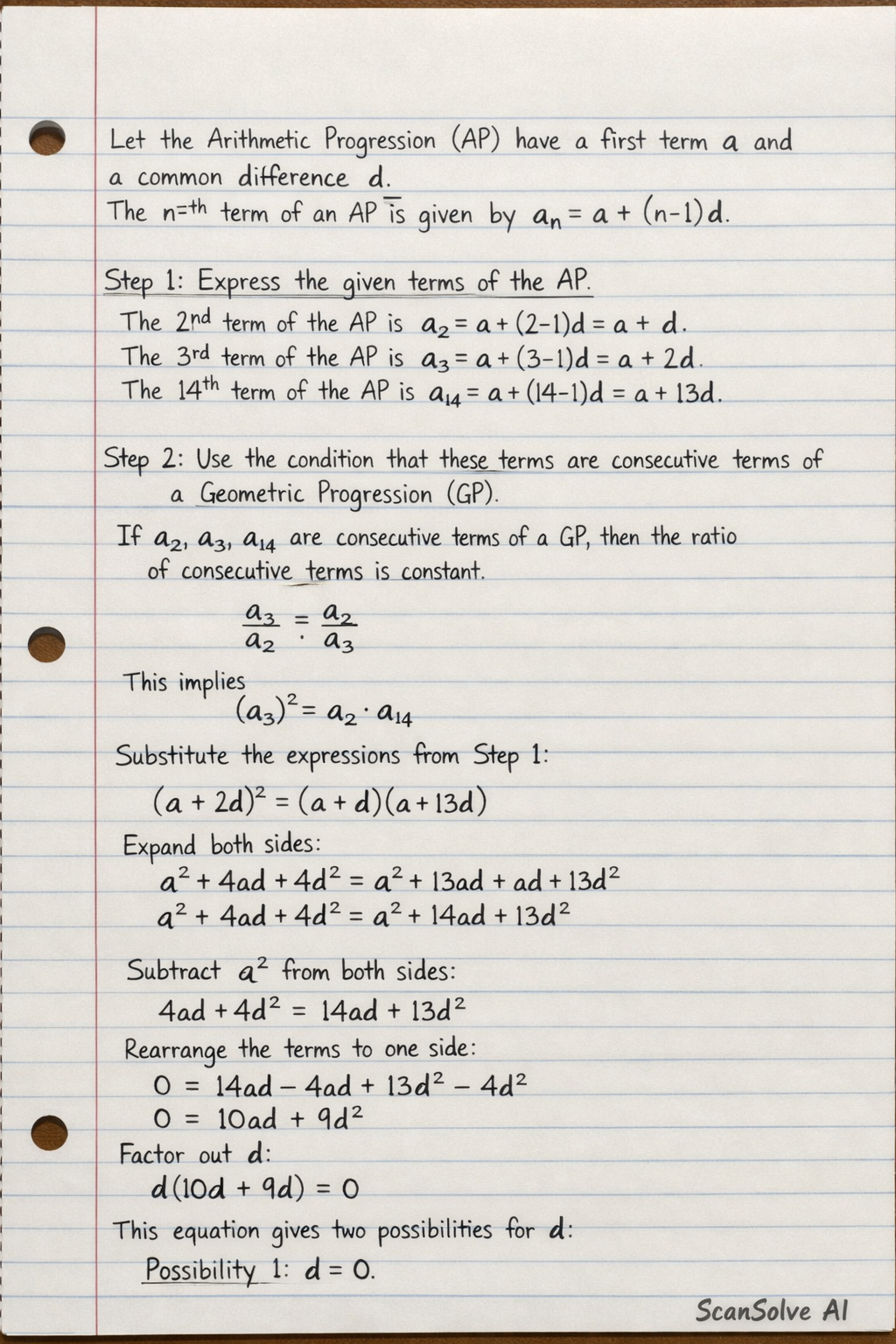
4 stepsLet the Arithmetic Progression (AP) have a first term and a common difference .
The -th term of an AP is given by .
Express the given terms of the AP.
The 2nd term of the AP is .
The 3rd term of the AP is .
The 14th term of the AP is .Use the condition that these terms are consecutive terms of a Geometric Progression (GP).
If are consecutive terms of a GP, then the ratio of consecutive terms is constant.
This implies .
Substitute the expressions from Step 1:Expand both sides:
Subtract from both sides:
Rearrange the terms to one side:
Factor out :
This equation gives two possibilities for :
Possibility 1:
Possibility 2:Use the information about the 10th term of the AP.
The 10th term of the AP is 18.
So, we have the equation:
Solve for and using both possibilities.
-
Case 1: Substitute into the equation :
In this case, the first term is 18 and the common difference is 0.
-
Case 2: From this equation, express in terms of :
Now substitute this expression for into the equation :
To eliminate the fraction, multiply the entire equation by 10:
Simplify the fraction by dividing both numerator and denominator by 9:
Now find using :
In this case, the first term is -2 and the common difference is .
There are two possible pairs for the first term and common difference of the progression.
The first term and common difference are:
- ,
- ,
-
Still stuck on this one?
Ask a follow-up, and the answer starts from this question.
More Mathematics Questions
Handwritten Step-by-Step Solution
Get this as a handwritten image on WhatsApp — like a tutor wrote it for you.
Try on WhatsApp