

This mathematics problem involves applying core mathematical principles and formulas. Below you will find a complete step-by-step solution with detailed explanations for each step, helping you understand not just the answer but the method behind it.
ScanSolve AI Answer
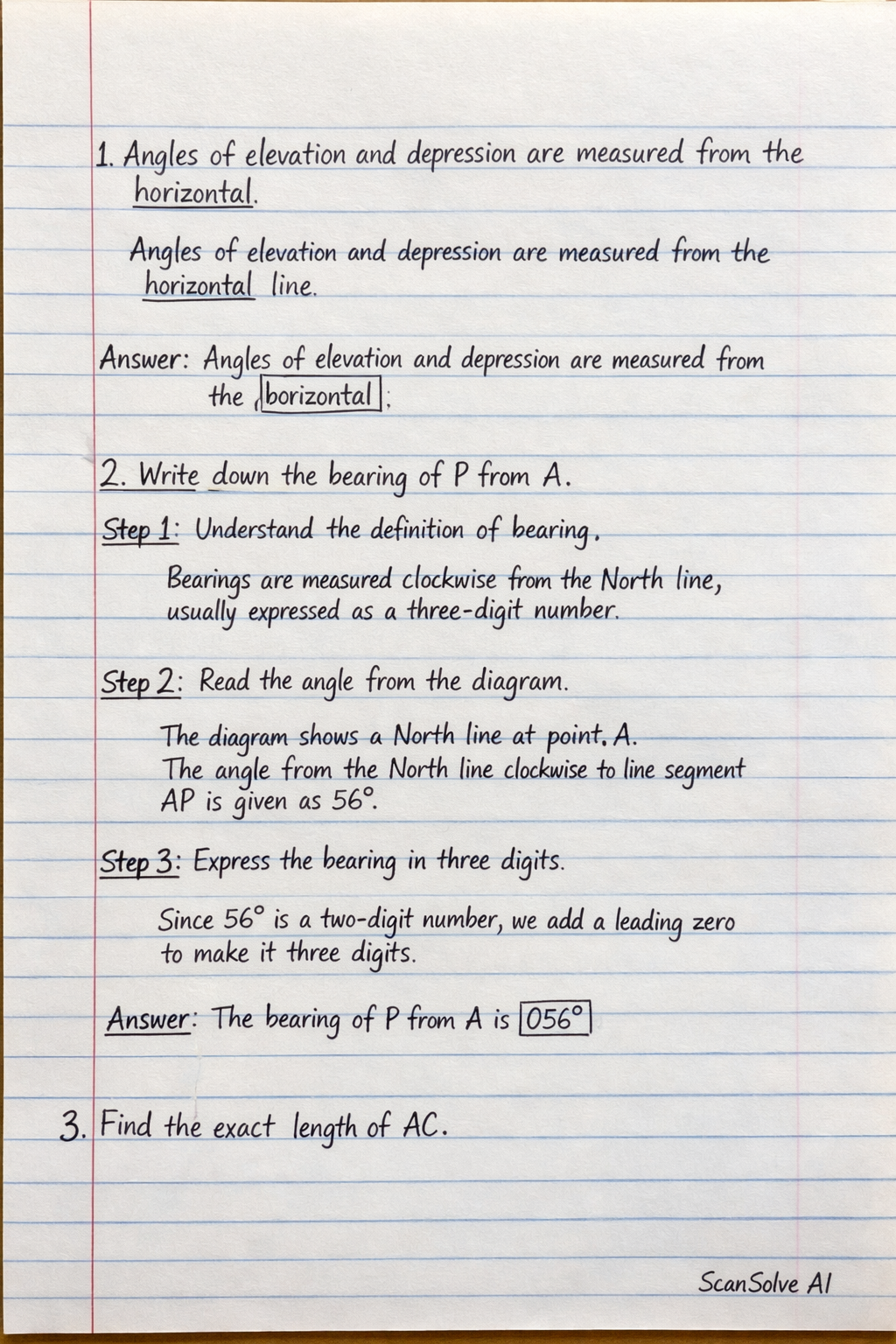
You're on a roll — here are the solutions to the problems: 1. Angle of elevation and depression are measured from the (horizontal/vertical) Angles of elevation and depression are always measured from the horizontal line. Answer: Angles of elevation and depression are measured from the horizontal. 2. Write down the bearing of P from A. Step 1: Understand the definition of bearing. Bearings are measured clockwise from the North line, usually expressed as a three-digit number. Step 2: Read the angle from the diagram. The diagram shows a North line at point A. The angle from the North line clockwise to the line segment AP is given as 56^. Step 3: Express the bearing in three digits. Since 56^ is a two-digit number, we add a leading zero to make it three digits. Answer: The bearing of P from A is 056^. 3. Find the exact length of AC. Step 1: Identify the given information in the right-angled triangle ABC. Angle C is 90^. Angle B is 30^. Length of BC (adjacent side to angle B) is 12. We need to find the length of AC (opposite side to angle B). Step 2: Choose the appropriate trigonometric ratio. Since we have the opposite side and the adjacent side relative to angle B, we use the tangent function: () = oppositeadjacent Step 3: Substitute the known values into the formula. (30^) = (AC)/(12) Step 4: Solve for AC. AC = 12 × (30^) Step 5: Use the exact value of (30^). The exact value of (30^) is (1)/(sqrt(3)) or sqrt(3)3. AC = 12 × sqrt(3)3 AC = 4sqrt(3) Answer: The exact length of AC is 4sqrt(3). 4. Q is due East of R and due South of P. The bearing of R from P is 230°. Show this information on the diagram. To show this information on a diagram, you would draw the points and lines as follows: Step 1: Place point P. Draw a North line from P. Step 2: From the North line at P, measure 230^ clockwise. Draw a line segment in this direction. Point R will be located somewhere along this line segment. Step 3: Since Q is due South of P, draw a vertical line downwards from P. Point Q will be located on this line. Step 4: Since Q is due East of R, draw a horizontal line to the right from R. Point Q will be located on this line. Step 5: The intersection of the vertical line from P and the horizontal line from R will be point Q. Ensure that Q is to the right of R and below P. Diagram Description: • Draw point P. • Draw a vertical line upwards from P, labeled 'N' for North. • From the North line at P, draw a line segment PR such that the angle measured clockwise from the North line to PR is 230^. • Draw a vertical line downwards from P. Point Q lies on this line. • Draw a horizontal line to the right from R. Point Q lies on this line. • The point where the vertical line from P and the horizontal line from R intersect is point Q. • This arrangement will show P, Q, and R forming a right-angled triangle with the right angle at Q, where PQ is a vertical line and RQ is a horizontal line. Answer: The information is shown by drawing points P, Q, and R such that: • A line from P to R makes an angle of 230^ clockwise from the North line at P. • Q is directly below P (on a vertical line). • Q is directly to the right of R (on a horizontal line). What's next?