We read your photo as:

Define sin θ in a right-angled triangle. 2. Calculate tan 60°. 3. Given cot θ = 12/5 and 180° < θ < 360°, find cos θ. 4. Solve 2 sin(x+10°) = 1.532.

Mathematics

ScanSolve AI Answer

Answers

5 parts
1.2

3\sqrt{3}

1.3

−1213-\frac{12}{13}

2.1

40.0∘40.0^\circ

2.2

16\frac{1}{6}

3.2

35.0 m35.0 \text{ m}

Step-by-step solution

14 steps

Part 1

Part 1.1

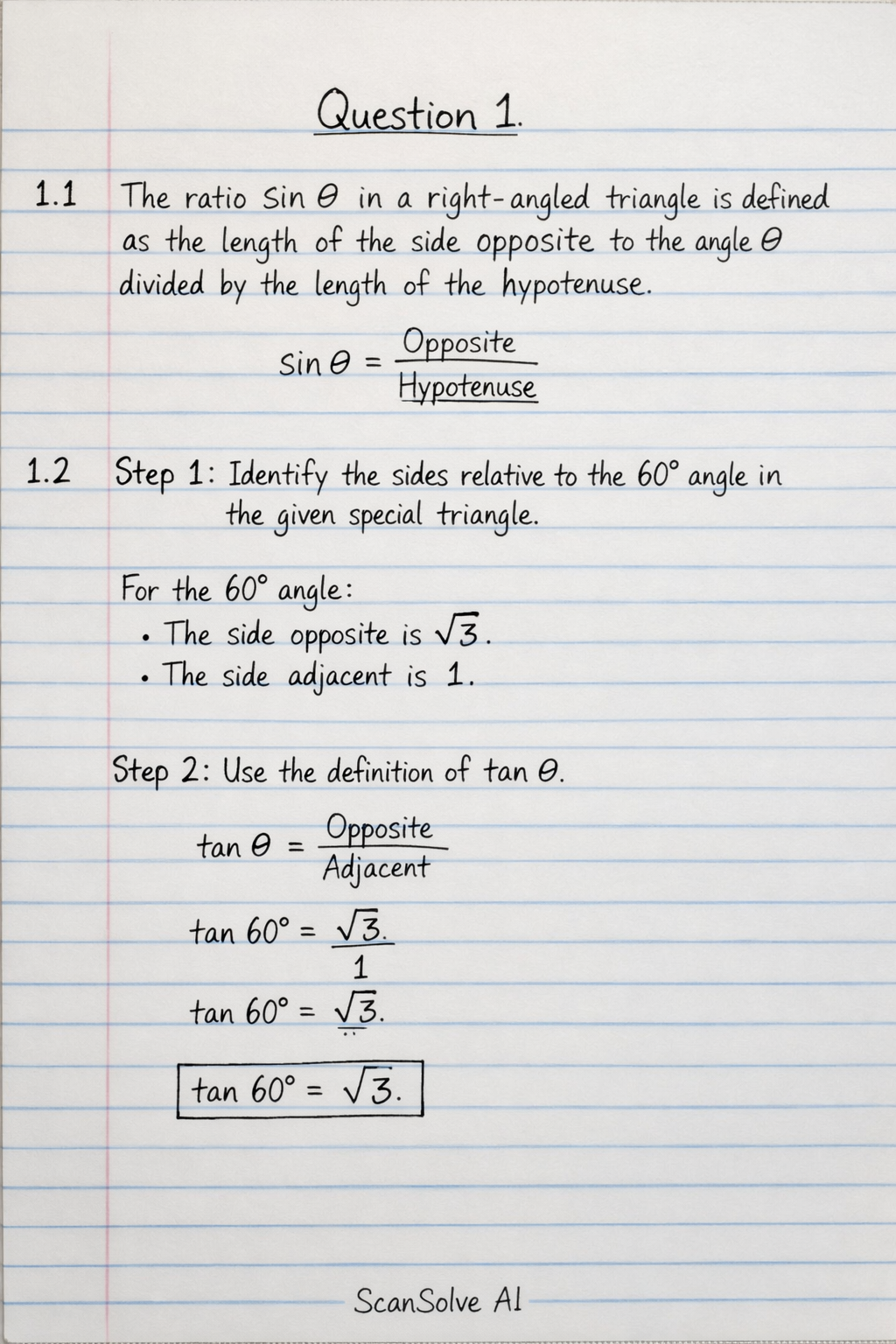
The ratio sin⁡θ\sin \theta in a right-angled triangle is defined as the length of the side opposite to the angle θ\theta divided by the length of the hypotenuse.

sin⁡θ=OppositeHypotenuse\sin \theta = \frac{\text{Opposite}}{\text{Hypotenuse}}

Part 1.2

3\sqrt{3}

  1. Identify the sides relative to the 60∘60^\circ angle in the given special triangle.

    For the 60∘60^\circ angle:

    • The side opposite is 3\sqrt{3}.
    • The side adjacent is 1.
  2. Use the definition of tan⁡θ\tan \theta.

    tan⁡θ=OppositeAdjacent\tan \theta = \frac{\text{Opposite}}{\text{Adjacent}} tan⁡60∘=31\tan 60^\circ = \frac{\sqrt{3}}{1} tan⁡60∘=3\tan 60^\circ = \boxed{\sqrt{3}}

Part 1.3

−1213-\frac{12}{13}

  1. Use the given information to determine the quadrant and coordinates.

    Given cot⁡θ=125\cot \theta = \frac{12}{5} and 180∘<θ<360∘180^\circ < \theta < 360^\circ.
    Since cot⁡θ\cot \theta is positive, θ\theta must be in Quadrant III (where both xx and yy are negative).
    We know cot⁡θ=xy\cot \theta = \frac{x}{y}. So, we can set x=−12x = -12 and y=−5y = -5.

  2. Calculate the hypotenuse rr.

    Using the Pythagorean theorem r2=x2+y2r^2 = x^2 + y^2:

    r2=(−12)2+(−5)2r^2 = (-12)^2 + (-5)^2 r2=144+25r^2 = 144 + 25 r2=169r^2 = 169 r=169r = \sqrt{169} r=13r = 13
  3. Determine the value of cos⁡θ\cos \theta.

    cos⁡θ=xr\cos \theta = \frac{x}{r} cos⁡θ=−1213\cos \theta = \frac{-12}{13} cos⁡θ=−1213\cos \theta = \boxed{-\frac{12}{13}}

Part 2

Part 2.1

40.0∘40.0^\circ

  1. Isolate sin⁡(x+10∘)\sin(x+10^\circ).

    2sin⁡(x+10∘)=1.5322 \sin(x+10^\circ) = 1.532 sin⁡(x+10∘)=1.5322\sin(x+10^\circ) = \frac{1.532}{2} sin⁡(x+10∘)=0.766\sin(x+10^\circ) = 0.766
  2. Find the reference angle.

    Let α=x+10∘\alpha = x+10^\circ.

    α=arcsin⁡(0.766)\alpha = \arcsin(0.766) α≈49.99∘\alpha \approx 49.99^\circ
  3. Find xx within the given range 0∘<x<90∘0^\circ < x < 90^\circ.

    Since 0∘<x<90∘0^\circ < x < 90^\circ, then 10∘<x+10∘<100∘10^\circ < x+10^\circ < 100^\circ.
    Since sin⁡(x+10∘)\sin(x+10^\circ) is positive, x+10∘x+10^\circ can be in Quadrant I or Quadrant II.
    For Quadrant I:

    x+10∘=49.99∘x+10^\circ = 49.99^\circ x=49.99∘−10∘x = 49.99^\circ - 10^\circ x=39.99∘x = 39.99^\circ

    Rounding to one decimal place:

    x=40.0∘x = \boxed{40.0^\circ}

    (The Quadrant II solution x+10∘=180∘−49.99∘=130.01∘  ⟹  x=120.01∘x+10^\circ = 180^\circ - 49.99^\circ = 130.01^\circ \implies x = 120.01^\circ is outside the given range for xx.)

Part 2.2

16\frac{1}{6}

  1. Recall the values of special angles.

    sin⁡45∘=22\sin 45^\circ = \frac{\sqrt{2}}{2} cos⁡45∘=22\cos 45^\circ = \frac{\sqrt{2}}{2} tan⁡60∘=3\tan 60^\circ = \sqrt{3} cot⁡30∘=1tan⁡30∘=11/3=3\cot 30^\circ = \frac{1}{\tan 30^\circ} = \frac{1}{1/\sqrt{3}} = \sqrt{3}
  2. Substitute the values into the expression.

    sin⁡45∘⋅cos⁡45∘tan⁡60∘⋅cot⁡30∘=(22)⋅(22)3⋅3\frac{\sin 45^\circ \cdot \cos 45^\circ}{\tan 60^\circ \cdot \cot 30^\circ} = \frac{\left(\frac{\sqrt{2}}{2}\right) \cdot \left(\frac{\sqrt{2}}{2}\right)}{\sqrt{3} \cdot \sqrt{3}}
  3. Simplify the expression.

    =243= \frac{\frac{2}{4}}{3} =123= \frac{\frac{1}{2}}{3} =12×13= \frac{1}{2} \times \frac{1}{3} =16= \boxed{\frac{1}{6}}

Part 3

Part 3.1

A neat, labeled diagram representing the scenario:

\begin{tikzpicture} \coordinate (A) at (0,0); \coordinate (B) at (5,0); \coordinate (C) at (5,3.5); \draw (A) node[below] {A} -- (B) node[below] {B} -- (C) node[right] {C} -- cycle; \draw (B) rectangle +(0.2,0.2); \draw (A) -- (C); \pic [draw, angle radius=1cm, "35$^\circ$"] {angle = C--A--B}; \node at (2.5,-0.3) {50 m}; \node at (5.3,1.75) {BC}; \end{tikzpicture}

(Diagram shows a right-angled triangle ABC, with angle B = 90 degrees, AB = 50m, angle A = 35 degrees, and BC as the height of the tower.)

Part 3.2

35.0 m35.0 \text{ m}

  1. Identify the relevant trigonometric ratio.

    In the right-angled triangle △ABC\triangle ABC, we have the adjacent side AB=50AB = 50 m and the angle ∠A=35∘\angle A = 35^\circ. We need to find the opposite side BCBC.
    We use the tangent function: tan⁡A=OppositeAdjacent\tan A = \frac{\text{Opposite}}{\text{Adjacent}}.

    tan⁡35∘=BCAB\tan 35^\circ = \frac{BC}{AB}
  2. Substitute values and solve for BCBC.

    tan⁡35∘=BC50 m\tan 35^\circ = \frac{BC}{50 \text{ m}} BC=50 m×tan⁡35∘BC = 50 \text{ m} \times \tan 35^\circ BC≈50 m×0.7002075BC \approx 50 \text{ m} \times 0.7002075 BC≈35.010375 mBC \approx 35.010375 \text{ m}

    Rounding to one decimal place:

    BC=35.0 mBC = \boxed{35.0 \text{ m}}

Part 3.3· 1 step

  1. Set up the new scenario with point D.

    Assume point

Was this helpful?

Still stuck on this one?

Ask a follow-up, and the answer starts from this question.

Got a different question?Ask your own question
Handwritten step-by-step solution preview

Handwritten Step-by-Step Solution

Get this as a handwritten image on WhatsApp — like a tutor wrote it for you.

Try on WhatsApp