
We read your photo as:
The average volume of a cone with radius r and height h is given by the formula V = (1)/(3) pi r2 h.
ScanSolve AI Answer
Answer
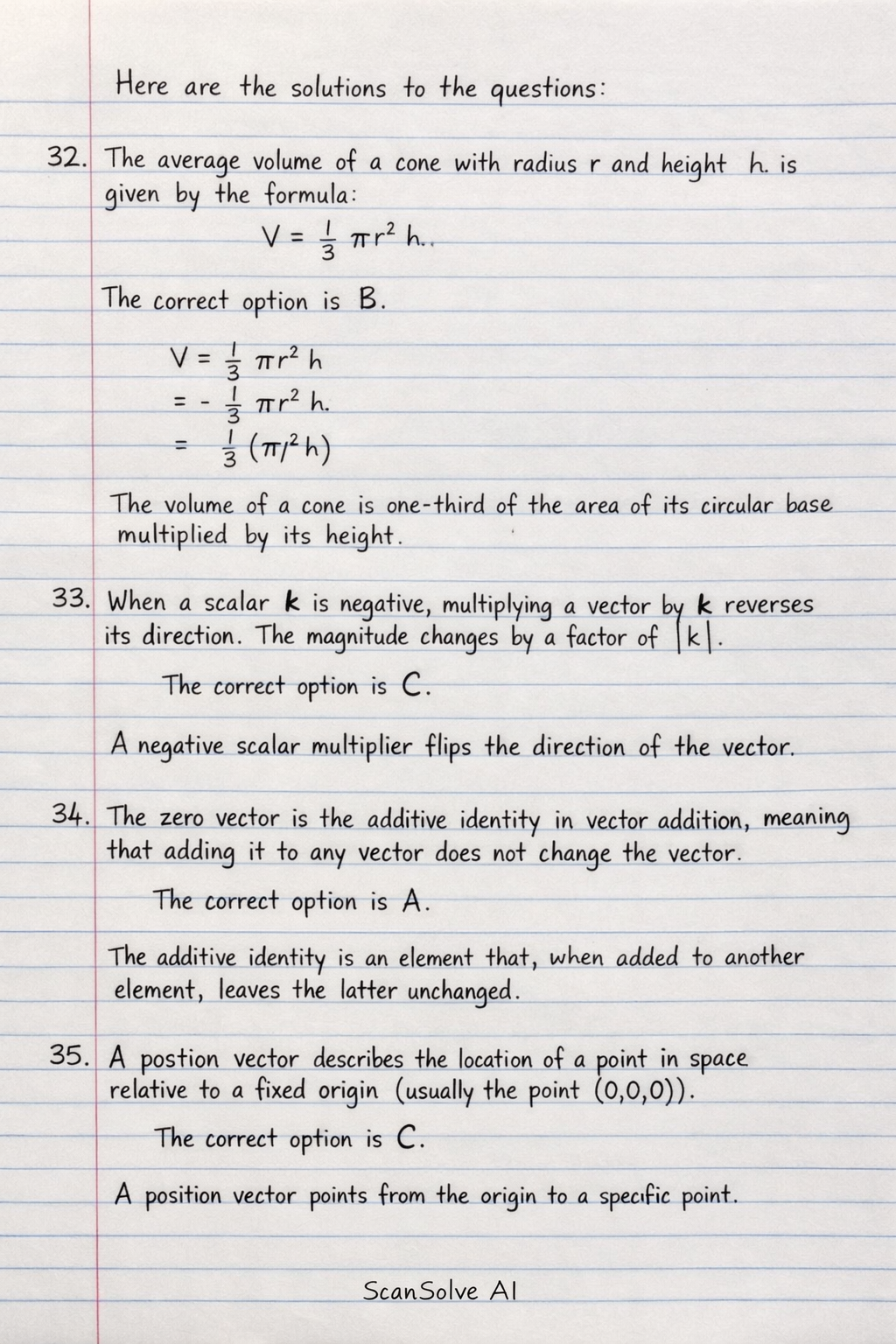
Here are the solutions to the questions:
32. The average volume of a cone with radius and height is given by the formula .
The correct option is B.
- The volume of a cone is one-third of the area of its circular base multiplied by its height.
33. When a scalar is negative, multiplying a vector by reverses its direction. The magnitude changes by a factor of .
The correct option is C.
- A negative scalar multiplier flips the direction of the vector.
34. The zero vector is the additive identity in vector addition, meaning that adding it to any vector does not change the vector.
The correct option is A.
- The additive identity is an element that, when added to another element, leaves the latter unchanged.
35. A position vector describes the location of a point in space relative to a fixed origin (usually the point ).
The correct option is C.
- A position vector points from the origin to a specific point.
36. In a geometric progression, each term is obtained by multiplying the previous term by a constant value, known as the common ratio.
The correct option is C.
- This constant multiplier is called the common ratio.
37. The sequence given is .
Let's check the ratio between consecutive terms: , , .
This is a geometric progression with a common ratio of 3. The question asks for the "common difference", which is typically for an arithmetic progression. Assuming this is a typo and it meant "common ratio", the value is 3.
The correct option is B.
- The sequence is a geometric progression, and its *common
Try one yourself
A new problem that tests the same skill.
Still stuck on this one?
Ask a follow-up, and the answer starts from this question.
More Mathematics Questions
Handwritten Step-by-Step Solution
Get this as a handwritten image on WhatsApp — like a tutor wrote it for you.
Try on WhatsApp