

This mathematics problem involves applying core mathematical principles and formulas. Below you will find a complete step-by-step solution with detailed explanations for each step, helping you understand not just the answer but the method behind it.
ScanSolve AI Answer
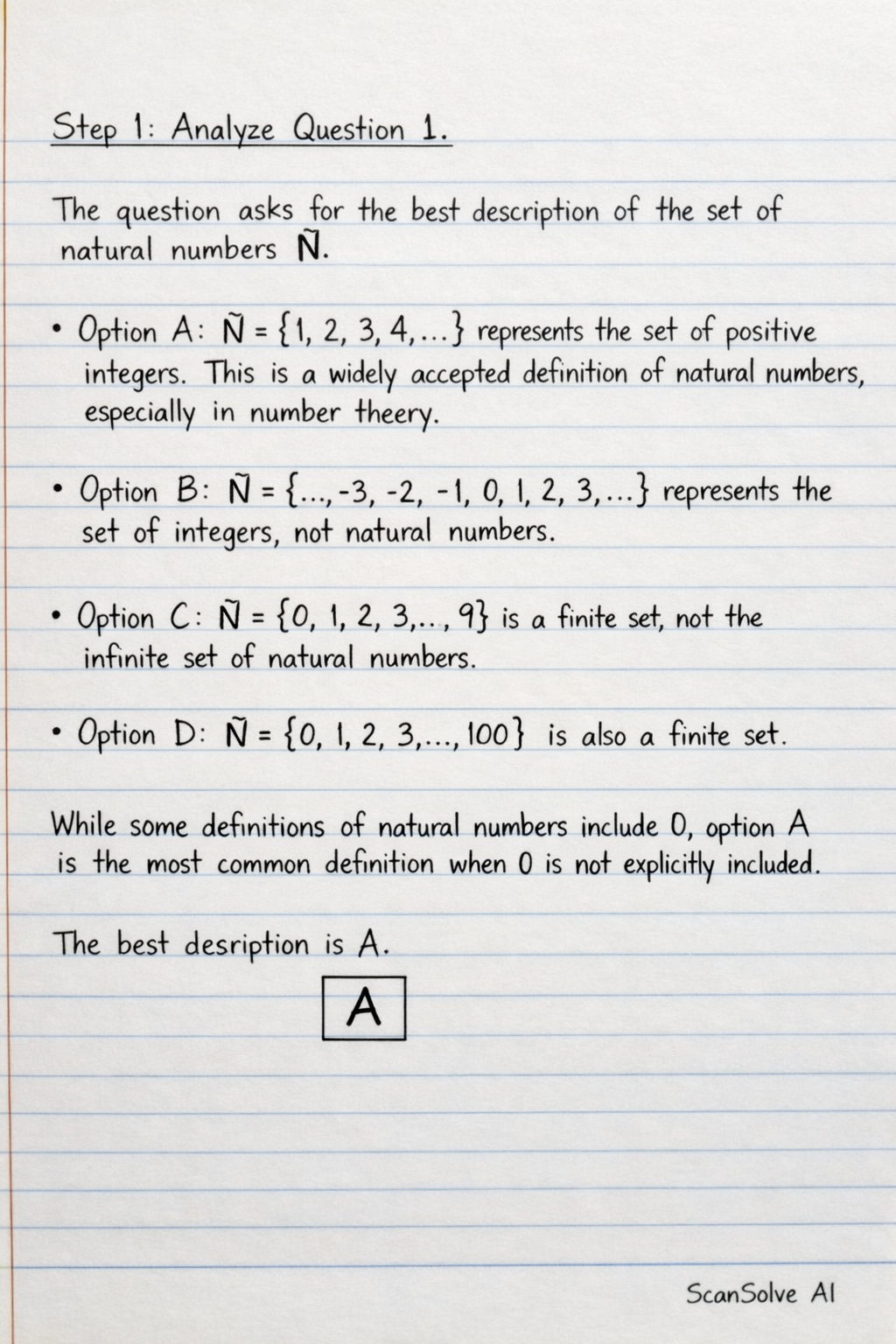
Step 1: Analyze Question 1. The question asks for the best description of the set of natural numbers N. • Option A: N = \1, 2, 3, 4, ...\ represents the set of positive integers. This is a widely accepted definition of natural numbers, especially in number theory. • Option B: N = \..., -3, -2, -1, 0, 1, 2, 3, ...\ represents the set of integers, not natural numbers. • Option C: N = \0, 1, 2, 3, ..., 9\ is a finite set, not the infinite set of natural numbers. • Option D: N = \0, 1, 2, 3, ..., 100\ is also a finite set. While some definitions of natural numbers include 0, option A is the most common definition when 0 is not explicitly included. The best description is A. A Step 2: Analyze Question 2. The question asks why the equation ax b ±od n is a linear congruence. • A congruence is "linear" if the variable x has an exponent of 1. This means it is of the first degree in x. • Option A: "It is of the first degree in x" directly explains why it is called linear. • Option B: "a, b, and n are all integers" is true for any congruence, not specific to linear ones. • Option C: "It involves x and n" is also true for any congruence. • Option D: "It has a unique solution" is not always true for linear congruences; the existence and uniqueness of solutions depend on (a, n). The reason it is a linear congruence is that it is of the first degree in x. A Step 3: Analyze Question 3. Given a 3 ±od 7 and b 2 ±od 7, we need to find ab ±od 7. To multiply in modular arithmetic, we multiply the remainders: ab (3)(2) ±od 7 ab 6 ±od 7 The value of ab modulo 7 is 6. The correct option is C. C Step 4: Analyze Question 4. The question asks which statements are true about the Peano axioms. • Statement I: 0 is a natural number. The most common modern formulation of the Peano axioms defines the set of natural numbers N starting with 0. So, under this formulation, 0 is a natural number. • Statement II: Every natural number has a unique successor. The Peano axioms state that every natural number n has a successor S(n), and if S(n) = S(m), then n = m. This implies that each natural number has one and only one successor. This statement is true. • Statement III: Every natural number has an additive inverse in N. An additive inverse for a number n is a number m such that n+m=0. For example, the additive inverse of 1 is -1. However, negative numbers are not part of the set of natural numbers N. Therefore, this statement is false. Based on the common formulation of Peano axioms, statements I and II are true, while statement III is false. Thus, "I and II only" is the correct choice. The correct option is D. D