
We read your photo as:
What are the definitions of regular and irregular polygons, a pentagon, and how to find the value of x in a quadrilateral?
ScanSolve AI Answer
Answer
Step-by-step solution
7 stepshere are the solutions to the questions:
-
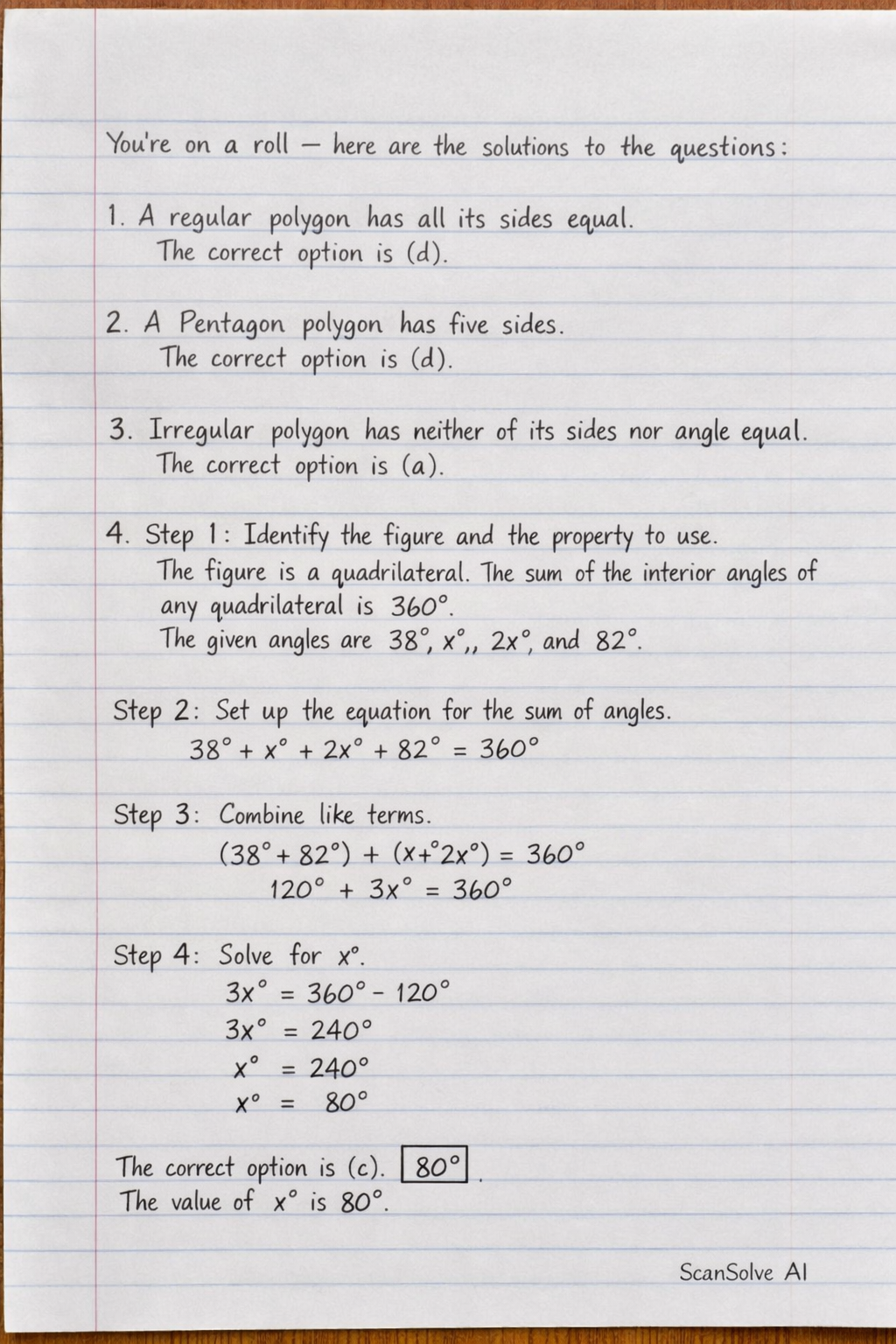
A regular polygon has all its sides equal. The correct option is (d).
-
A Pentagon polygon has five sides. The correct option is (d).
-
Irregular polygon has neither of its sides nor angle equal. The correct option is (a).
-
Step 1: Identify the figure and the property to use. The figure is a quadrilateral. The sum of the interior angles of any quadrilateral is . The given angles are , , , and .
Set up the equation for the sum of angles.
$$ 38^\circ + x^\circ + 2x^\circ + 82^\circ = 360^\circ $$Combine like terms.
$$ (38^\circ + 82^\circ) + (x^\circ + 2x^\circ) = 360^\circ $$ $$ 120^\circ + 3x^\circ = 360^\circ $$Solve for .
$$ 3x^\circ = 360^\circ - 120^\circ $$ $$ 3x^\circ = 240^\circ $$ $$ x^\circ = \frac{240^\circ}{3} $$ $$ x^\circ = 80^\circ $$ The correct option is (c). The value of $x^\circ$ is $\boxed{\text{80}^\circ}$.5. Step 1: Recall the formula for the volume of a cuboid. The volume () of a cuboid is given by the formula:
Substitute the given values into the formula.
Given: $V = 270\text{m}^3$, length ($l$) $= 9\text{m}$, breadth ($b$) $= 5\text{m}$. $$ 270\text{m}^3 = 9\text{m} \times 5\text{m} \times \text{height} $$Calculate the height.
$$ 270\text{m}^3 = 45\text{m}^2 \times \text{height} $$ $$ \text{height} = \frac{270\text{m}^3}{45\text{m}^2} $$ $$ \text{height} = 6\text{m} $$ The height of the cuboid is $\boxed{\text{6m}}$.6. a) How many sides does the polygon have?
Use the formula for the sum of interior angles of a polygon.
The sum of the interior angles of a polygon with $n$ sides is given by: $$ \text{Sum} = (n-2) \times 180^\circ $$Substitute the given sum and solve for .
Given sum $= 198^\circ$.
$$
198^\circ = (n-2) \times 180^\circ
$$
$$
\frac{198^\circ}{180^\circ} = n-2
$$
$$
1.1 = n-2
$$
$$
n = 1.1 + 2
$$
$$
n = 3.1
$$
Since the number of sides of a polygon must be a whole number, a polygon with a sum of angles equal to $198^\circ$ does not exist. The smallest sum of angles for a polygon (a triangle) is $180^\circ$.

**b)** What is the value of t in the diagram?
The diagram for this part of the question is missing from the image provided.
Try one yourself
A new problem that tests the same skill.
Still stuck on this one?
Ask a follow-up, and the answer starts from this question.
More Mathematics Questions
Handwritten Step-by-Step Solution
Get this as a handwritten image on WhatsApp — like a tutor wrote it for you.
Try on WhatsApp