
We read your photo as:
What is the degree of each polynomial and which expressions are polynomials with reasons?
ScanSolve AI Answer
Step-by-step solution
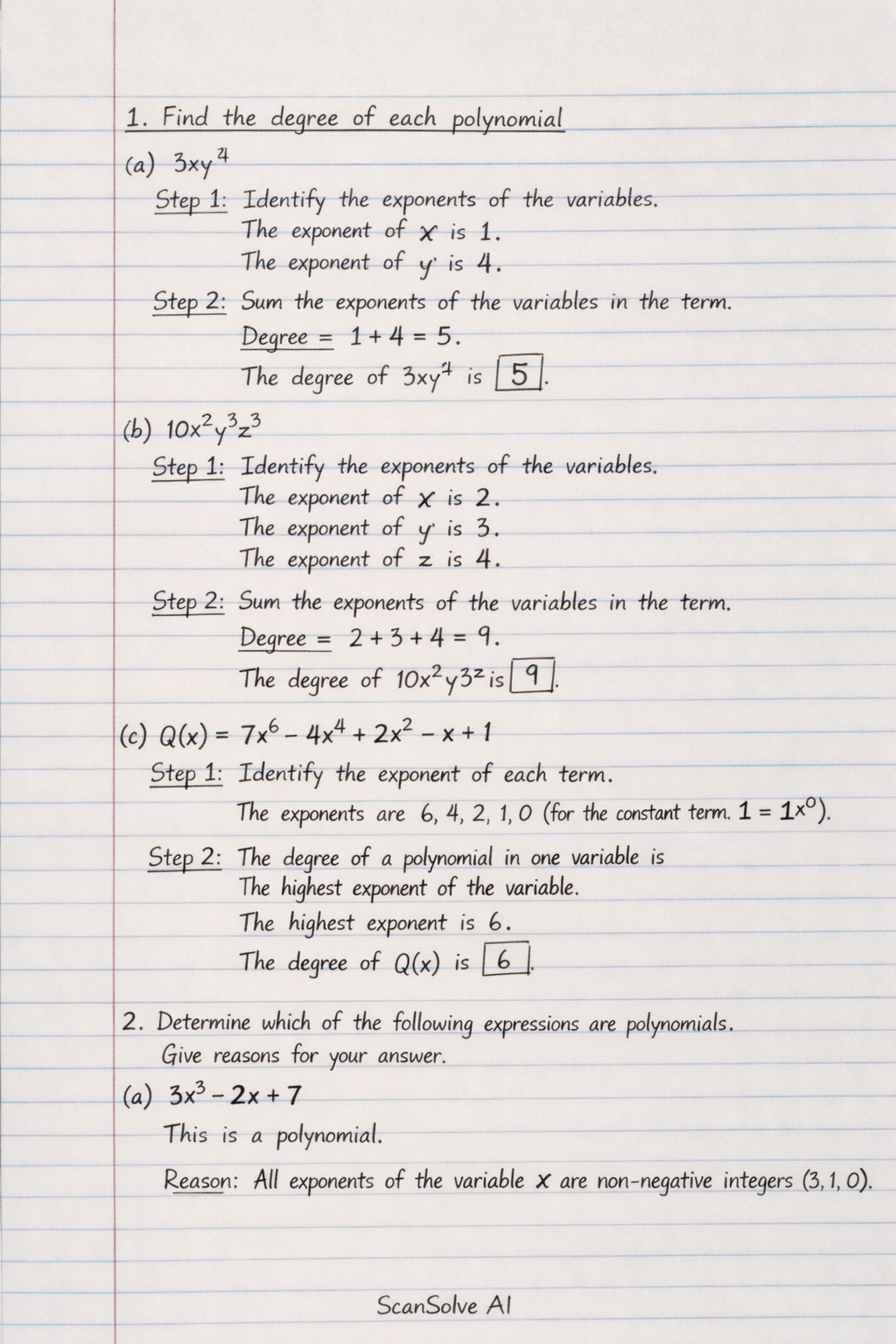
12 steps1. Find the degree of each polynomial
a)
Identify the exponents of the variables.
The exponent of is 1.
The exponent of is 4.Sum the exponents of the variables in the term.
Degree .
The degree of is .b)
Identify the exponents of the variables.
The exponent of is 2.
The exponent of is 3.
The exponent of is 4.Sum the exponents of the variables in the term.
Degree .
The degree of is .c)
Identify the exponent of each term.
The exponents are (for the constant term ).
The degree of a polynomial in one variable is the highest exponent of the variable.
The highest exponent is 6.
The degree of is .2. Determine which of the following expressions are polynomials. Give reasons for your answer.
a)
This is a polynomial.
Reason: All exponents of the variable are non-negative integers ().b)
This is not a polynomial.
Reason: The term can be written as , which has a negative exponent (). Polynomials require non-negative integer exponents.c)
This is not a polynomial.
Reason: The term involves a fractional exponent (). Polynomials require integer exponents.3. Find the remainder when the polynomial is divided by .
Apply the Remainder Theorem.
The Remainder Theorem states that if a polynomial is divided by , the remainder is .
Here, and the divisor is , so .Evaluate .
The remainder is .
4. Rewrite the polynomial in descending powers of : .
Identify the terms and their powers of .
(power 4)
(power 2)
(power 1)
5 (power 0, constant term)Arrange the terms from the highest power to the lowest.
The polynomial in descending powers of is .
5. Given , find the value of .
Substitute into the polynomial .
Calculate the value.
The value of is .
Still stuck on this one?
Ask a follow-up, and the answer starts from this question.
More Mathematics Questions
Handwritten Step-by-Step Solution
Get this as a handwritten image on WhatsApp — like a tutor wrote it for you.
Try on WhatsApp