
The dependency ratio
Mathematics
ScanSolve AI Answer
Answer
88.57
Step-by-step solution
3 stepsThe dependency ratio is a measure showing the number of dependents (people aged 0-14 and 65+) per 100 people of working age (typically 15-64).
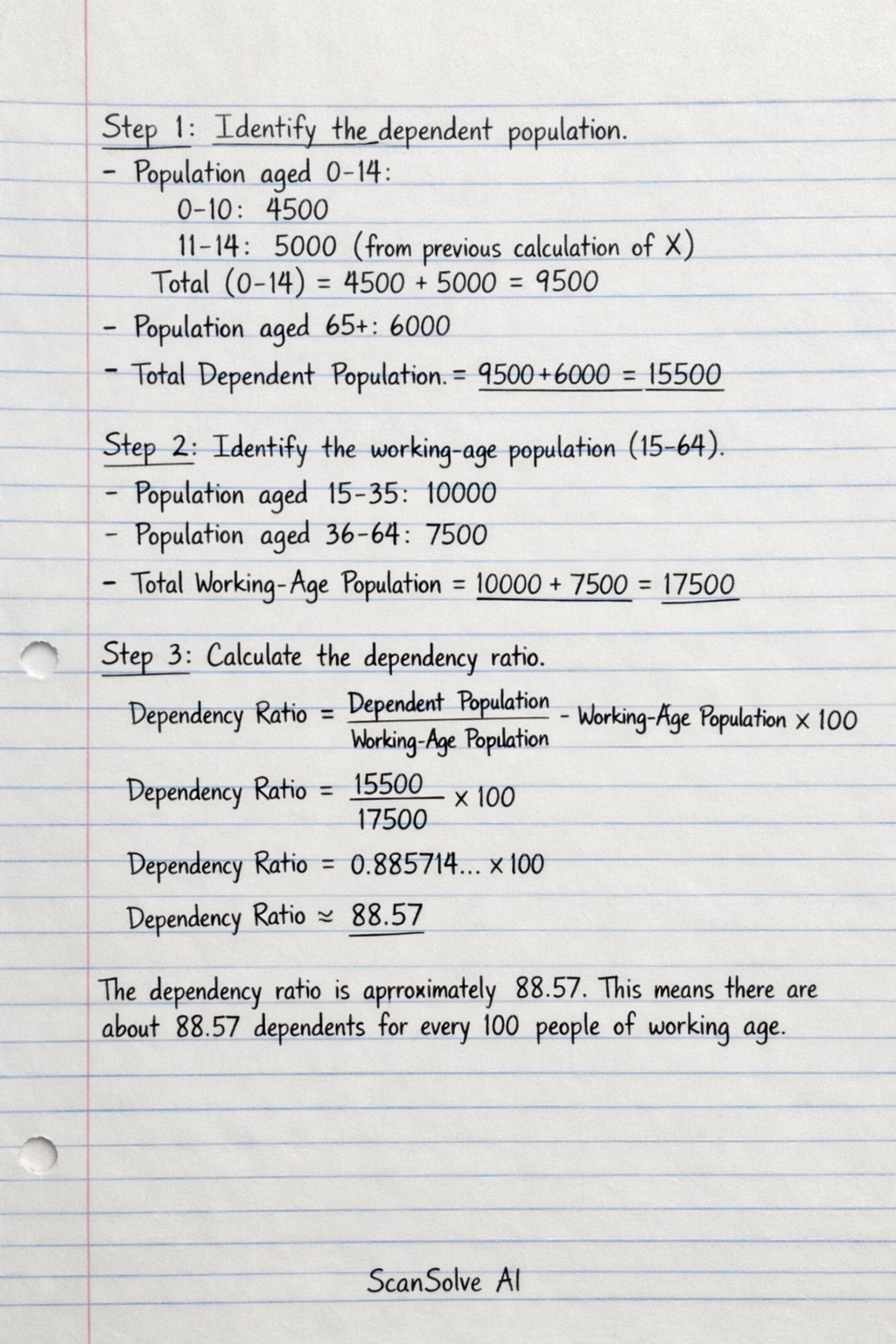
Identify the dependent population.
- Population aged 0-14:
- 0-10: 4500
- 11-14: 5000 (from previous calculation of X)
- Total (0-14) =
- Population aged 65 above: 6000
- Total Dependent Population =
- Population aged 0-14:
Identify the working-age population (15-64).
- Population aged 15-35: 10000
- Population aged 36-64: 7500
- Total Working-Age Population =
Calculate the dependency ratio.
The dependency ratio is approximately 88.57. This means there are about 88.57 dependents for every 100 people of working age.
Was this helpful?
Try one yourself
A new problem that tests the same skill.
Still stuck on this one?
Ask a follow-up, and the answer starts from this question.
Got a different question?Ask your own question
More Mathematics Questions
QCalculate the dependency ratio given the following age distribution: 0-14 years (25%), 15-60 years…QWhat are the advantages and disadvantages of a population pyramid, and how is the dependency ratio…QFrom the above data calculate: (a) X, Y, Z (b) The total population of the town (c) the difference…QCalculate the ratio (AD)/(DF).QDetermine the ratio of contributions.
Handwritten Step-by-Step Solution
Get this as a handwritten image on WhatsApp — like a tutor wrote it for you.
Try on WhatsApp