

This mathematics problem involves applying core mathematical principles and formulas. Below you will find a complete step-by-step solution with detailed explanations for each step, helping you understand not just the answer but the method behind it.
ScanSolve AI Answer
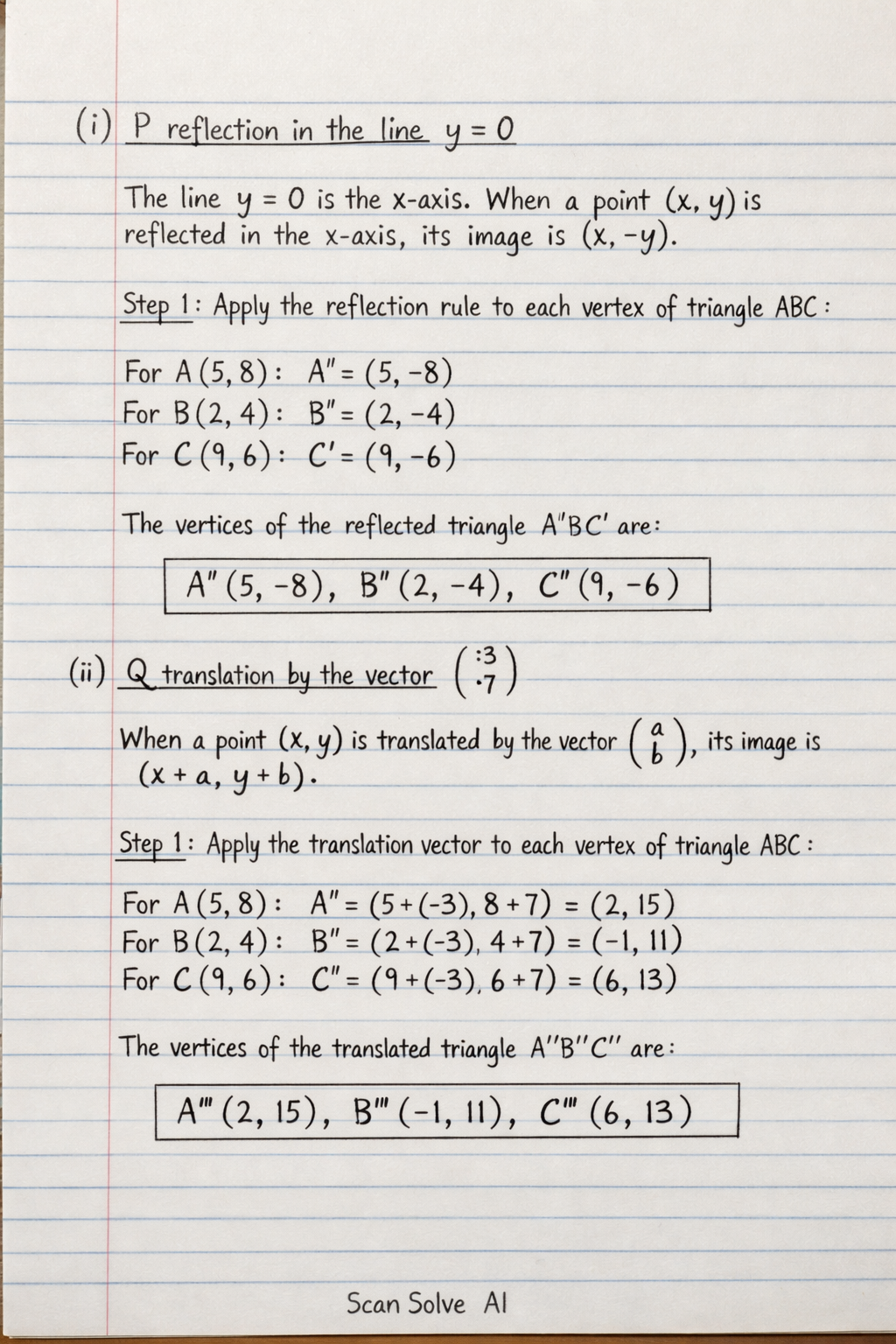
Here are the coordinates of the images after each transformation: (i) P reflection in the line y=0 The line y=0 is the x-axis. When a point (x, y) is reflected in the x-axis, its image is (x, -y). Step 1: Apply the reflection rule to each vertex of triangle ABC. For A(5, 8): A' = (5, -8) For B(2, 4): B' = (2, -4) For C(9, 6): C' = (9, -6) The vertices of the reflected triangle A'B'C' are A'(5, -8), B'(2, -4), C'(9, -6) (ii) Q translation by the vector -3 \\ 7 When a point (x, y) is translated by the vector a \\ b , its image is (x+a, y+b). Step 1: Apply the translation vector to each vertex of triangle ABC. For A(5, 8): A'' = (5 + (-3), 8 + 7) = (2, 15) For B(2, 4): B'' = (2 + (-3), 4 + 7) = (-1, 11) For C(9, 6): C'' = (9 + (-3), 6 + 7) = (6, 13) The vertices of the translated triangle A''B''C'' are A''(2, 15), B''(-1, 11), C''(6, 13) (iii) R rotation clockwise through 90^ about X(2,2) To rotate a point (x, y) about a center of rotation (a, b): 1. Translate the point so the center of rotation is at the origin: (x-a, y-b). 2. Apply the rotation rule for rotation about the origin. For a 90^ clockwise rotation, (x, y) (y, -x). 3. Translate the point back by (a, b): (x'+a, y'+b). Step 1: Translate each vertex of triangle ABC so that X(2,2) is the origin. For A(5, 8): (5-2, 8-2) = (3, 6) For B(2, 4): (2-2, 4-2) = (0, 2) For C(9, 6): (9-2, 6-2) = (7, 4) Step 2: Apply the 90^ clockwise rotation rule (x, y) (y, -x) to the translated points. For (3, 6): (6, -3) For (0, 2): (2, -0) = (2, 0) For (7, 4): (4, -7) Step 3: Translate the rotated points back by adding the coordinates of X(2,2). For (6, -3): A''' = (6+2, -3+2) = (8, -1) For (2, 0): B''' = (2+2, 0+2) = (4, 2) For (4, -7): C''' = (4+2, -7+2) = (6, -5) The vertices of the rotated triangle A'''B'''C''' are A'''(8, -1), B'''(4, 2), C'''(6, -5) 3 done, 2 left today. You're making progress.