
We read your photo as:
The diagram below shows a square. What is its perimeter? Sheila had 3 containers of capacity 15, 20 and 30 litres. What is the largest container that can be filled by each of the above containers?
ScanSolve AI Answer
Step-by-step solution
11 stepshere are the solutions to the questions you sent:
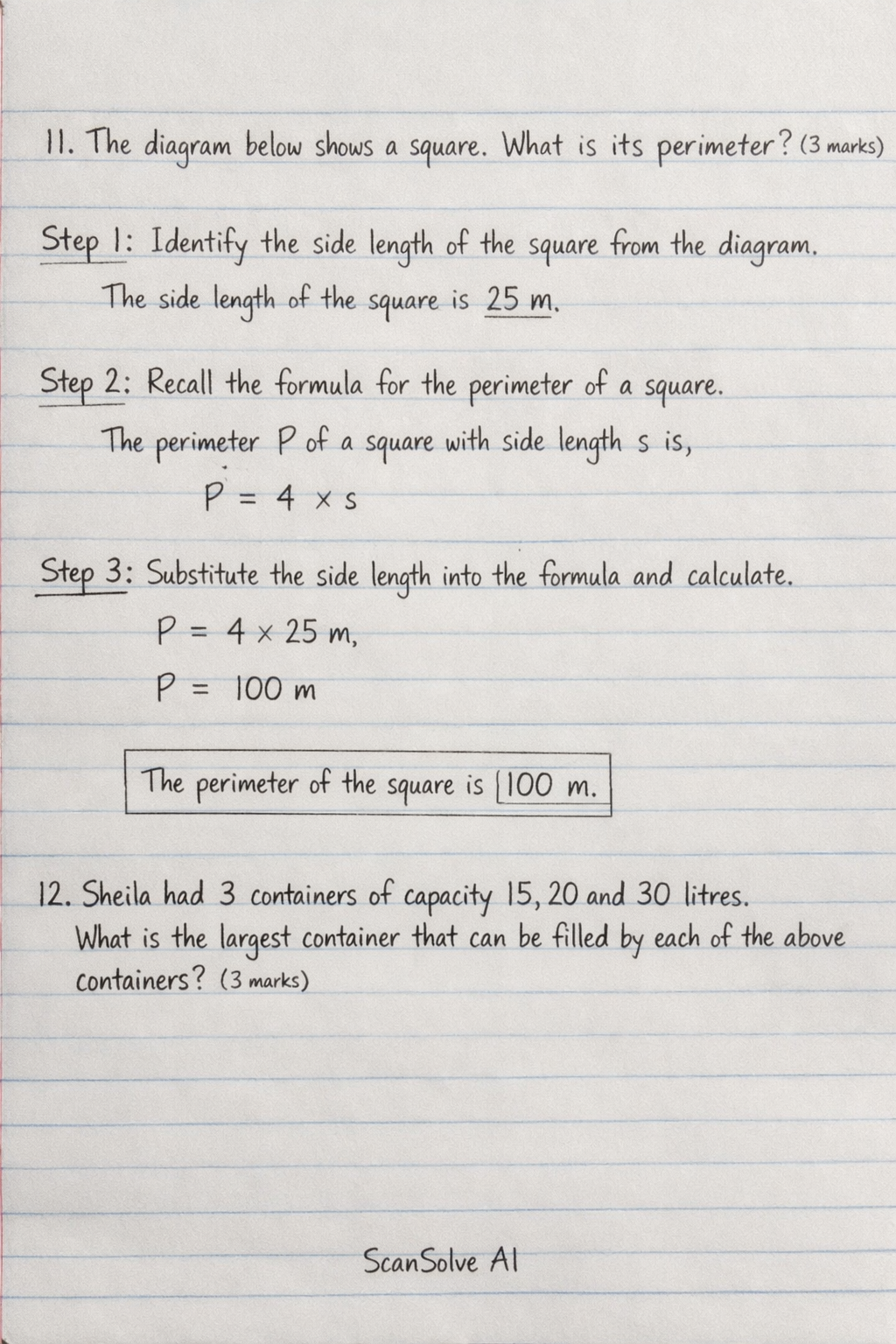
11. The diagram below shows a square. What is its perimeter? (3 marks)
Identify the side length of the square from the diagram.
The side length of the square is .
Recall the formula for the perimeter of a square.
The perimeter of a square with side length is .
Substitute the side length into the formula and calculate.
The perimeter of the square is .
12. Sheila had 3 containers of capacity 15, 20 and 30 litres. What is the largest container that can be filled by each of the above containers? (3 marks)
Understand the question.
"Largest container that can be filled by each of the above containers" means we need to find the Least Common Multiple (L.C.M.) of the given capacities.
The capacities are 15, 20, and 30 litres.Find the prime factorization of each number.
To find the L.C.M., take the highest power of each prime factor present in any of the numbers.
The prime factors are 2, 3, and 5.
The highest power of 2 is (from 20).
The highest power of 3 is (from 15 and 30).
The highest power of 5 is (from 15, 20, and 30).Multiply these highest powers together.
The largest container that can be filled by each of the above containers is .
13. Test whether 482350 can be divisible by 11. (4 marks)
Apply the divisibility rule for 11.
The rule states that a number is divisible by 11 if the alternating sum of its digits is 0 or a multiple of 11.
Calculate the alternating sum of the digits, starting from the rightmost digit and alternating signs.
Digits of 482350 are 4, 8, 2, 3, 5, 0.
Sum of digits at odd places (1st, 3rd, 5th from right):
Sum of digits at even places (2nd, 4th, 6th from right):Find the difference between these two sums.
Conclude based on the result.
Since the difference is 0, the number 482350 is divisible by 11.
The number 482350 .
Still stuck on this one?
Ask a follow-up, and the answer starts from this question.
More Mathematics Questions
Handwritten Step-by-Step Solution
Get this as a handwritten image on WhatsApp — like a tutor wrote it for you.
Try on WhatsApp