The diagram shows dots and crosses in the first 3 patterns. (a) Complete the table. (b) Find (i) the number of crosses needed for pattern 45, (ii) the nth term for the sum of crosses and dots.

Mathematics
The diagram shows dots and crosses in the first 3 patterns. (a) Complete the table. (b) Find (i) the number of crosses needed for pattern 45, (ii) the nth term for the sum of crosses and dots.

ScanSolve AI Answer

Answer

137

Thuso😍😍, let's knock this out.

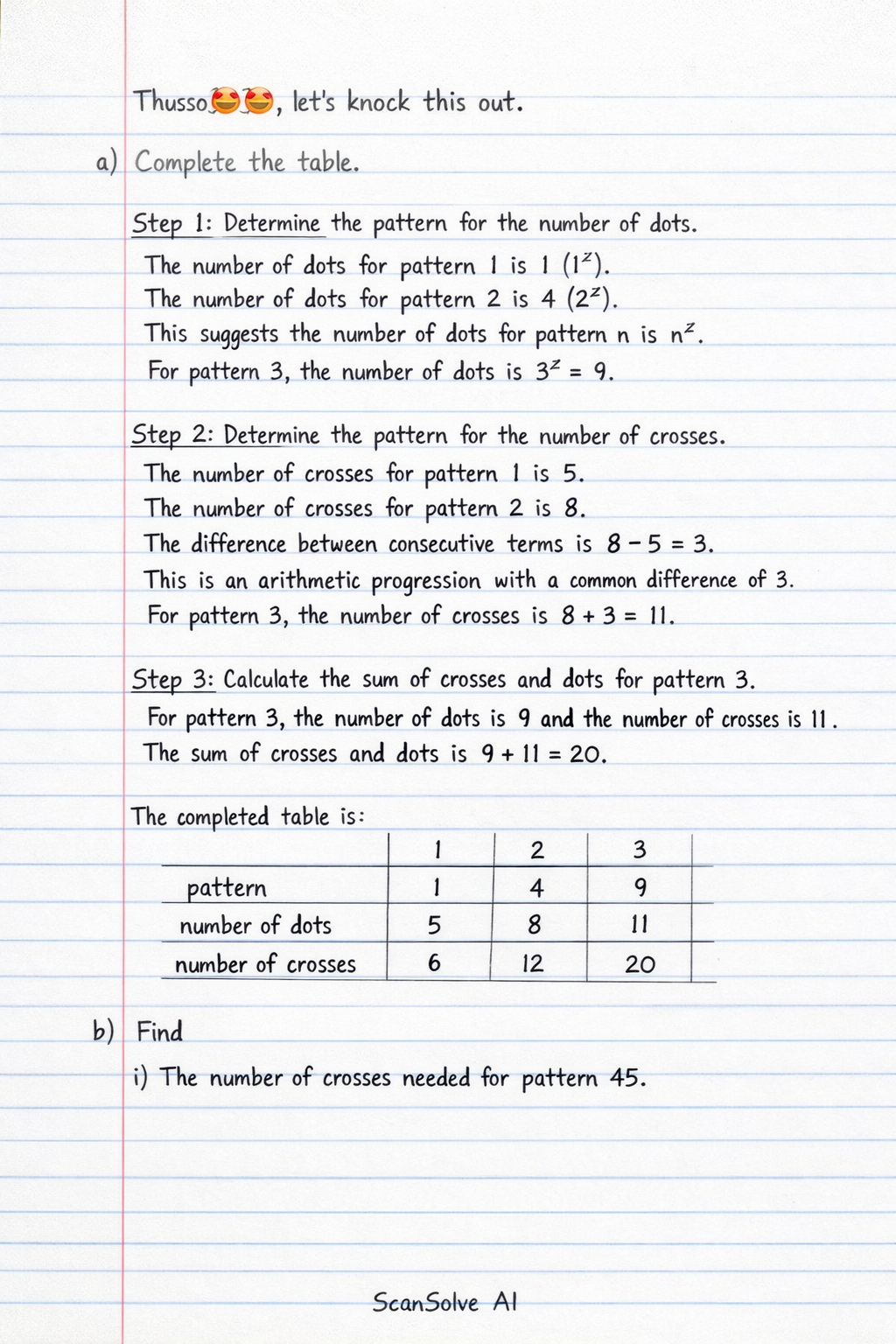
a) Complete the table.

Step 1: Determine the pattern for the number of dots. The number of dots for pattern 1 is 1 (121^2). The number of dots for pattern 2 is 4 (222^2). This suggests the number of dots for pattern nn is n2n^2. For pattern 3, the number of dots is 32=93^2 = 9.

Step 2: Determine the pattern for the number of crosses. The number of crosses for pattern 1 is 5. The number of crosses for pattern 2 is 8. The difference between consecutive terms is 85=38 - 5 = 3. This is an arithmetic progression with a common difference of 3. For pattern 3, the number of crosses is 8+3=118 + 3 = 11.

Step 3: Calculate the sum of crosses and dots for pattern 3. For pattern 3, the number of dots is 9 and the number of crosses is 11. The sum of crosses and dots is 9+11=209 + 11 = 20.

The completed table is: | pattern | 1 | 2 | 3 | |---|---|---|---| | number of dots | 1 | 4 | 9 | | number of crosses | 5 | 8 | 11 | | sum of crosses and dots | 6 | 12 | 20 |

b) Find

i) The number of crosses needed for pattern 45.

Step 1: Find the nnth term formula for the number of crosses. The sequence for the number of crosses is 5,8,11,5, 8, 11, \dots. This is an arithmetic progression with the first term a=5a = 5 and the common difference d=85=3d = 8 - 5 = 3. The formula for the nnth term of an arithmetic progression is Tn=a+(n1)dT_n = a + (n-1)d. Substitute a=5a=5 and d=3d=3: Tn=5+(n1)3T_n = 5 + (n-1)3 Tn=5+3n3T_n = 5 + 3n - 3 Tn=3n+2T_n = 3n + 2

Step 2: Calculate the number of crosses for pattern 45. Substitute n=45n=45 into the formula: T45=3(45)+2T_{45} = 3(45) + 2 T45=135+2T_{45} = 135 + 2 T45=137T_{45} = 137 The number of crosses needed for pattern 45 is 137\boxed{137}.

ii) The nnth term for the sum of crosses and dots.

Step 1: Analyze the sequence for the sum of crosses and dots. The sequence is 6,12,20,6, 12, 20, \dots. Calculate the first differences: 126=612 - 6 = 6 2012=820 - 12 = 8 Calculate the second differences: 86=28 - 6 = 2 Since the second differences are constant, the nnth term is a quadratic sequence of the form Tn=an2+bn+cT_n = an^2 + bn + c.

Step 2: Determine the coefficients a,b,a, b, and cc. The second difference is equal to 2a2a: 2a=2    a=12a = 2 \implies a = 1 The first term of the first differences is equal to 3a+b3a+b: 3a+b=63a+b = 6 Substitute a=1a=1: 3(1)+b=63(1)+b = 6 3+b=6    b=33+b = 6 \implies b = 3 The first term of the sequence is equal to a+b+ca+b+c: a+b+c=6a+b+c = 6 Substitute a=1a=1 and b=3b=3: 1+3+c=61+3+c = 6 4+c=6    c=24+c = 6 \implies c = 2 Therefore, the nnth term for the sum of crosses and dots is Tn=1n2+3n+2T_n = 1n^2 + 3n + 2. The nnth term for the sum of crosses and dots is n2+3n+2\boxed{n^2 + 3n + 2}.

Drop the next question! 📸

Was this helpful?

Need help with your own homework?

Get instant step-by-step solutions to any question. Free to start.

Ask Your Question
Handwritten step-by-step solution preview

Handwritten Step-by-Step Solution

Get this as a handwritten image on WhatsApp — like a tutor wrote it for you.

Try on WhatsApp

Still have questions?

Quick Answer

Thuso😍😍, let's knock this out. a) Complete the table.

The diagram shows dots and crosses in the first 3 patterns. (a) Complete the table. (b) Find (i) the number of crosses needed for pattern 45, (ii) the nth term for the sum of crosses and dots.
Mathematics

This mathematics problem involves applying core mathematical principles and formulas. Below you will find a complete step-by-step solution with detailed explanations for each step, helping you understand not just the answer but the method behind it.

ScanSolve AI Answer
Thuso😍😍, let's knock this out. a) Complete the table. Step 1: Determine the pattern for the number of dots. The number of dots for pattern 1 is 1 (1^2). The number of dots for pattern 2 is 4 (2^2). This suggests the number of dots for pattern n is n^2. For pattern 3, the number of dots is 3^2 = 9. Step 2: Determine the pattern for the number of crosses. The number of crosses for pattern 1 is 5. The number of crosses for pattern 2 is 8. The difference between consecutive terms is 8 - 5 = 3. This is an arithmetic progression with a common difference of 3. For pattern 3, the number of crosses is 8 + 3 = 11. Step 3: Calculate the sum of crosses and dots for pattern 3. For pattern 3, the number of dots is 9 and the number of crosses is 11. The sum of crosses and dots is 9 + 11 = 20. The completed table is: | pattern | 1 | 2 | 3 | |---|---|---|---| | number of dots | 1 | 4 | 9 | | number of crosses | 5 | 8 | 11 | | sum of crosses and dots | 6 | 12 | 20 | b) Find i) The number of crosses needed for pattern 45. Step 1: Find the nth term formula for the number of crosses. The sequence for the number of crosses is 5, 8, 11, . This is an arithmetic progression with the first term a = 5 and the common difference d = 8 - 5 = 3. The formula for the nth term of an arithmetic progression is T_n = a + (n-1)d. Substitute a=5 and d=3: T_n = 5 + (n-1)3 T_n = 5 + 3n - 3 T_n = 3n + 2 Step 2: Calculate the number of crosses for pattern 45. Substitute n=45 into the formula: T_45 = 3(45) + 2 T_45 = 135 + 2 T_45 = 137 The number of crosses needed for pattern 45 is 137. ii) The nth term for the sum of crosses and dots. Step 1: Analyze the sequence for the sum of crosses and dots. The sequence is 6, 12, 20, . Calculate the first differences: 12 - 6 = 6 20 - 12 = 8 Calculate the second differences: 8 - 6 = 2 Since the second differences are constant, the nth term is a quadratic sequence of the form T_n = an^2 + bn + c. Step 2: Determine the coefficients a, b, and c. The second difference is equal to 2a: 2a = 2 a = 1 The first term of the first differences is equal to 3a+b: 3a+b = 6 Substitute a=1: 3(1)+b = 6 3+b = 6 b = 3 The first term of the sequence is equal to a+b+c: a+b+c = 6 Substitute a=1 and b=3: 1+3+c = 6 4+c = 6 c = 2 Therefore, the nth term for the sum of crosses and dots is T_n = 1n^2 + 3n + 2. The nth term for the sum of crosses and dots is n^2 + 3n + 2. Drop the next question! 📸