The diagram solve it

Mathematics

ScanSolve AI Answer

Answer

x=50∘,y=130∘,z=150∘x = 50^\circ, y = 130^\circ, z = 150^\circ

Step-by-step solution

3 steps

Here's how to solve for xx, yy, and zz using circle theorems:

  1. Find the value of xx.

    The angle subtended by an arc at the center of a circle is twice the angle subtended by the same arc at any point on the remaining part of the circle.
    Arc QRQR subtends ∠QOR\angle QOR at the center and ∠QPR\angle QPR at the circumference.

    ∠QOR=2×∠QPR\angle QOR = 2 \times \angle QPR

    Given ∠QOR=100∘\angle QOR = 100^\circ and ∠QPR=x\angle QPR = x:

    100∘=2x100^\circ = 2x x=100∘2x = \frac{100^\circ}{2} x=50∘x = 50^\circ
  2. Find the value of yy.

    The quadrilateral PQRSPQRS is a cyclic quadrilateral because all its vertices lie on the circle. In a cyclic quadrilateral, opposite angles are supplementary (add up to 180∘180^\circ).
    Angles ∠QPS\angle QPS and ∠QRS\angle QRS are opposite angles.

    ∠QPS+∠QRS=180∘\angle QPS + \angle QRS = 180^\circ

    We know ∠QPS=x=50∘\angle QPS = x = 50^\circ and ∠QRS=y\angle QRS = y:

    50∘+y=180∘50^\circ + y = 180^\circ y=180∘−50∘y = 180^\circ - 50^\circ y=130∘y = 130^\circ
  3. Find the value of zz.

    Angles ∠PQR\angle PQR and ∠PSR\angle PSR are opposite angles in the cyclic quadrilateral PQRSPQRS.

    ∠PQR+∠PSR=180∘\angle PQR + \angle PSR = 180^\circ

    We know ∠PSR=z\angle PSR = z, so we need to find ∠PQR\angle PQR.
    From the diagram, ∠QRS=∠QRP+∠PRS\angle QRS = \angle QRP + \angle PRS.
    We know ∠QRS=y=130∘\angle QRS = y = 130^\circ and ∠PRS=30∘\angle PRS = 30^\circ:

    130∘=∠QRP+30∘130^\circ = \angle QRP + 30^\circ ∠QRP=130∘−30∘\angle QRP = 130^\circ - 30^\circ ∠QRP=100∘\angle QRP = 100^\circ

    Now, consider △PQR\triangle PQR. The sum of angles in a triangle is 180∘180^\circ.

    ∠QPR+∠PQR+∠PRQ=180∘\angle QPR + \angle PQR + \angle PRQ = 180^\circ

    We know ∠QPR=x=50∘\angle QPR = x = 50^\circ and ∠PRQ=∠QRP=100∘\angle PRQ = \angle QRP = 100^\circ:

    50∘+∠PQR+100∘=180∘50^\circ + \angle PQR + 100^\circ = 180^\circ 150∘+∠PQR=180∘150^\circ + \angle PQR = 180^\circ ∠PQR=180∘−150∘\angle PQR = 180^\circ - 150^\circ ∠PQR=30∘\angle PQR = 30^\circ

    Finally, substitute ∠PQR\angle PQR back into the cyclic quadrilateral property:

    ∠PQR+z=180∘\angle PQR + z = 180^\circ 30∘+z=180∘30^\circ + z = 180^\circ z=180∘−30∘z = 180^\circ - 30^\circ z=150∘z = 150^\circ

    The values are:

    x=50∘,y=130∘,z=150∘x = 50^\circ, y = 130^\circ, z = 150^\circ
Was this helpful?

Try one yourself

A new problem that tests the same skill.

Still stuck on this one?

Ask a follow-up, and the answer starts from this question.

Got a different question?Ask your own question
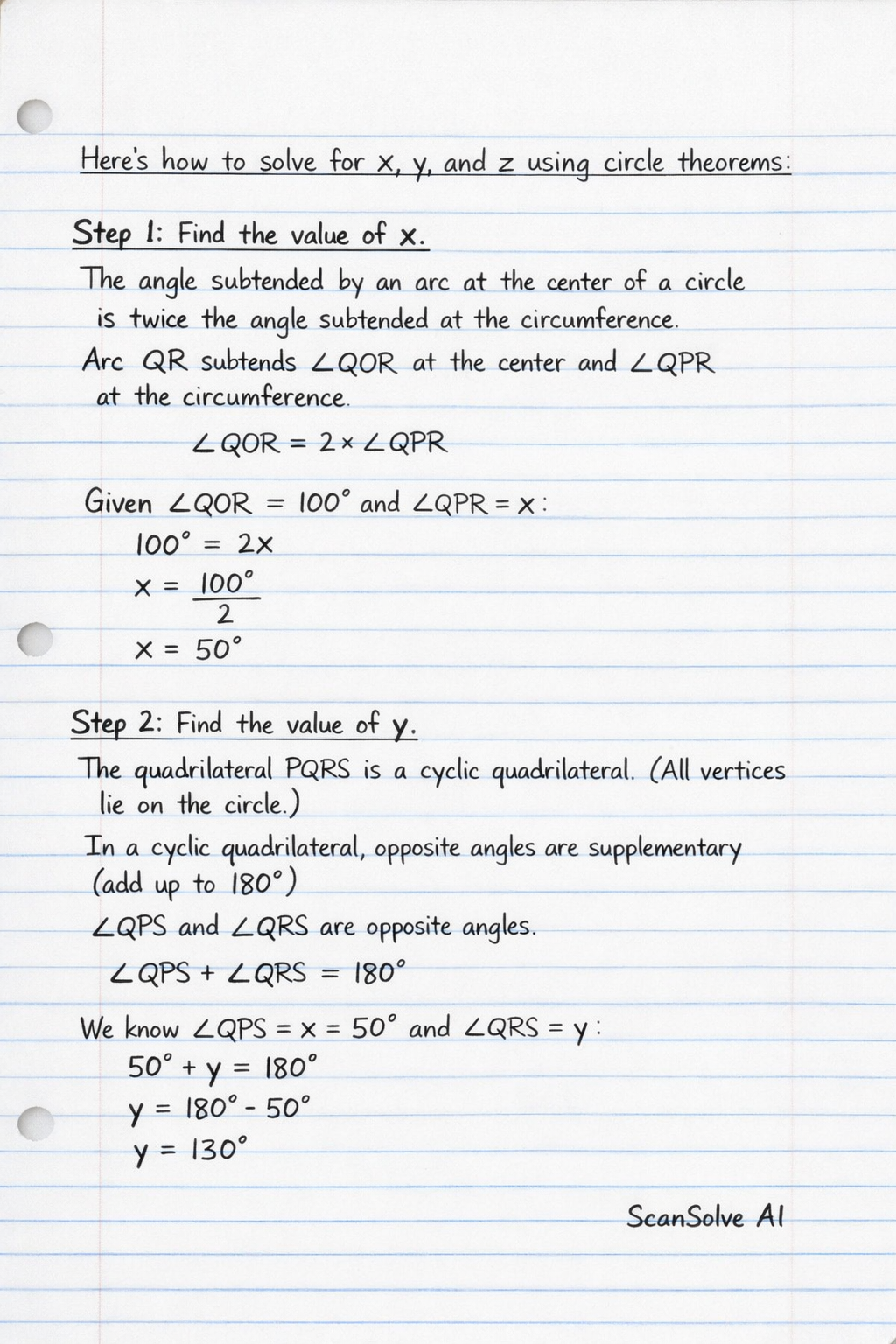
Handwritten step-by-step solution preview

Handwritten Step-by-Step Solution

Get this as a handwritten image on WhatsApp — like a tutor wrote it for you.

Try on WhatsApp