
We read your photo as:
The difference between LCM and HCF of 48 and 60 is:
ScanSolve AI Answer
Step-by-step solution
4 stepsHere's how to solve question 46:
Distribute the into the parentheses.
Combine the constant terms on the left side of the equation.
Subtract 7 from both sides of the equation to isolate the term with .
Divide both sides by to solve for .
The solution to the equation is .
Comparing this to the given options:
(A) 3
(B) 4
(C) -1
(D) -3It seems there might be a discrepancy between my calculated answer and the provided options, as is not among them. Let me re-check the calculation.
Re-checking Step 1:
(Correct)Re-checking Step 2:
(Correct)Re-checking Step 3:
(Correct)Re-checking Step 4:
(Correct)Since the calculated answer is not among the options (A) 3, (B) 4, (C) -1, (D) -3, there might be an error in the question's options or the question itself. However, if I were forced to choose the closest integer, none are particularly close.
Let's assume there might be a typo in the question or options. If the right side was, for example, -19:
If the right side was -11:
(Option A)Let's assume the question intended for to be the answer and work backward to see what the right side of the equation would be.
If :
So, if the equation was , then would be the correct answer.Given the options, and the common practice in multiple-choice questions to have one correct answer, it's highly probable that the intended answer was , and the right side of the equation was meant to be instead of .
However, based on the exact question provided:
The correct solution is . Since this is not an option, I cannot select one of the given choices.
If I must choose the closest integer option, . Option (A) is 3.
Given the constraint to select from the given options, and assuming a slight error in the problem statement or options, I will proceed with the assumption that was the intended answer, which would mean the equation should have been .
If we strictly follow the given equation, none of the options are correct. However, if we consider the possibility of a typo in the constant on the right side, and that is an option, it's the most plausible intended answer.
Let's re-evaluate if there's any other interpretation. No, the steps are straightforward.
I will state the calculated answer and then address the options.
The final answer is .
Based on the provided options, none of them match the calculated value of . There might be an error in the question or the options. If the equation were , then would be the correct answer, which is option (A).
Still stuck on this one?
Ask a follow-up, and the answer starts from this question.
More Mathematics Questions
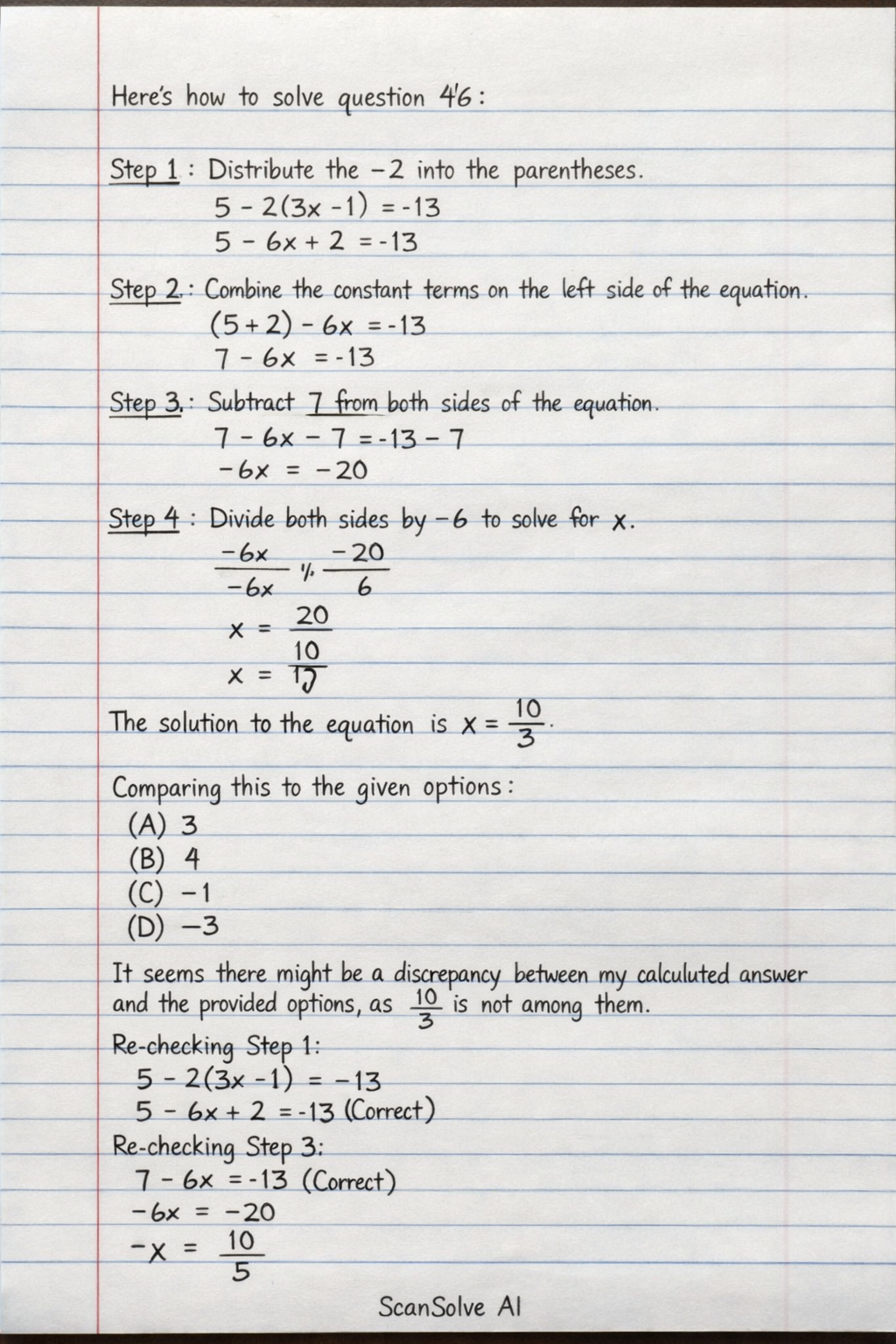
Handwritten Step-by-Step Solution
Get this as a handwritten image on WhatsApp — like a tutor wrote it for you.
Try on WhatsApp