
We read your photo as:
The distance between Ogoja and Nbube is 24km. If a driver covered the distance in 1½hours, what was his average speed for the journey?
ScanSolve AI Answer
Answer
Step-by-step solution
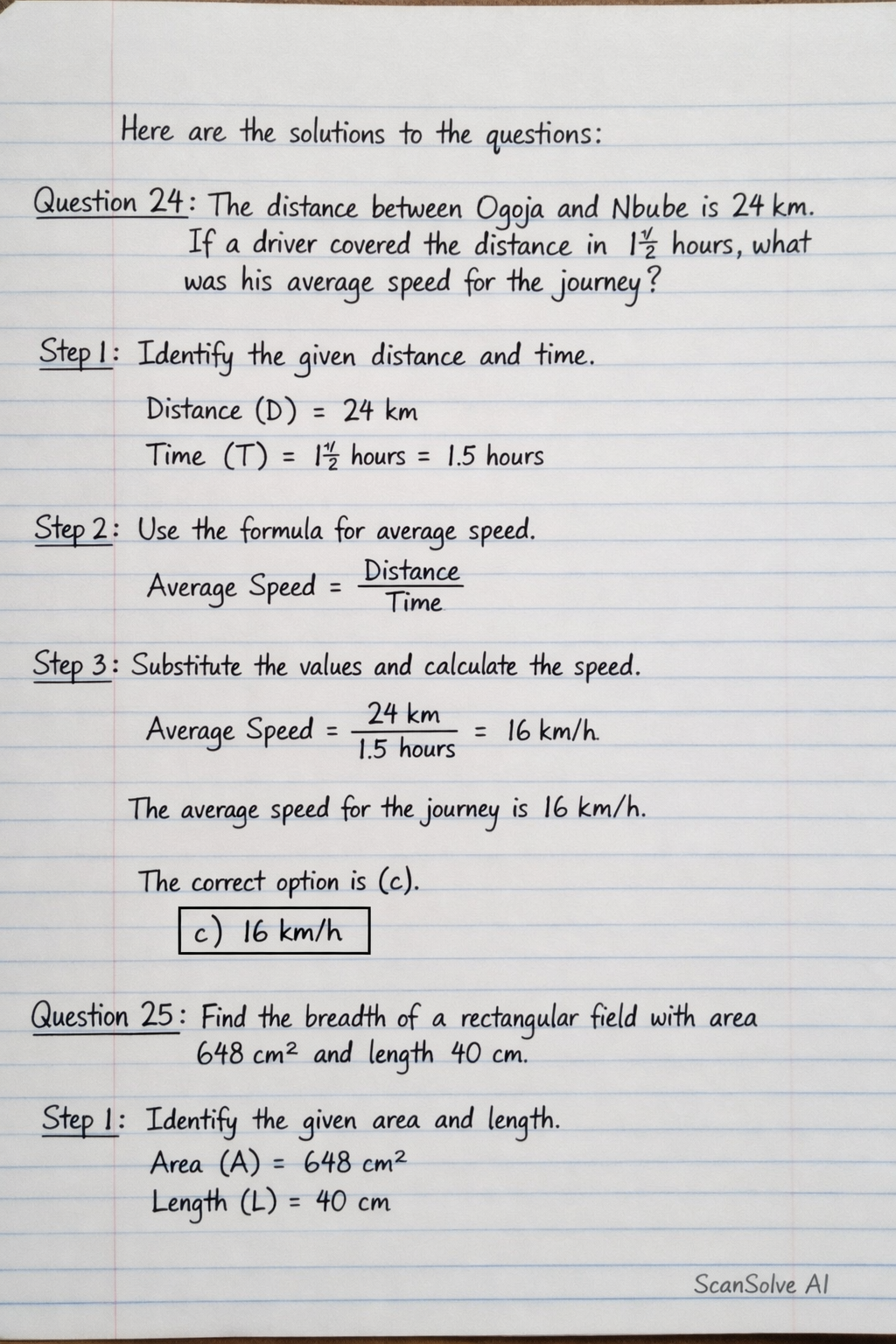
39 stepsHere are the solutions to the questions:
Part 24· 3 steps
The distance between Ogoja and Nbube is 24km. If a driver covered the distance in hours, what was his average speed for the journey?
Identify the given distance and time.
Distance () = 24 km
Time () = hours = 1.5 hoursUse the formula for average speed.
Substitute the values and calculate the speed.
The average speed for the journey is .
The correct option is (c).
Part 25· 3 steps
Find the breadth of a rectangular field with area and length .
Identify the given area and length.
Area () =
Length () =Use the formula for the area of a rectangle, , where is the breadth.
Rearrange the formula to solve for breadth and substitute the values.
The breadth of the rectangular field is .
The correct option is (b).
Part 26· 4 steps
Find the difference between the LCM and HCF of 10 and 12.
Find the prime factorization of 10 and 12.
Calculate the HCF (Highest Common Factor).
HCF(10, 12) = 2
Calculate the LCM (Least Common Multiple).
LCM(10, 12) =
Find the difference between the LCM and HCF.
Difference =
The difference is 58.The correct option is (d).
Part 27· 2 steps
Ayobami used 587kg of sugar to bake a cake and mixed 140kg sugar for coating the cake. How much of sugar content is used?
Identify the amounts of sugar used.
Sugar for baking = 587 kg
Sugar for coating = 140 kgAdd the amounts to find the total sugar content.
Total sugar =
The total sugar content used is .The correct option is (b).
Part 28· 4 steps
Simplify .
Simplify the innermost square root.
Substitute and simplify the next part of the expression.
Simplify the remaining square roots.
Perform the final addition.
The simplified value is 4.
The correct option is (a).
Part 29· 5 steps
Simplify .
Convert mixed numbers to improper fractions.
Rewrite the expression.
Find the LCM of the denominators (3, 4, 2), which is 12.
Convert fractions to have this common denominator.
Perform the operations.
Convert the improper fraction back to a mixed number.
The simplified value is .
The correct option is (c).
Part 30· 3 steps
Add 3min. 25secs. and 2mins. 44secs.
Add the minutes and seconds separately.
Minutes:
Seconds:Convert the total seconds into minutes and remaining seconds.
(since 1 min = 60 secs)
Add the converted minutes to the total minutes.
Total time =
The sum is 6 mins. 9 secs.The correct option is (b).
Part 31· 3 steps
What is the volume of a cylinder with base diameter 14cm and height 10cm?
Identify the given values and calculate the radius.
Diameter () = 14 cm Radius () =
Height () = 10 cmUse the formula for the volume of a cylinder, .
Use .
Substitute the values and calculate the volume.
The volume of the cylinder is .
The correct option is (b).
Part 32· 4 steps
Find the value of P in the figure below.
Recognize that angles on a straight line sum to .
Set up the equation based on the given angles.
Solve for $2P$.
Solve for P.
The value of P is .
The correct option is (c).
Part 33· 2 steps
Change 3% to fraction in its lowest term.
Convert the percentage to a fraction by dividing by 100.
Check if the fraction can be simplified.
The numerator (3) is a prime number. The denominator (100) is not divisible by 3.
Therefore, the fraction is already in its lowest term.The correct option is (a).
Part 34· 1 step
A line from the centre of a circle to any point on a circumference is called ---
Recall the definition of a radius.
A radius is a line segment that connects the center of a circle to any point on its circumference.
The correct option is (b).
Part 35· 3 steps
Write 2019 in Roman numeral.
Break down the number 2019.
Convert each part to its Roman numeral.
Combine the Roman numerals.
The Roman numeral for 2019 is MMXIX.The correct option is (b).
Part 36· 2 steps
Convert to binary number.
Perform repeated division by 2, noting the remainders.
remainder 0
remainder 0
remainder 1
remainder 1Read the remainders from bottom to top.
The binary representation of is .
The correct option is (a).
Try one yourself
A new problem that tests the same skill.
Still stuck on this one?
Ask a follow-up, and the answer starts from this question.
More Mathematics Questions
Handwritten Step-by-Step Solution
Get this as a handwritten image on WhatsApp — like a tutor wrote it for you.
Try on WhatsApp