
We read your photo as:
The first 100 prime numbers
ScanSolve AI Answer
Answers
2 partsStep-by-step solution
5 stepsHere's the solution to the problems you've provided:
Part 1· 2 steps
Inequality and Set
Interpret the given information.
The expression is not a standard mathematical notation for a single compound inequality. However, the set is written below it. This set represents all integers such that is strictly greater than 4 and less than or equal to 9. This corresponds to the inequality .
Verify the set for the implied inequality.
For integers satisfying :
- must be greater than 4, so .
- must be less than or equal to 9, so . Combining these conditions, the integers that satisfy both are . The set you provided, , is correct for the implied inequality .
Part 2541
The first 100 prime numbers
Define a prime number.
A prime number is a natural number greater than 1 that has exactly two distinct positive divisors: 1 and itself.
List the first few prime numbers.
The first few prime numbers are:
State the 100th prime number.
Listing all 100 prime numbers is extensive. The 100th prime number is .
Try one yourself
A new problem that tests the same skill.
Still stuck on this one?
Ask a follow-up, and the answer starts from this question.
More Mathematics Questions
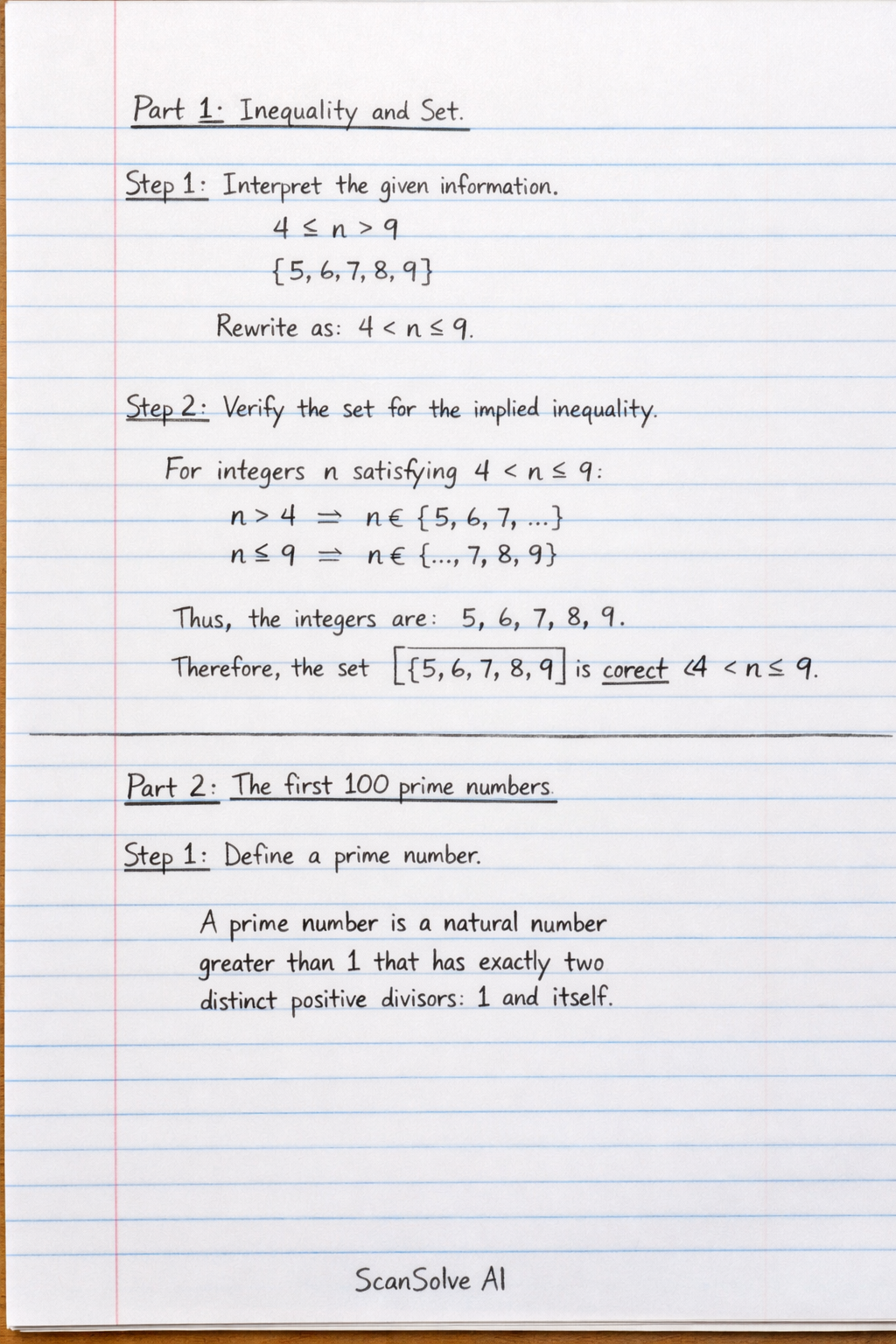
Handwritten Step-by-Step Solution
Get this as a handwritten image on WhatsApp — like a tutor wrote it for you.
Try on WhatsApp