
We read your photo as:
What is the sum of the first hundred odd numbers?
ScanSolve AI Answer
Answer
Step-by-step solution
4 stepsIdentify the sequence of numbers.
The first hundred odd numbers form an arithmetic progression: .
Determine the number of terms and the first term.
We need the sum of the first hundred odd numbers, so the number of terms .
The first term .Determine the last term.
The -th odd number is given by the formula .
For the 100th odd number, .Calculate the sum of the arithmetic progression.
The sum of an arithmetic progression is given by the formula .
Substitute the values:Alternatively, the sum of the first odd numbers is .
For :The sum of the first hundred odd numbers is 10000.
Comparing this with the given options:
A 200
B 500
C 1 000
D 10 000
E 100 000The correct option is D.
The final answer is .
Try one yourself
A new problem that tests the same skill.
Still stuck on this one?
Ask a follow-up, and the answer starts from this question.
More Mathematics Questions
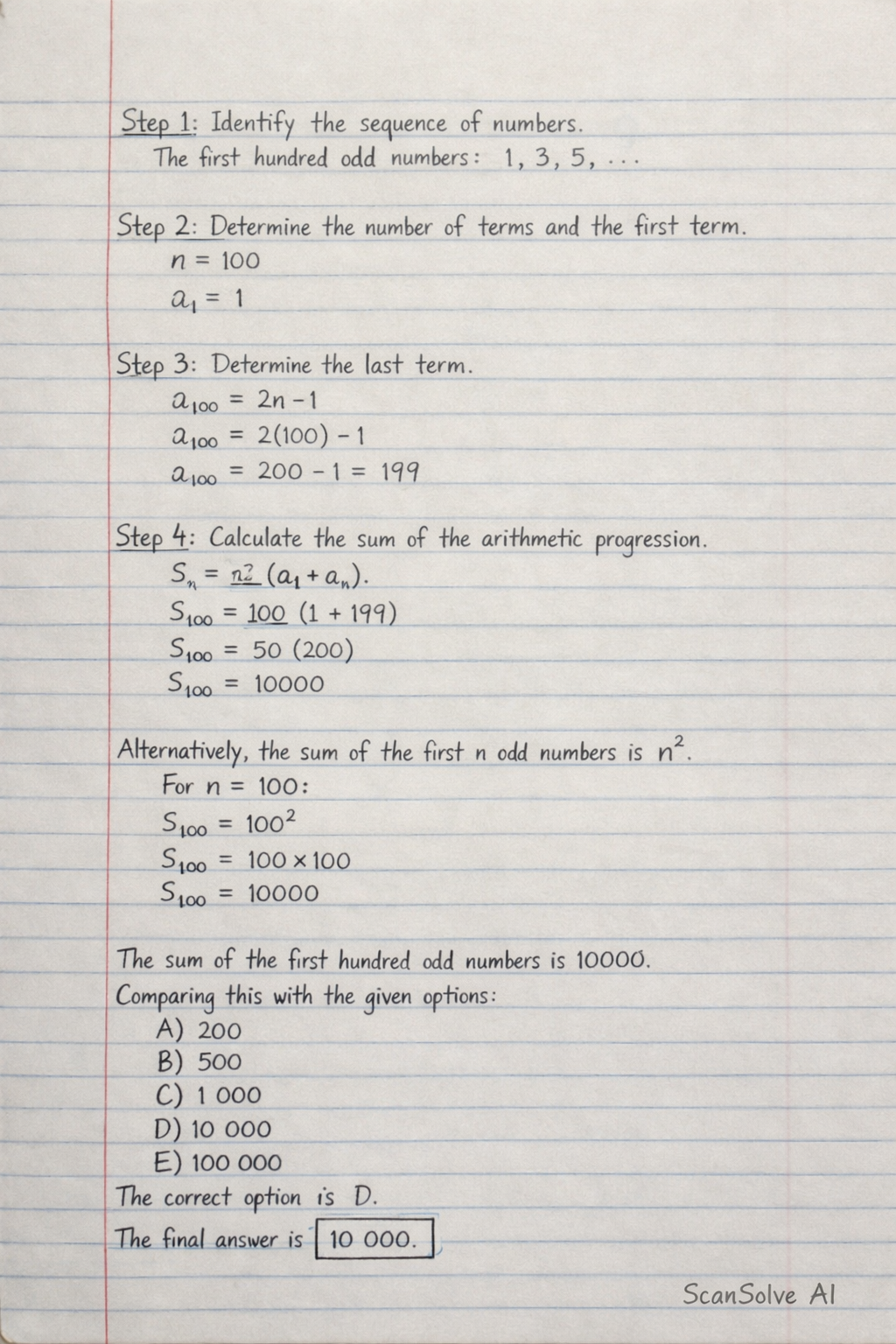
Handwritten Step-by-Step Solution
Get this as a handwritten image on WhatsApp — like a tutor wrote it for you.
Try on WhatsApp