
We read your photo as:
What do the following terms mean: parallel lines, perpendicular lines, complementary angles, supplementary angles, vertically opposite angles?
ScanSolve AI Answer
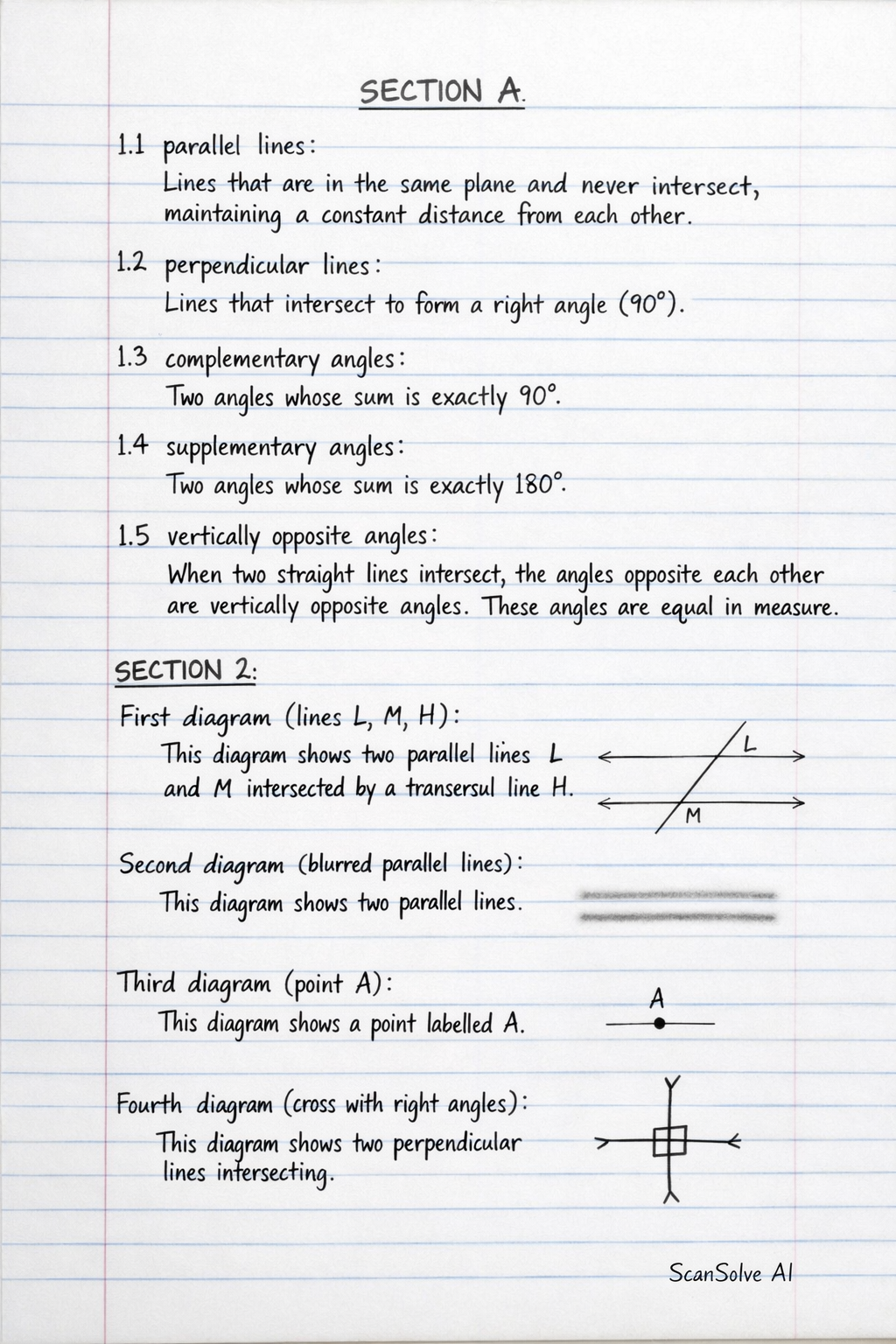
Here are the definitions and diagram descriptions:
SECTION A
-
1.1 parallel lines: Lines that are in the same plane and never intersect, maintaining a constant distance from each other.
-
1.2 perpendicular lines: Lines that intersect to form a right angle ().
-
1.3 complementary angles: Two angles whose sum is exactly .
-
1.4 supplementary angles: Two angles whose sum is exactly .
-
1.5 vertically opposite angles: When two straight lines intersect, the angles opposite each other are vertically opposite angles. These angles are equal in measure.
SECTION 2
-
First diagram (lines L, M, H): This diagram shows two parallel lines (L and M) intersected by a transversal line (H).
-
Second diagram (blurred parallel lines): This diagram shows two parallel lines.
-
Third diagram (point A): This diagram shows a point labeled A.
-
Fourth diagram (cross with right angles): This diagram shows two perpendicular lines intersecting.
-
Fifth diagram (lines E-F, G-H with right angle): This diagram shows two perpendicular lines intersecting.
Still stuck on this one?
Ask a follow-up, and the answer starts from this question.
More Mathematics Questions
Handwritten Step-by-Step Solution
Get this as a handwritten image on WhatsApp — like a tutor wrote it for you.
Try on WhatsApp