

This mathematics problem involves applying core mathematical principles and formulas. Below you will find a complete step-by-step solution with detailed explanations for each step, helping you understand not just the answer but the method behind it.
ScanSolve AI Answer
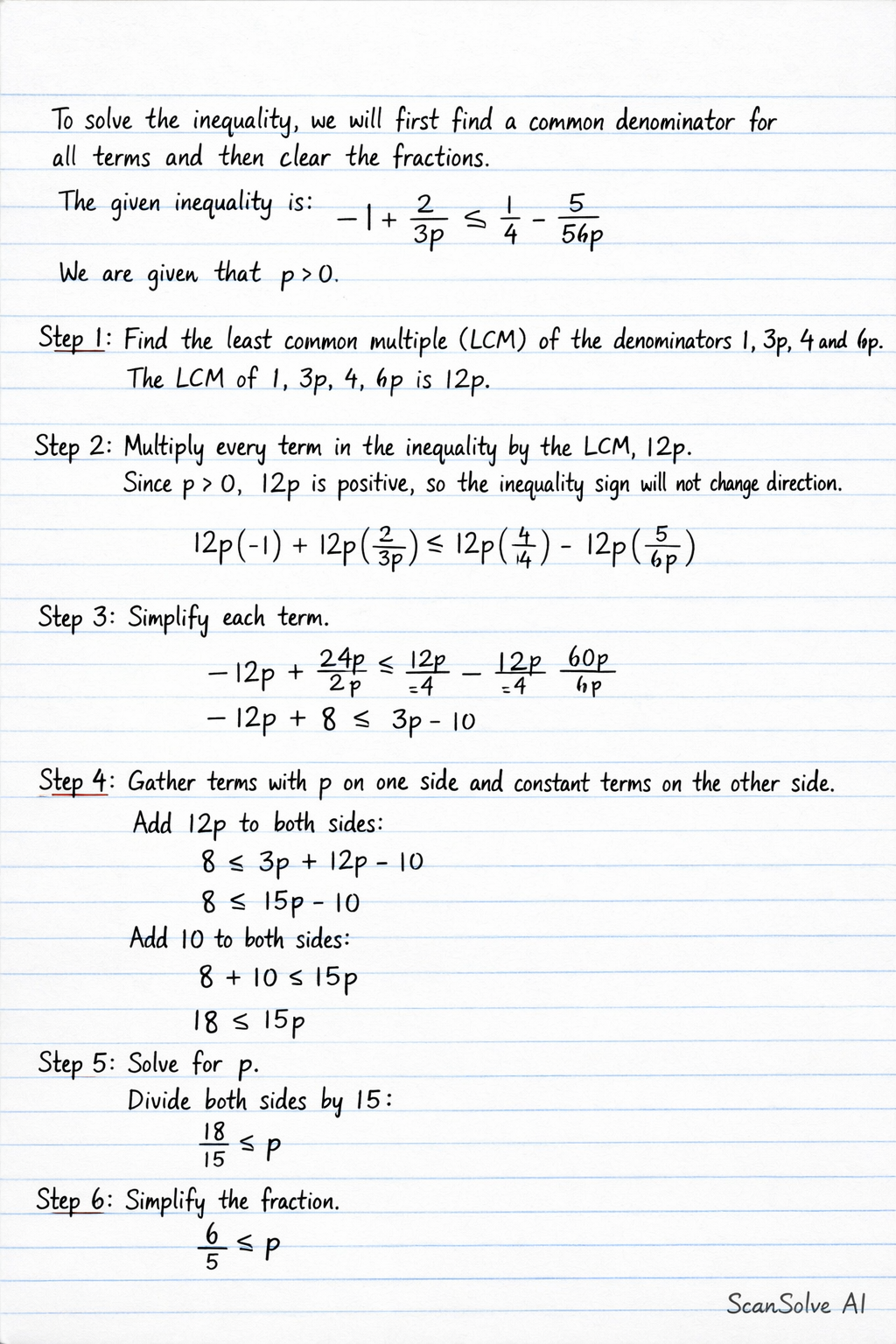
To solve the inequality, we will first find a common denominator for all terms and then clear the fractions. The given inequality is: -1 + (2)/(3p) (1)/(4) - (5)/(6p) We are given that p > 0. Step 1: Find the least common multiple (LCM) of the denominators 1, 3p, 4, and 6p. The LCM of 1, 3p, 4, 6p is 12p. Step 2: Multiply every term in the inequality by the LCM, 12p. Since p > 0, 12p is positive, so the inequality sign will not change direction. 12p(-1) + 12p((2)/(3p)) 12p((1)/(4)) - 12p((5)/(6p)) Step 3: Simplify each term. -12p + (24p)/(3p) (12p)/(4) - (60p)/(6p) -12p + 8 3p - 10 Step 4: Gather terms with p on one side and constant terms on the other side. Add 12p to both sides: 8 3p + 12p - 10 8 15p - 10 Add 10 to both sides: 8 + 10 15p 18 15p Step 5: Solve for p. Divide both sides by 15: (18)/(15) p Step 6: Simplify the fraction. (6)/(5) p This can also be written as p (6)/(5). Since (6)/(5) = 1.2, and 1.2 > 0, the condition p > 0 is satisfied. The solution for p is: p (6)/(5)