
We read your photo as:
The given inequality is ((x+1)²+3)/((x+3)(x−2)) < 0.
ScanSolve AI Answer
Answer
Step-by-step solution
4 stepsAnalyze the numerator of the inequality.
The given inequality is .
Consider the numerator: .
Since is always greater than or equal to 0 for any real number , adding 3 to it means that is always greater than or equal to 3.
Therefore, the numerator is always positive.Determine the sign of the denominator.
For the entire fraction to be less than 0 (negative), and since the numerator is always positive, the denominator must be negative.
So, we must have .Solve the inequality for the denominator.
To find when , we find the roots of the quadratic expression . The roots are and .
This is a parabola opening upwards. The expression will be negative when is between its roots.
Thus, the solution to is .Compare with the given options.
The set of values for is .
This matches option D.The final answer is .
Try one yourself
A new problem that tests the same skill.
Still stuck on this one?
Ask a follow-up, and the answer starts from this question.
More Mathematics Questions
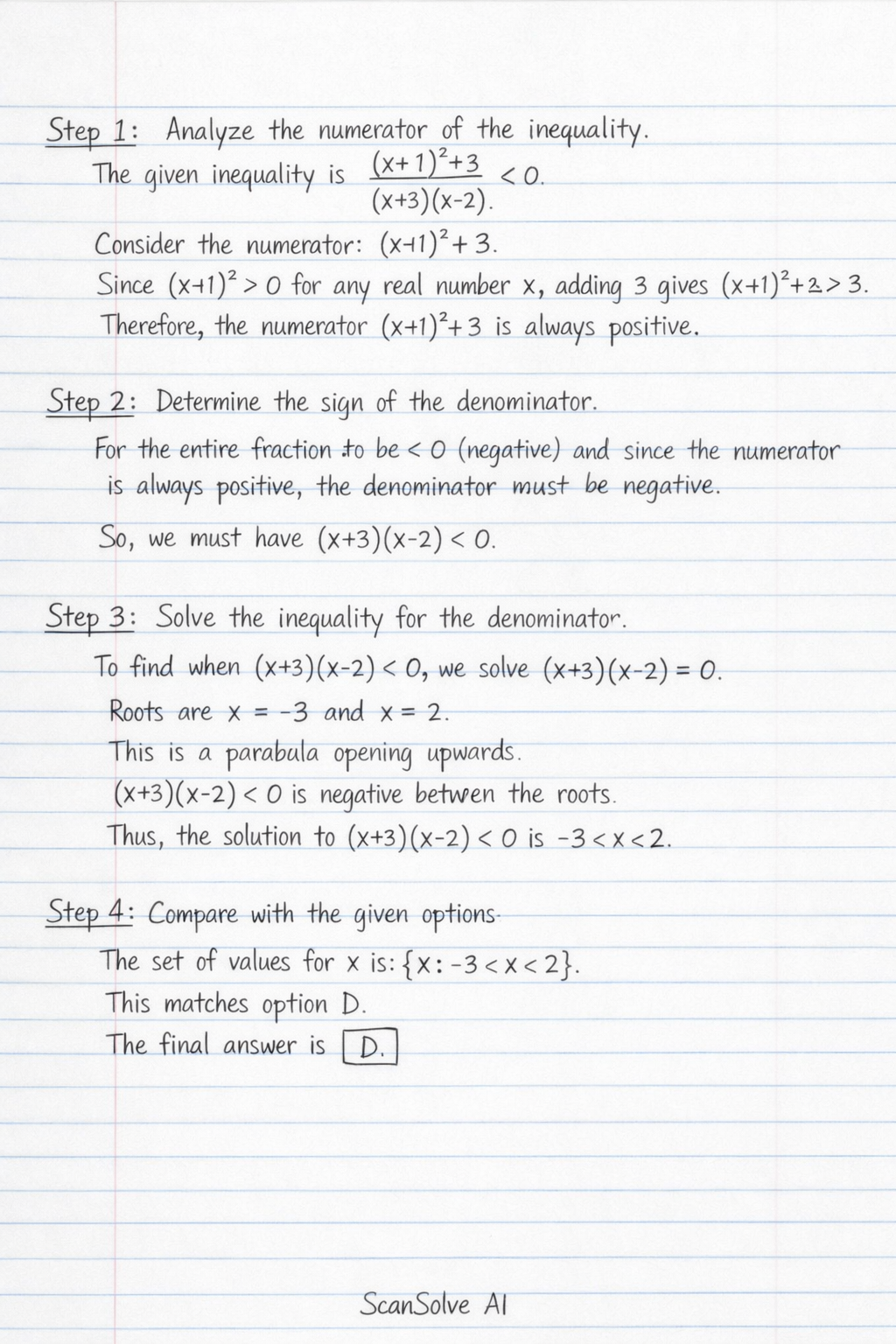
Handwritten Step-by-Step Solution
Get this as a handwritten image on WhatsApp — like a tutor wrote it for you.
Try on WhatsApp