
We read your photo as:
The homework involves calculating the area and width of rectangles and the area of a square given its perimeter. It also includes a table completion task for rectangle dimensions.
ScanSolve AI Answer
This answer stops before the end.
It was cut off when it was first written. Ask ScanSolve this question again for the full working.
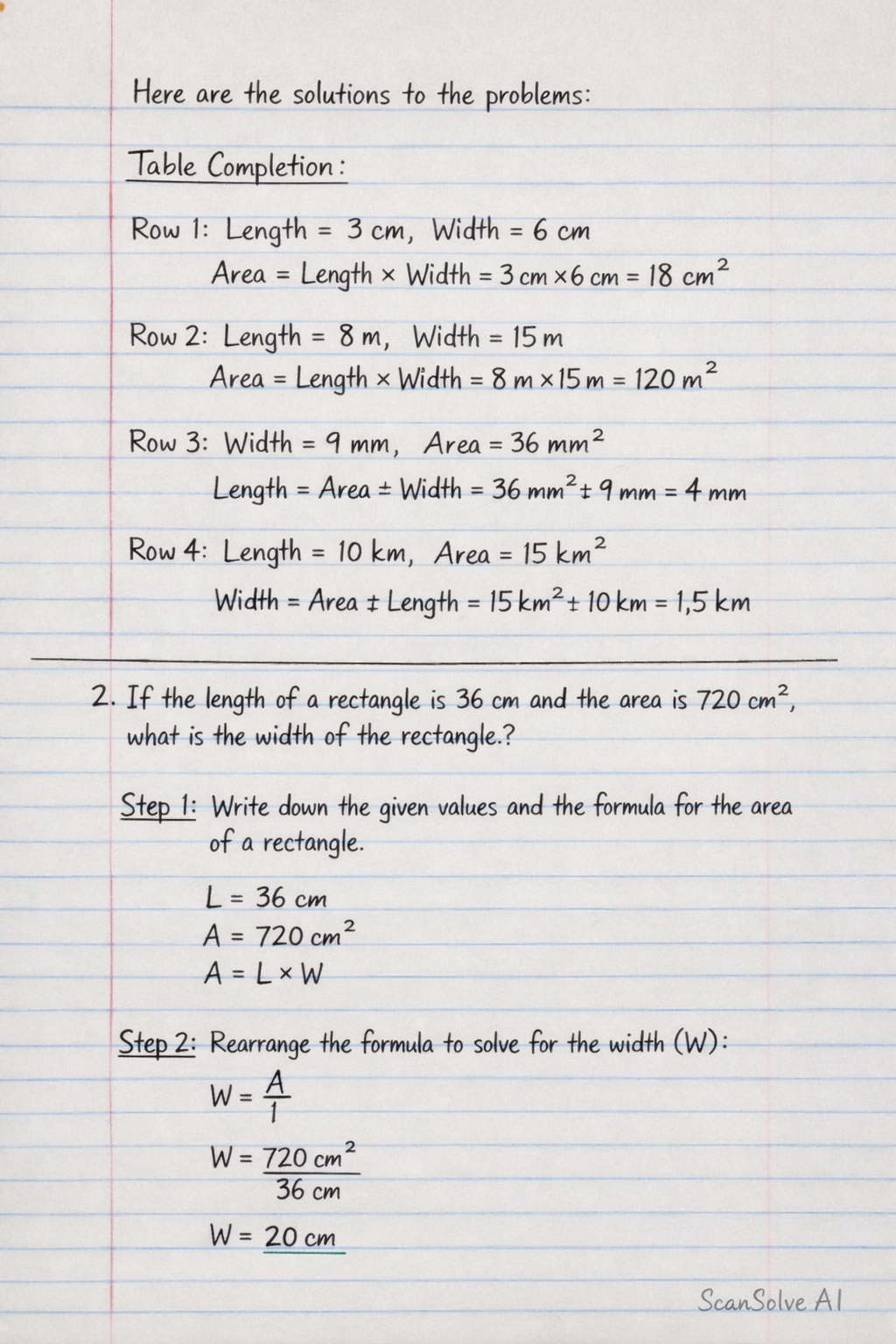
Here are the solutions to the problems:
Table Completion:
-
Row 1: Length = 3 cm, Width = 6 cm Area = Length Width =
-
Row 2: Length = 8 m, Width = 15 m Area = Length Width =
-
Row 3: Width = 9 mm, Area = 36 mm Length = Area Width =
-
Row 4: Length = 10 km, Area = 15 km Width = Area Length =
2. If the length of a rectangle is 36 cm and the area is 720 cm, what is the width of the rectangle?
Step 1: Write down the given values and the formula for the area of a rectangle.
Step 2: Rearrange the formula to solve for the width ().
Step 3: Substitute the given values into the formula and calculate.
The width of the rectangle is .
3. What is the area of a square with a perimeter of 44 m?
Step 1: Write down the given perimeter and the formula for the perimeter of a square.
where is the side length of the square.
Step 2: Solve for the side length ().
Step 3: Calculate the area of the square using the formula .
The area of the square is .
4. A square having length 6 m has the same perimeter as a rectangle. Find the area of the rectangle if its length is 4 cm longer than its width.
Assumption: The length of the rectangle is 4 meters longer than its width, to maintain consistent units with the square's dimensions.
Step 1: Calculate the perimeter of the square.
Side length of square .
Perimeter of square .
Step 2: The perimeter of the rectangle is the same as the square.
Perimeter of rectangle .
Let the length of the rectangle be and the width be .
We are given .
The formula for the perimeter of a rectangle is .
Step 3: Substitute the expressions for and into the perimeter formula and solve for .
Step 4: Calculate the length .
Step 5: Calculate the area of the rectangle.
The area of the rectangle is .
5. The length of a rectangle is twice its width. If its area is 288 cm, find the length of the rectangle.
Step 1: Write down the given information.
Let the width of the rectangle be .
The length .
Area .
Step 2: Use the area formula and substitute .
Step 3: Solve for .
Step 4: Calculate the length .
The length of the rectangle is .
6. The figure shows a hole cut in the middle of a cardboard. Calculate the shaded area.
Step 1: Identify the dimensions of the outer square and the inner square (hole).
Outer square side length = 10 cm.
Inner square side length = 4 cm.
Step 2: Calculate the area of the outer square.
Area of outer square .
Step 3: Calculate the area of the inner square (the hole).
Area of inner square .
Step 4: Calculate the shaded area by subtracting the inner area from the outer area.
Shaded Area =
Shaded Area =
Shaded Area =
The shaded area is .
7. PQRS is a square of length 12 cm. A square LMNS of area 25 cm is removed from it. What will be the length of LP?
Step 1: Determine the side length of square PQRS.
Side length of PQRS, .
So, .
Step 2: Determine the side length of square LMNS.
Area of LMNS, .
Side length of LMNS, .
From the diagram, S is a common vertex, and L is on PS. Thus, is a side of the square LMNS.
So, .
Step 3: Calculate the length of LP.
The length of LP is .
8. The area of a square is twice the area of a rectangle with dimensions 45 cm and 10 cm. Find the length of the square.
Step 1: Calculate the area of the rectangle.
Length of rectangle .
Width of rectangle .
Area of rectangle .
Step 2: Calculate the area of the square.
Area of square
.
Step 3: Find the length of the square's side ().
For a square, .
The length of the square is .
9. The width of a rectangle is 4 cm less than its length and its perimeter is 48 cm. Find its area.
Step 1: Define the length and width in terms of a single variable.
Let the length of the rectangle be .
The width .
Step 2: Use the given perimeter and the perimeter formula.
Perimeter .
.
Step 3: Substitute into the perimeter formula and solve for .
Step 4: Calculate the width .
Still stuck on this one?
Ask a follow-up, and the answer starts from this question.
More Mathematics Questions
Handwritten Step-by-Step Solution
Get this as a handwritten image on WhatsApp — like a tutor wrote it for you.
Try on WhatsApp