
We read your photo as:
The image contains problems from a test labeled "TEST 8". Each problem consists of a diagram with circles and numbers. The task is to identify the pattern and fill in the missing numbers in the circles. There are examples and numbered problems (1) through (12).
ScanSolve AI Answer
This "TEST 8" puzzle is quite challenging because the provided examples do not follow a simple, consistent arithmetic rule that would typically be found in foundational math exercises. The central number in the examples is not the sum of the outer numbers, nor is it one of the numbers provided in the list below the diagram.
Given the ambiguity, I will proceed with the most common and straightforward interpretation for this type of puzzle, which is: From the four numbers given, three numbers are placed in the outer circles, and their sum is placed in the central circle. One number from the list of four will be a distractor (unused).
If this rule does not work for a specific problem, I will state that it cannot be solved with this rule, as the examples are too inconsistent to derive a universal pattern.
Let's solve each problem based on this assumed rule:
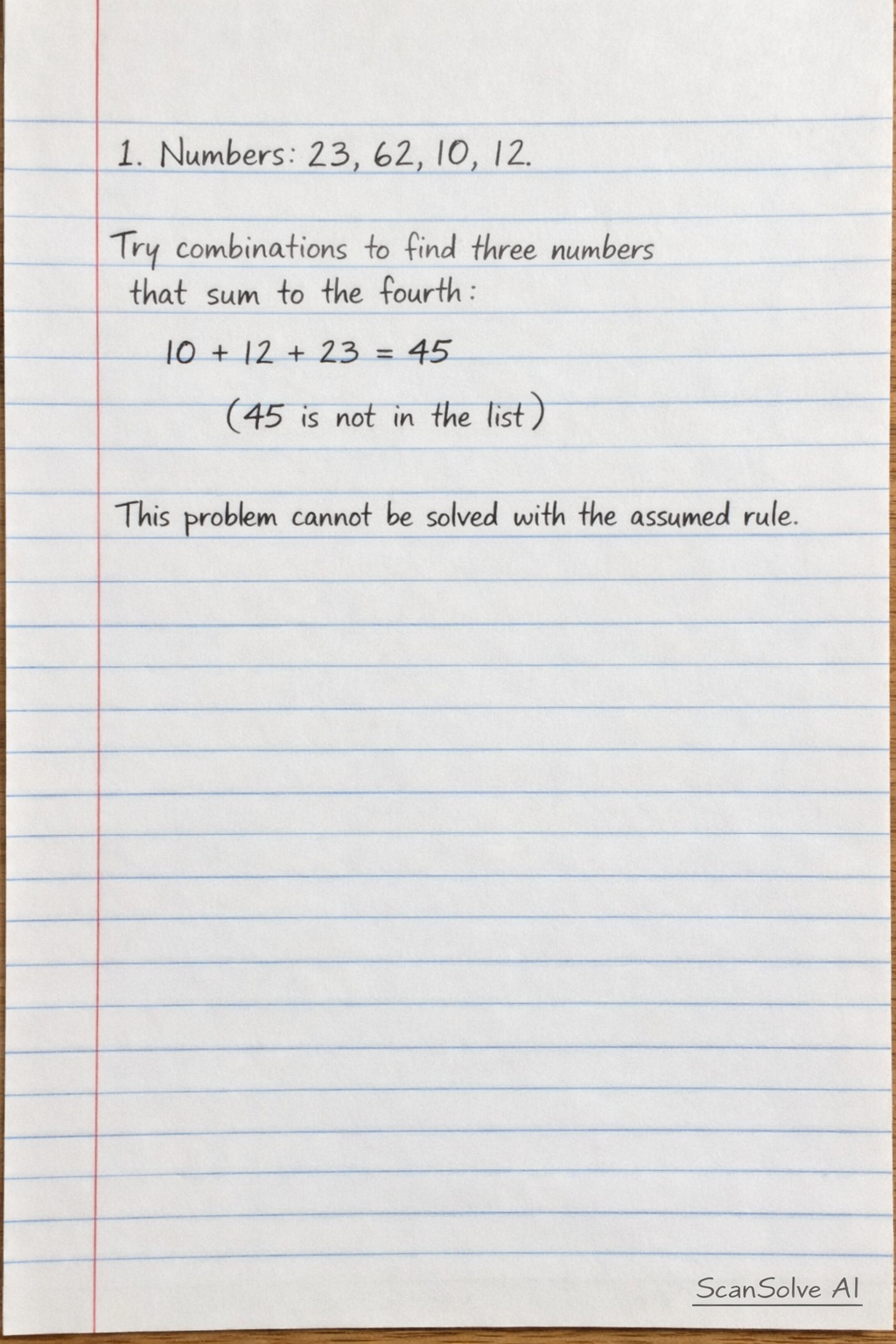
1. Numbers: 23, 62, 10, 12
- Try combinations to find three numbers that sum to the fourth:
- . (45 is not in the list)
- This problem cannot be solved with the assumed rule.
2. Numbers: 31, 22, 26, 30
- Try combinations:
- . (78 is not in the list)
- This problem cannot be solved with the assumed rule.
3. Numbers: 48, 15, 48, 60
- Try combinations:
- . (111 is not in the list)
- This problem cannot be solved with the assumed rule.
4. Numbers: 8, 11, 100, 48
- Try combinations:
- . (67 is not in the list)
- This problem cannot be solved with the assumed rule.
5. Numbers: 55, 96, 34, 62
- Try combinations:
- . (151 is not in the list)
- This problem cannot be solved with the assumed rule.
6. Numbers: 12, 67, 18, 20
- Try combinations:
- . (50 is not in the list)
- This problem cannot be solved with the assumed rule.
7. Numbers: 16, 27, 18, 20
- Try combinations:
- . (54 is not in the list)
- This problem cannot be solved with the assumed rule.
8. Numbers: 36, 41, 66, 60
- Try combinations:
- . (137 is not in the list)
- This problem cannot be solved with the assumed rule.
9. Numbers: 84, 48, 11, 25
- Try combinations:
- . (84 is in the list!)
- Therefore:
- Outer circles: 11, 25, 48
- Central circle: 84
- Unused number: None (all numbers are used)
- This solution contradicts the examples which show one number unused. However, it is the only problem that fits the "sum of three equals the fourth" rule.
10. Numbers: 26, 88, 12, 50
- Try combinations:
- . (88 is in the list!)
- Therefore:
- Outer circles: 12, 26, 50
- Central circle: 88
- Unused number: None (all numbers are used)
11. Numbers: 66, 15, 20, 31
- Try combinations:
- . (66 is in the list!)
- Therefore:
- Outer circles: 15, 20, 31
- Central circle: 66
- Unused number: None (all numbers are used)
12. Numbers: 10, 15, 20, 45
- Try combinations:
- . (45 is in the list!)
- Therefore:
- Outer circles: 10, 15, 20
- Central circle: 45
- Unused number: None (all numbers are used)
Summary of Solutions (based on the rule: sum of three numbers equals the fourth number):
- 1. Numbers: 23, 62, 10, 12
- Cannot be solved with this rule.
- 2. Numbers: 31, 22, 26, 30
- Cannot be solved with this rule.
- 3. Numbers: 48, 15, 48, 60
- Cannot be solved with this rule.
- 4. Numbers: 8, 11, 100, 48
- Cannot be solved with this rule.
- 5. Numbers: 55, 96, 34, 62
- Cannot be solved with this rule.
- 6. Numbers: 12, 67, 18, 20
- Cannot be solved with this rule.
- 7. Numbers: 16, 27, 18, 20
- Cannot be solved with this rule.
- 8. Numbers: 36, 41, 66, 60
- Cannot be solved with this rule.
- 9. Numbers: 84, 48, 11, 25
- Outer: 11, 25, 48
- Central:
- 10. Numbers: 26, 88, 12, 50
- Outer: 12, 26, 50
- Central:
- 11. Numbers: 66, 15, 20, 31
- Outer: 15, 20, 31
- Central:
- 12. Numbers: 10, 15, 20, 45
- Outer: 10, 15, 20
- Central:
The first 8 problems do not fit this common rule, which suggests the puzzle might be flawed or follows a very complex rule not evident from the examples.
Still stuck on this one?
Ask a follow-up, and the answer starts from this question.
More Mathematics Questions
Handwritten Step-by-Step Solution
Get this as a handwritten image on WhatsApp — like a tutor wrote it for you.
Try on WhatsApp