This mathematics problem involves applying core mathematical principles and formulas. Below you will find a complete step-by-step solution with detailed explanations for each step, helping you understand not just the answer but the method behind it.
ScanSolve AI Answer
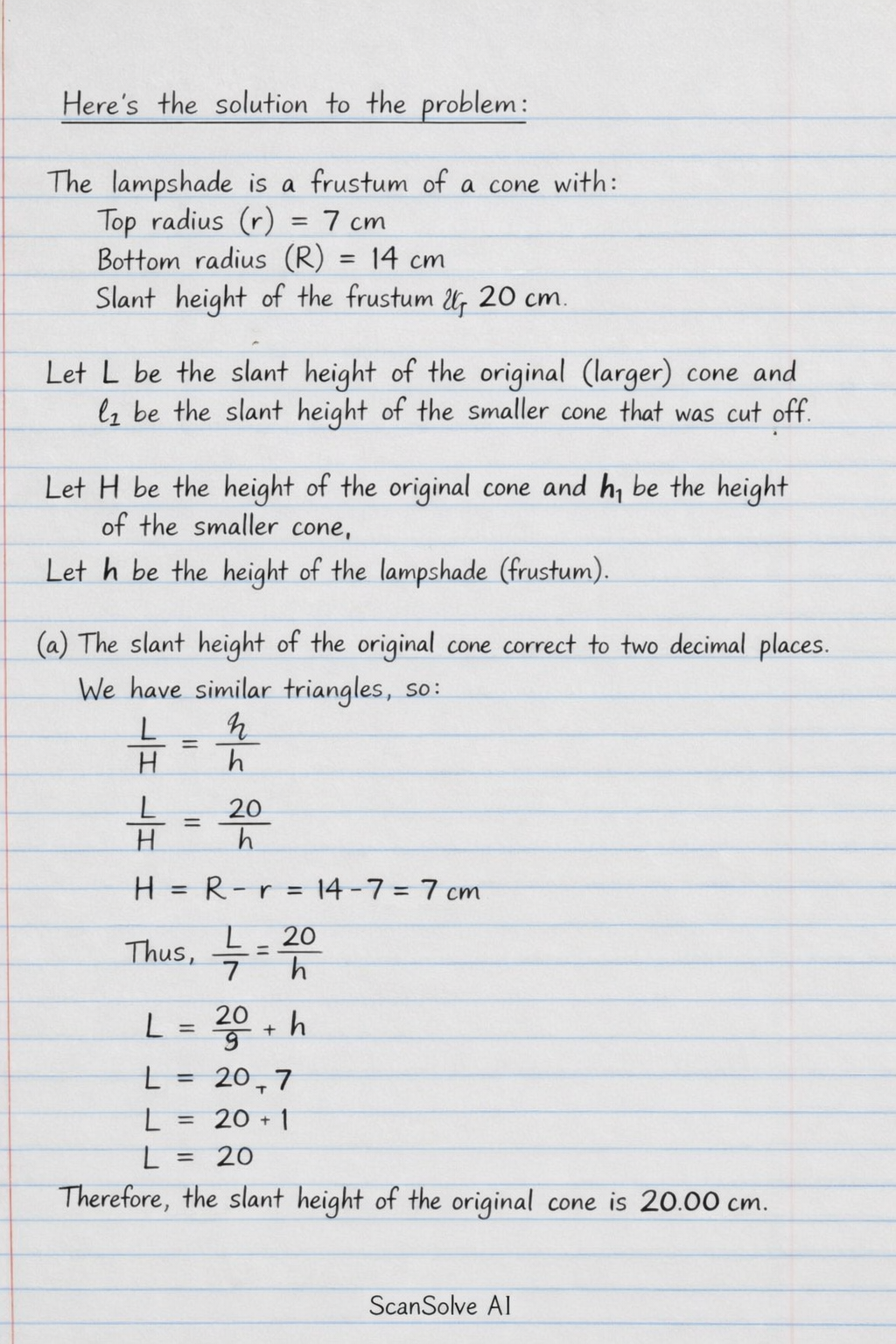
Here's the solution to the problem:
The lampshade is a frustum of a cone with:
Top radius ($r$) = 7 cm
Bottom radius ($R$) = 14 cm
Slant height of the frustum ($l_f$) = 20 cm
Let $L$ be the slant height of the original (larger) cone and $l_1$ be the slant height of the smaller cone that was cut off.
Let $H$ be the height of the original cone and $h_1$ be the height of the smaller cone.
Let $h$ be the height of the lampshade (frustum).
a) The slant height of the original cone correct to two decimal places.
Step 1: Use similar triangles formed by the radii and slant heights.
For the original cone and the smaller cone, we have:
$$ \frac{R}{r} = \frac{L}{l_1} $$
$$ \frac{14}{7} = \frac{L}{l_1} $$
$$ 2 = \frac{L}{l_1} \implies L = 2l_1 $$
Step 2: Use the given slant height of the frustum.
The slant height of the frustum is the difference between the slant height of the original cone and the smaller cone:
$$ L - l_1 = 20 \text{ cm} $$
Step 3: Substitute $L = 2l_1$ into the equation.
$$ 2l_1 - l_1 = 20 $$
$$ l_1 = 20 \text{ cm} $$
Step 4: Calculate $L$.
$$ L = 2l_1 = 2 \times 20 = 40 \text{ cm} $$
The slant height of the original cone is 40.00 cm.
b) The height h, of the lampshade.
Step 1: Consider a right-angled triangle formed by the height of the frustum ($h$), the difference in radii ($R-r$), and the slant height of the frustum ($l_f$).
The difference in radii is $14 - 7 = 7$ cm.
The slant height of the frustum is $20$ cm.
Step 2: Apply the Pythagorean theorem.
$$ h^2 + (R-r)^2 = l_f^2 $$
$$ h^2 + (14-7)^2 = 20^2 $$
$$ h^2 + 7^2 = 20^2 $$
$$ h^2 + 49 = 400 $$
$$ h^2 = 400 - 49 $$
$$ h^2 = 351 $$
$$ h = \sqrt{351} $$
Step 3: Calculate the numerical value.
$$ h \approx 18.73499 \text{ cm} $$
Rounding to two decimal places:
The height of the lampshade is $\boxed{18.73 \text{ cm}}$.
c) The curved surface area of the lampshade.
Step 1: Use the formula for the curved surface area (CSA) of a frustum.
$$ \text{CSA} = \pi (R + r) l_f $$
Where $R = 14$ cm, $r = 7$ cm, and $l_f = 20$ cm.
Step 2: Substitute the values.
$$ \text{CSA} = \pi (14 + 7) (20) $$
$$ \text{CSA} = \pi (21) (20) $$
$$ \text{CSA} = 420\pi \text{ cm}^2 $$
Step 3: Calculate the numerical value.
$$ \text{CSA} \approx 420 \times 3.14159265 $$
$$ \text{CSA} \approx 1319.4689 \text{ cm}^2 $$
Rounding to two decimal places:
The curved surface area of the lampshade is $\boxed{1319.47 \text{ cm}^2}$.
d) The volume of the lampshade correct to 4 significant figures.
Step 1: Calculate the height of the original cone ($H$) and the smaller cone ($h_1$).
From part (a), $L = 40$ cm and $l_1 = 20$ cm.
For the original cone:
$$ H = \sqrt{L^2 - R^2} = \sqrt{40^2 - 14^2} = \sqrt{1600 - 196} = \sqrt{1404} \text{ cm} $$
For the smaller cone:
$$ h_1 = \sqrt{l_1^2 - r^2} = \sqrt{20^2 - 7^2} = \sqrt{400 - 49} = \sqrt{351} \text{ cm} $$
Note that $H = \sqrt{4 \times 351} = 2\sqrt{351}$.
Step 2: Use the formula for the volume of a frustum, which is the volume of the original cone minus the volume of the smaller cone.
$$ V = \frac{1}{3}\pi R^2 H - \frac{1}{3}\pi r^2 h_1 $$
Step 3: Substitute the values.
$$ V = \frac{1}{3}\pi (14^2) \sqrt{1404} - \frac{1}{3}\pi (7^2) \sqrt{351} $$
$$ V = \frac{1}{3}\pi (196) (2\sqrt{351}) - \frac{1}{3}\pi (49) \sqrt{351} $$
$$ V = \frac{1}{3}\pi \sqrt{351} (196 \times 2 - 49) $$
$$ V = \frac{1}{3}\pi \sqrt{351} (392 - 49) $$
$$ V = \frac{1}{3}\pi \sqrt{351} (343) $$
$$ V = \frac{343\pi \sqrt{351}}{3} \text{ cm}^3 $$
Step 4: Calculate the numerical value.
$$ \sqrt{351} \approx 18.7349916 $$
$$ V \approx \frac{343 \times 3.14159265 \times 18.7349916}{3} $$
$$ V \approx \frac{20188.760}{3} $$
$$ V \approx 6729.5866 \text{ cm}^3 $$
Step 5: Round to 4 significant figures.
The first four significant figures are 6, 7, 2, 9. The fifth digit is 5, so we round up the fourth digit.
The volume of the lampshade is $\boxed{6730 \text{ cm}^3}$.
The lampshade is a frustum of a cone with:
|Mathematics
The lampshade is a frustum of a cone with:
ScanSolve AI Answer
Here's the solution to the problem:
The lampshade is a frustum of a cone with:
Top radius (r) = 7 cm
Bottom radius (R) = 14 cm
Slant height of the frustum (lf) = 20 cm
Let L be the slant height of the original (larger) cone and l1 be the slant height of the smaller cone that was cut off.
Let H be the height of the original cone and h1 be the height of the smaller cone.
Let h be the height of the lampshade (frustum).
a) The slant height of the original cone correct to two decimal places.
Step 1: Use similar triangles formed by the radii and slant heights.
For the original cone and the smaller cone, we have:
rR=l1L714=l1L2=l1L⟹L=2l1
Step 2: Use the given slant height of the frustum.
The slant height of the frustum is the difference between the slant height of the original cone and the smaller cone:
L−l1=20cm
Step 3: Substitute L=2l1 into the equation.
2l1−l1=20l1=20cm
Step 4: Calculate L.
L=2l1=2×20=40cm
The slant height of the original cone is 40.00 cm.
b) The height h, of the lampshade.
Step 1: Consider a right-angled triangle formed by the height of the frustum (h), the difference in radii (R−r), and the slant height of the frustum (lf).
The difference in radii is 14−7=7 cm.
The slant height of the frustum is 20 cm.
Step 2: Apply the Pythagorean theorem.
h2+(R−r)2=lf2h2+(14−7)2=202h2+72=202h2+49=400h2=400−49h2=351h=351
Step 3: Calculate the numerical value.
h≈18.73499cm
Rounding to two decimal places:
The height of the lampshade is 18.73cm.
c) The curved surface area of the lampshade.
Step 1: Use the formula for the curved surface area (CSA) of a frustum.
CSA=π(R+r)lf
Where R=14 cm, r=7 cm, and lf=20 cm.
Step 2: Substitute the values.
CSA=π(14+7)(20)CSA=π(21)(20)CSA=420πcm2
Step 3: Calculate the numerical value.
CSA≈420×3.14159265CSA≈1319.4689cm2
Rounding to two decimal places:
The curved surface area of the lampshade is 1319.47cm2.
d) The volume of the lampshade correct to 4 significant figures.
Step 1: Calculate the height of the original cone (H) and the smaller cone (h1).
From part (a), L=40 cm and l1=20 cm.
For the original cone:
H=L2−R2=402−142=1600−196=1404cm
For the smaller cone:
h1=l12−r2=202−72=400−49=351cm
Note that H=4×351=2351.
Step 2: Use the formula for the volume of a frustum, which is the volume of the original cone minus the volume of the smaller cone.
V=31πR2H−31πr2h1
Step 3: Substitute the values.
V=31π(142)1404−31π(72)351V=31π(196)(2351)−31π(49)351V=31π351(196×2−49)V=31π351(392−49)V=31π351(343)V=3343π351cm3
Step 4: Calculate the numerical value.
351≈18.7349916V≈3343×3.14159265×18.7349916V≈320188.760V≈6729.5866cm3
Step 5: Round to 4 significant figures.
The first four significant figures are 6, 7, 2, 9. The fifth digit is 5, so we round up the fourth digit.
The volume of the lampshade is 6730cm3.
Need help with your own homework?
Get instant step-by-step solutions to any question. Free to start.