

This mathematics problem involves applying core mathematical principles and formulas. Below you will find a complete step-by-step solution with detailed explanations for each step, helping you understand not just the answer but the method behind it.
ScanSolve AI Answer
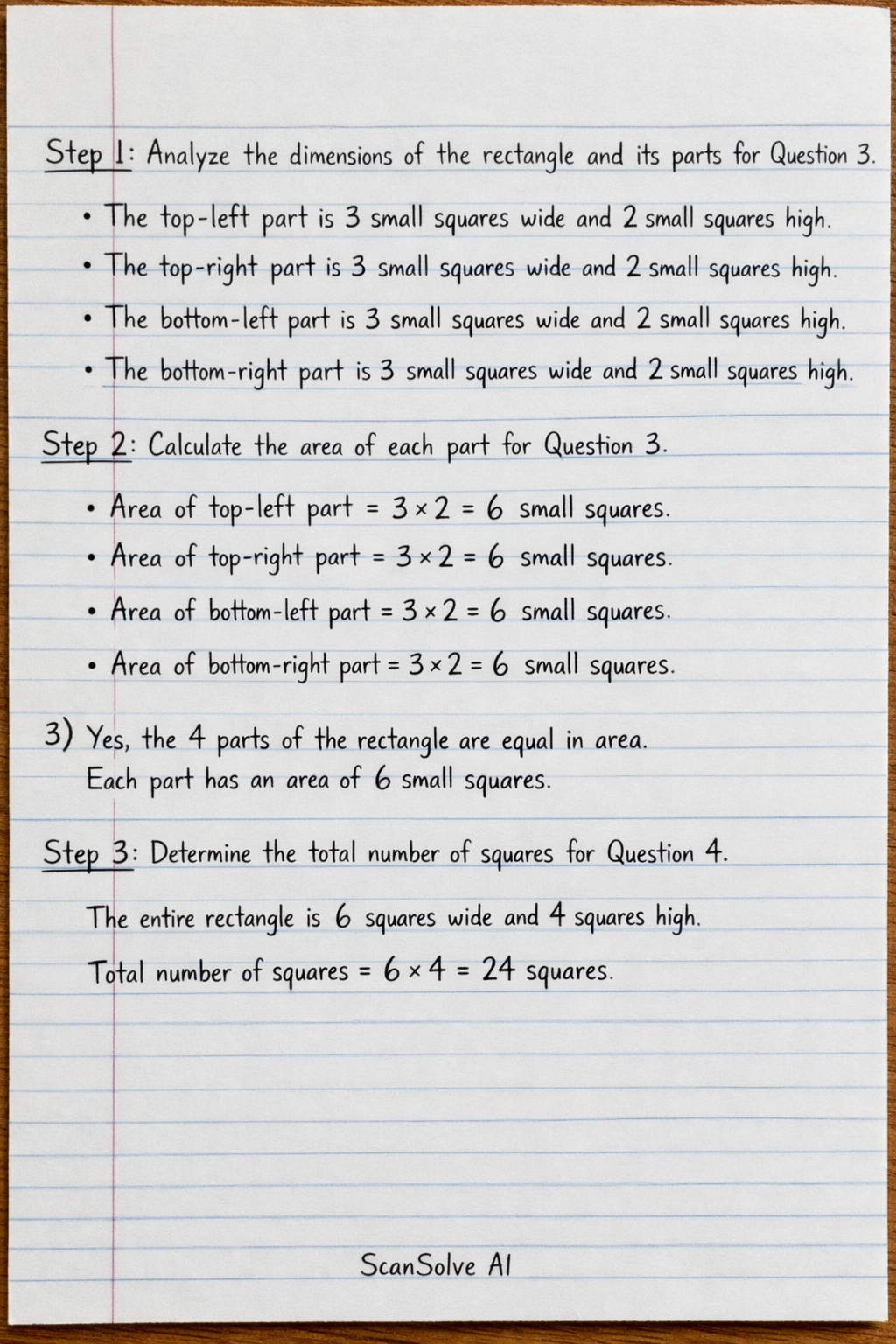
Step 1: Analyze the dimensions of the rectangle and its parts for Question 3. The large rectangle is divided into 4 smaller rectangles by thick lines. • The top-left part is 3 small squares wide and 2 small squares high. • The top-right part is 3 small squares wide and 2 small squares high. • The bottom-left part is 3 small squares wide and 2 small squares high. • The bottom-right part is 3 small squares wide and 2 small squares high. Step 2: Calculate the area of each part for Question 3. The area of each part is the product of its width and height in small squares. • Area of top-left part = 3 × 2 = 6 small squares. • Area of top-right part = 3 × 2 = 6 small squares. • Area of bottom-left part = 3 × 2 = 6 small squares. • Area of bottom-right part = 3 × 2 = 6 small squares. 3) Yes, the 4 parts of the rectangle are equal in area. Each part has an area of 6 small squares. Step 3: Determine the total number of squares for Question 4. The entire rectangle is 6 squares wide and 4 squares high. Total number of squares = 6 × 4 = 24 squares. Step 4: Count the number of shaded squares for Question 4. Count the gray shaded squares in the rectangle. There are 4 shaded squares. Step 5: Calculate the fraction of the rectangle that is shaded gray for Question 4. Fraction shaded = Number of shaded squaresTotal number of squares (4)/(24) Simplify the fraction by dividing both the numerator and the denominator by their greatest common divisor, which is 4. (4 ÷ 4)/(24 ÷ 4) = (1)/(6) 4) The fraction of the rectangle that is shaded gray is (1)/(6).